
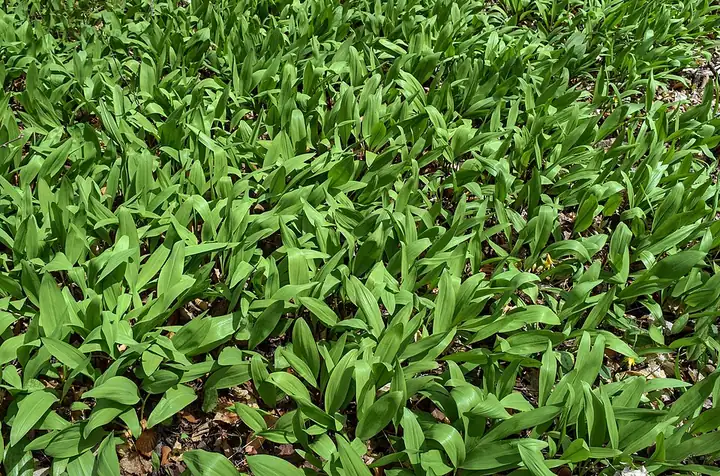
Ramps (wild leeks)
Allium tricoccum · Amaryllis family (Amaryllidaceae)
| Hardiness zones | 3 to 8 |
|---|---|
| Sun | part shade |
| Water | high |
| Life cycle | perennial |
| Frost | Hardy: takes frost |
| Soil pH | 4.7–6.7 |
| Spacing | 4 to 6 inches |
About Ramps (wild leeks)
Ramps are a native woodland onion of eastern North America, prized in early spring for broad leaves and small bulbs that taste of sweet onion and strong garlic; they are a different plant from the garden leek. Wild stands have been badly over-harvested: Great Smoky Mountains National Park bans collecting them, the New River Gorge parks stopped all ramp harvest in 2022, and Quebec has banned commercial harvest since 1995. Grow them from nursery-propagated bulbs or from seed, and never dig wild plants.
Hardy in zones 3-8 (UW-Madison). It needs a cool, shaded woodland spot under deciduous trees, with soil that stays moist all year, not just in spring.
When to plant
Timing is counted from your average last spring frost (and first fall frost). Sow & Tell works out the actual dates for your ZIP code.
Plant large bulbs (over 1/2 inch across) about 3 inches deep and 4 to 6 inches apart in early spring, or in fall if the soil stays moist until it freezes, and mulch with 2 to 3 inches of hardwood leaves. Bulbs give harvest-size plants in 2 to 3 years; seed sown in late summer or early fall takes 6 to 18 months to sprout, about 4 years to the first leaf harvest and 5 to 7 years to bulbs.
Soil
Well-drained soil rich in decomposed leaf litter that stays moist year-round; bulbs rot in waterlogged soil.
Work composted hardwood leaves into the bed if the soil is low in organic matter; don't add lime if the pH is above 4.9. NC State notes gypsum (about 100 lb per 1,000 sq ft) may help, though the calcium question is still debated.
Feeding
- each fall, if the leaf layer is thin: hardwood leaves or composted leaves. Rake a fresh layer of hardwood leaves over the bed; as they rot they feed the plants, hold moisture and protect bulbs from deep cold.
Don't use pine bark or commercial mulches (they gave poor results), don't let the soil dry out in any season, and skip garden chemicals since the plants are eaten.
Harvest
Pick in early spring just before the leaves start to yellow, and skip plants sending up a flower stalk. In your own patch, cut one leaf and leave at least one on each plant, and dig bulbs only after the bed has filled in, thinning no more than about 10 to 15 percent of the plants in a year.
Leaves are picked once each spring, before they yellow. Cutting one leaf and leaving the bulb lets the plant come back next year; digging whole plants ends them, so in a home bed dig only a small share each year (growers rotate so each part of the bed is dug once every 5 to 7 years).
Varieties (2)
There are no named ramp cultivars; extension sources describe two wild types.
| Variety | Type | Days | Notes |
|---|---|---|---|
| Narrow-leaf ramp | Allium burdickii (var. burdickii) | Smaller plant with narrower leaves and no red stem; grows in small, scattered patches, mostly in the Midwest. | |
| Wide-leaf ramp | Allium tricoccum (var. tricoccum) | The common, widespread ramp: larger, broader leaves and often a red-purple stem; forms big patches. |
Good neighbors
UW-Madison suggests pairing ramps with native plants that leaf out later, such as wild ginger and black cohosh, to cover the ground after ramps die back; this is about filling space, not pest control.
Pests to watch for
Allium leafminer
Diseases and problems
Septoria leaf spot, Bulb rot (in wet soil)
In the kitchen
Leaves, stems and bulbs are all eaten, raw in salads or cooked like onions or garlic: in potato soup, fried potatoes, eggs, cornbread or as cooked greens. They are very strong, so use them sparingly.
Keeping it: Keep ramps cool and a little moist: rinse and dry the leaves, wash the bulbs and trim the roots, and store them in the refrigerator in a container that isn't airtight.
Safety: Two deadly plants grow in the same woods and look like ramps: lily of the valley and false hellebore (Veratrum viride). Ramps have flat leaves that come straight from the ground and always smell strongly of onion and garlic when crushed; false hellebore has pleated leaves along an upright stalk in wet places, and neither look-alike smells of onion. If it doesn't smell like onion, don't eat it, and call Poison Control (1-800-222-1222) if someone may have eaten a look-alike.
Pets: Toxic to dogs, cats and horses: the ASPCA lists onion, garlic, leek and chives (Allium) as toxic. Ramps aren't listed by name, but they are an Allium too, so keep pets away from them.
Sources
- plants.ces.ncsu.edu
- content.ces.ncsu.edu
- fs.usda.gov
- hort.extension.wisc.edu
- extension.psu.edu
- lincolnu.edu
- nps.gov
- nps.gov
- forestencyclopedia.net
- newswire.ca
- healthvermont.gov
- healthvermont.gov
- aspca.org
- aspca.org
Photo: Photo: The Cosmonaut, CC BY-SA 2.5 ca, via Wikimedia Commons (CC BY-SA 2.5 ca). Photo resized for the web.

Planting dates and advice are general guidance; check with your local Cooperative Extension office for your area.