
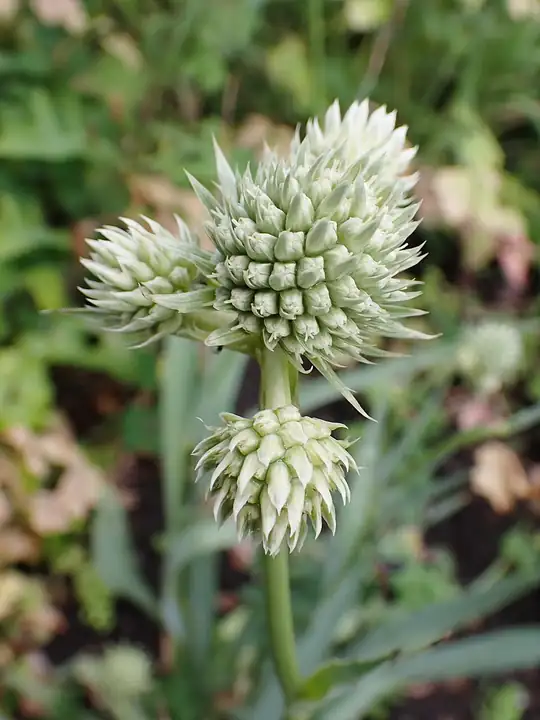
Rattlesnake master
Eryngium yuccifolium (var. yuccifolium; var. synchaetum on the Southeast coastal plain) · Carrot family (Apiaceae)
| Hardiness zones | 3 to 8 |
|---|---|
| Sun | full sun |
| Water | low |
| Life cycle | perennial |
| Frost | Hardy: takes frost |
| Soil pH | 5.0–7.5 |
| Spacing | 36 to 72 inches |
About Rattlesnake master
Rattlesnake master is a striking prairie plant with yucca-like, spine-edged blue-green leaves and stiff stems topped by round, 1-inch, white-green 'buttons' that smell faintly of honey and buzz with bees, wasps and butterflies in summer (Wisconsin Extension, NC State). It's native from east Texas north to Nebraska and Minnesota, east to New Jersey and south to Florida (USDA NRCS), and is a cousin of culantro and the sea hollies in the same genus, Eryngium. The name comes from a mistaken belief that its root cured snakebite. It's rare enough to be listed as endangered in Maryland and threatened in Michigan and Ohio (USDA NRCS), so buy nursery-grown plants or seed.
Hardy in zones 3-8 (NC State, Wisconsin Extension, USDA NRCS). Not listed as invasive, but it self-sows readily and USDA NRCS notes it can get weedy in some regions if left unmanaged.
When to plant
Timing is counted from your average last spring frost (and first fall frost). Sow & Tell works out the actual dates for your ZIP code.
Easy from seed: sow outdoors in fall to sprout in spring, or give seed about 60 days of cold, moist treatment (33-38 F) and sow 1/4 inch deep in spring (USDA NRCS, Wisconsin Extension). A deep taproot means it moves poorly, so plant small and leave it be; division is possible in late spring or early fall but often fails (NC State, Wisconsin Extension). Don't fertilize the first year (USDA NRCS). No sourced day count to first bloom.
Soil
Lean, well-drained soil: sandy is ideal, but clay, gravel and rocky ground are fine, at about pH 5-7.5; rich soil or shade makes it flop, and it won't stand in water (Wisconsin Extension, USDA NRCS).
Plant in lean, well-drained soil; no compost or fertilizer is needed, since it does best in dry, poor soil and gets floppy in fertile ground (Wisconsin Extension).
Feeding
Rich soil, extra fertilizer and shade all make the flower stems lean and fall over; USDA NRCS advises only moderate fertility to prevent lodging. Don't plant it beside paths: the leaf edges are spiny.
Harvest
Blooms from June to August (NC State); the buttons age from green-white to brown. Cut heads fresh or let them dry for arrangements (NC State, Wisconsin Extension). Leave some stems standing for winter interest, or snip seed heads before they shed if seedlings pop up where you don't want them (Wildflower Center).
Varieties (1)
No named garden cultivars are documented by the extension, USDA or Wildflower Center sources we checked (USDA NRCS names none); only the southern botanical variety is listed.
| Variety | Type | Days | Notes |
|---|---|---|---|
| var. synchaetum | Rattlesnake master (E. yuccifolium), botanical variety | A southern form of wet pine savannas on the coastal plain from southeast North Carolina to Florida, with narrower leaves; it prefers moister soil. |
Good neighbors
Blazing star (liatris), Little bluestem
Wisconsin Extension pairs it with blazing star (Liatris) and little bluestem in prairie-style plantings; this is a design pairing, not a pest-control claim.
Pests to watch for
Voles
In the kitchen
Safety: None of the extension, Wildflower Center or USDA sources we checked lists it as poisonous, but there's no research-based guidance on eating it; treat it as an ornamental. The stiff leaf spines can scratch, so wear gloves and keep it away from paths (NC State).
Pets: Not listed by the ASPCA (no rattlesnake master, button snakeroot or Eryngium entry on its dog, cat or horse lists).
Sources
- plants.ces.ncsu.edu
- hort.extension.wisc.edu
- wildflower.org
- plants.sc.egov.usda.gov
- nrcs.usda.gov
- aspca.org
- aspca.org
- aspca.org
- aspca.org
- aspca.org
Photo: Photo: Krzysztof Ziarnek, Kenraiz / Wikimedia Commons, CC BY-SA 4.0 (CC BY-SA 4.0). Photo resized for the web.

Planting dates and advice are general guidance; check with your local Cooperative Extension office for your area.