
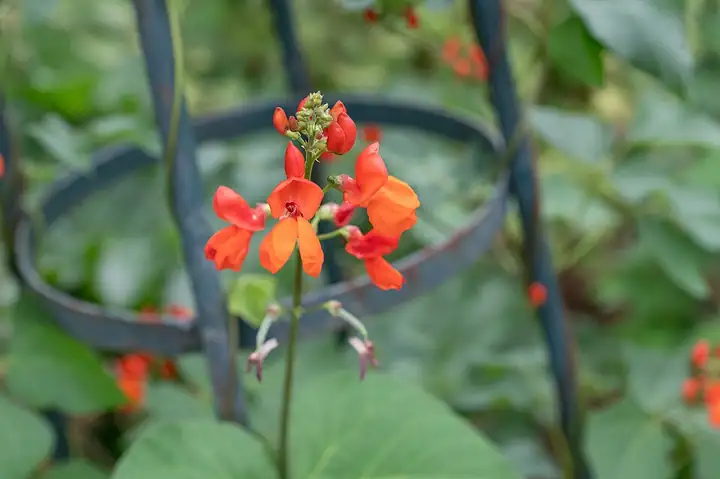
Scarlet runner bean
Phaseolus coccineus · Pea family (Fabaceae)
| Hardiness zones | 3 to 11 |
|---|---|
| Sun | full sun |
| Water | moderate |
| Life cycle | tender perennial (grown as an annual) |
| Frost | Tender: killed by frost |
| Soil pH | 6.0–8.0 |
| Spacing | 4 to 8 inches |
| Days to harvest | 65 to 85 days |
| Soil temperature to plant | at least 50°F |
About Scarlet runner bean
Scarlet runner bean is a fast, twining vine from the mountains of Mexico and Central America, grown both for its sprays of scarlet flowers, which hummingbirds and bees love, and for its pods and big speckled beans. Vines usually reach 6 to 8 feet in Midwest gardens and can top 15 feet. It sets the most pods in cool summers and fall; hot weather cuts pod set.
Grown as a warm-season annual in every zone; frost kills the leaves. In zones 7 to 11 it can live a few years from its fleshy roots, and northern gardeners can dig the roots and store them in damp sand for winter.
When to plant
Timing is counted from your average last spring frost (and first fall frost). Sow & Tell works out the actual dates for your ZIP code.
Days count from seeding to first pods for named varieties (about 65 to 85 days); flowers start about two months after sowing. Sow 2 to 3 inches deep once soil is at least 50F, or start seeds indoors a few weeks before the last frost and set out after it; put the trellis in at planting.
Soil
Well-drained soil rich in organic matter, kept evenly moist, especially while it flowers and sets pods.
Choose a sunny spot with soil rich in organic matter and set up a sturdy trellis, poles or netting before sowing.
Feeding
Heavy fertilizing gives lots of leaves but fewer flowers and beans; water well during flowering and pod set and mulch to hold moisture.
Harvest
Pick pods young, about 4 to 6 inches long, and use them like snap beans; keep picking so the vine keeps flowering. Older pods can be shelled while the beans are still pale pink, or left on the vine until dry and rattling for dry beans.
Flowers and pods keep coming until frost if you keep picking young pods; the heaviest crops come in cool summers and in fall, since hot weather cuts pod set.
Varieties (15)
| Variety | Type | Days | Notes |
|---|---|---|---|
| Hammond's Dwarf | Bush | Bush type 1.5-2 ft tall with small 4-5 in pods. | |
| Hestia | Dwarf bush | Bushy, about 18 in; red-and-white flowers; narrow, stringless pods. | |
| Black Coat | Pole | 70 days | Tangerine to crimson flowers and jet-black seeds; vines 6-7 ft with short pods. |
| Enorma Exhibition Variety | Pole | Excellent flavor. Very large pods, up to 20 in; productive. | |
| Golden Sunshine | Pole | 80 to 85 days | Chartreuse leaves with scarlet flowers; vines 5-8 ft; tender pods. |
| Lady Di | Pole | Scarlet flowers; long, narrow, stringless dark green pods that are slow to form seeds, which stretches the harvest; about 6 ft. | |
| Moonlight | Pole | White flowers; large stringless pods; very productive. | |
| Painted Lady | Pole | 80 days | Dry beans are sweet-tasting. Red-and-white (or pink) bicolor flowers; vines 8-10 ft; cream seeds streaked with brown. |
| Polestar | Pole | Red flowers; stringless pods over a long season, best picked at 6-8 in. | |
| Purple Aztec | Pole | Bright flowers on vigorous climbing vines; purple-speckled seeds. | |
| Scarlet Emperor | Pole | Long pods over a long season; black-and-purple mottled seeds; about 9 ft. | |
| Sunset | Pole | 65 to 70 days | Salmon-pink to peach flowers; about 6-8 ft. |
| White Emergo | Pole | White flowers and large white seeds. | |
| Albus | White flowers. | ||
| The Czar | White flowers. |
Good neighbors
Sweet corn, Winter squash and pumpkin
Arkansas Extension notes it was grown in the Indigenous Three Sisters planting with corn and squash, the corn holding up the vines; that is traditional practice, not a tested pest benefit.
Pests to watch for
Mexican bean beetle, Japanese beetle, Slugs, Rabbits
Diseases and problems
Mosaic viruses, Bacterial blights of beans, Anthracnose, Powdery mildew, White mold
In the kitchen
Slice young pods and boil, steam or saute them; shell half-grown beans and cook like limas; dry beans need a long soak and long cooking. The flowers are edible in salads.
Safety: Raw or undercooked beans contain a lectin (phytohaemagglutinin) that can cause severe nausea, vomiting and diarrhea, so cook dried beans thoroughly and eat raw pods only sparingly (NC State, Wisconsin Extension).
Pets: Not listed by the ASPCA
Sources
- hort.extension.wisc.edu
- plants.ces.ncsu.edu
- extension.illinois.edu
- uaex.uada.edu
- extension.umn.edu
- aspca.org
- aspca.org
- aspca.org
Photo: Photo: Mickaël Schauli / Wikimedia Commons, CC BY-SA 4.0 (CC BY-SA 4.0). Photo resized for the web.

Planting dates and advice are general guidance; check with your local Cooperative Extension office for your area.