
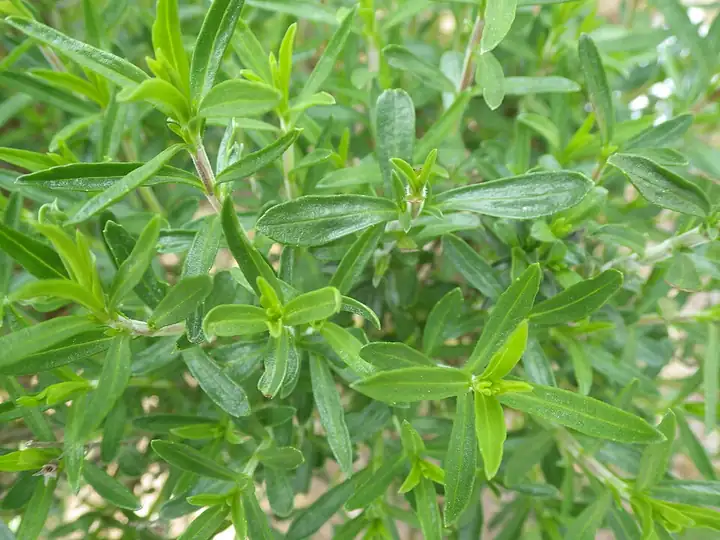
Savory (summer and winter)
Satureja hortensis and S. montana · Mint family (Lamiaceae)
| Hardiness zones | 2 to 11 |
|---|---|
| Sun | full sun |
| Water | moderate |
| Life cycle | annual |
| Frost | Half-hardy: takes a light frost |
| Spacing | 6 to 10 inches |
| Days to harvest | 60 days |
About Savory (summer and winter)
Savory is a small, peppery herb that has long been the classic seasoning for beans. Summer savory is a quick, bushy annual about 1 to 1.5 feet tall with a milder, sweeter flavor; winter savory is a low, woody perennial with stiff, glossy leaves and a stronger, slightly bitter taste (NC State, Illinois). Both are easy, need little care, and their small flowers are very attractive to bees.
Summer savory is an annual you can grow in any zone (NC State lists 2-11); winter savory is a perennial hardy in zones 5-10 that may look dead in winter but usually regrows in spring (NC State).
When to plant
Timing is counted from your average last spring frost (and first fall frost). Sow & Tell works out the actual dates for your ZIP code.
- Start seeds indoors: 4 to 6 weeks before the last frost
Sow summer savory directly after frost danger has passed, or start transplants indoors about 4-6 weeks ahead; sow on the surface or barely cover, since light helps it sprout (Illinois). It can be cut within about 2 months of sowing (NC State), and sowing again every 3-4 weeks keeps fresh leaves coming. Winter savory is easiest from cuttings or divisions (UGA).
Soil
Light, well-drained soil; summer savory likes richer soil that stays evenly moist, while winter savory does fine in sandy, lean, dry soil, and both do poorly in damp soil or shade (NC State, UGA, Illinois).
Work compost into well-drained soil and follow a soil test for lime and fertilizer; summer savory wants somewhat richer soil than winter savory, but rich soil in general gives leafy herbs with weaker flavor.
Feeding
- Early spring, as winter savory starts new growth: compost and a light amount of balanced fertilizer such as 10-10-10. Work a little compost and balanced fertilizer into the soil around the plants; most herbs need only moderate feeding, so follow a soil test.
Don't overfeed or keep the soil soggy; savory does poorly in damp soil and shade, and lush growth has less flavor.
Harvest
Cut leafy tops when flower buds first show, when the flavor is strongest; cutting back at that point brings a fresh flush of leaves (Illinois, NC State). Winter savory can be picked any time; trim out dead wood in early spring (Missouri, NC State).
Cut the leafy tops when flower buds appear and the plant sends out a fresh flush of leaves. Sow summer savory again every 3-4 weeks for a steady supply; winter savory can be picked any time for years.
Varieties (1)
Extension sources we checked name only one savory variety ('Midget' summer savory); NC State lists none for either species. Winter savory is sold simply as winter savory.
| Variety | Type | Days | Notes |
|---|---|---|---|
| Midget | Summer savory | Bushy, uniform little plant with more leaves than other summer savories. |
Good neighbors
Onion, Green beans (snap beans)
NC State says savory is grown with onions and beans and is said to help repel insect pests; that is traditional garden lore, and no named pest or trial is given.
In the kitchen
Leaves season beans above all, plus soups, stews, eggs, cabbage and other vegetables, meats, sausage, herb butters and vinegars; the small flowers are edible too (NC State, NMSU, Illinois).
Keeping it: Use fresh leaves soon after picking. Dried savory keeps best in airtight containers in a cool, dark place; dried herbs lose quality after 2 to 3 years.
Safety: Savory is an everyday kitchen herb, and the Extension sources we checked give no warnings for food amounts. If you eat the flowers, pick ones grown without pesticides and try a little first if you have plant allergies (UF/IFAS).
Pets: Non-toxic to dogs, cats and horses (ASPCA lists both summer and winter savory).
Sources
- plants.ces.ncsu.edu
- plants.ces.ncsu.edu
- extension.illinois.edu
- extension.missouri.edu
- pubs.nmsu.edu
- fieldreport.caes.uga.edu
- gardeningsolutions.ifas.ufl.edu
- aspca.org
- aspca.org
Photo: Photo: Josef Schlaghecken, CC BY-SA 4.0, via Wikimedia Commons (CC BY-SA 4.0). Photo resized for the web.

Planting dates and advice are general guidance; check with your local Cooperative Extension office for your area.