
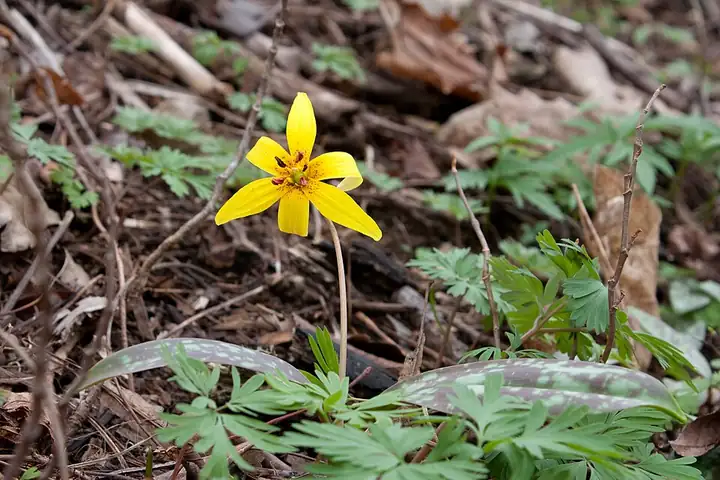
Trout lily
Erythronium americanum (yellow trout lily) · Lily family (Liliaceae)
| Hardiness zones | 3 to 8 |
|---|---|
| Sun | part shade |
| Water | high |
| Life cycle | perennial |
| Frost | Hardy: takes frost |
About Trout lily
Trout lily is a small spring wildflower named for its leaves, which are mottled maroon and green like a brook trout. A single nodding yellow flower with swept-back petals rises over a pair of leaves before the trees leaf out (NC State, wildflower.org). It is native to moist woods of the eastern U.S. from Maine and Minnesota south to Georgia and northeastern Oklahoma. It slowly forms big colonies, many of them one-leaf plants that don't flower, and goes fully dormant soon after blooming. Buy nursery-grown bulbs or plants rather than digging them from the wild (Missouri Extension).
Hardy in zones 3-8 (NC State). Native and not invasive; it spreads slowly into colonies.
When to plant
Timing is counted from your average last spring frost (and first fall frost). Sow & Tell works out the actual dates for your ZIP code.
Plant purchased bulbs (corms) or offsets; they do better than seed (NC State). Wildflower.org says to mark plants in spring, dig offsets in late summer, and set the small bulbs at least 3 inches deep with a good mulch. Established plants transplant poorly. Seed must be sown fresh and takes 4-7 years to bloom (Missouri Extension, NC State), so we give no day count to first flowers.
Soil
Moist, humus-rich, acidic soil (below about pH 6.0) that drains well; it tolerates occasional wet spots but not drought (NC State, wildflower.org).
Add plenty of leaf compost for moist, humus-rich, acidic soil (Missouri Extension, NC State).
Feeding
- Fall into winter, while dormant: a mulch of fallen leaves. Leave the leafy winter cover in place until spring (wildflower.org); no fertilizer schedule is given.
Don't move established plants, which transplant poorly, and don't let the soil dry out (NC State).
Harvest
Blooms in early spring (about March-May) for about 2 weeks, before the trees leaf out (NC State, wildflower.org). No deadheading is needed. Leave the leaves to fade on their own; the plant is dormant by early summer. If a clump has many leaves and few flowers, divide it.
Varieties (1)
NC State lists no cultivars of yellow trout lily. Wisconsin Extension describes 'Pagoda', a popular garden trout lily bred from western species, and the native white trout lily (E. albidum); we list 'Pagoda' since it's what most gardeners find for sale.
| Variety | Type | Days | Notes |
|---|---|---|---|
| Pagoda | Hybrid trout lily (E. tuolumnense x E. californicum 'White Beauty'), not E. americanum | 3-5 pale lemon-yellow flowers per 6-12 in stem over glossy, bronze-mottled leaves; vigorous and clump-forming. |
Good neighbors
Trillium, Jack-in-the-pulpit, Bleeding heart, Columbine, Hosta (plantain lily), Garden ferns (ostrich, Christmas, lady, Japanese painted)
These are design pairings, not pest-control companions: Wisconsin Extension suggests trilliums and jack-in-the-pulpit, plus bleeding heart, columbine, hostas and ferns that fill the gap once trout lilies go dormant (advice written for the genus).
In the kitchen
Safety: The sources we checked list no toxicity, but it is not a food plant in any of them, so don't eat it.
Pets: Not listed by the ASPCA (no trout lily, dog-tooth violet or Erythronium entry on its plant lists that we could check).
Sources
- plants.ces.ncsu.edu
- wildflower.org
- hort.extension.wisc.edu
- extension.missouri.edu
- aspca.org
- aspca.org
- aspca.org
- aspca.org
- aspca.org
Photo: Photo: Kaldari / Wikimedia Commons, Public domain. Photo resized for the web.

Planting dates and advice are general guidance; check with your local Cooperative Extension office for your area.