
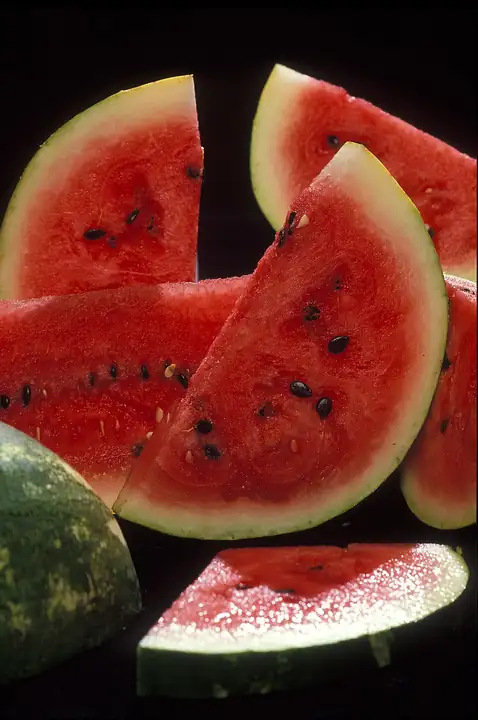
Watermelon
Citrullus lanatus · Gourd family (Cucurbitaceae)
| Hardiness zones | 3 to 11 |
|---|---|
| Sun | full sun |
| Water | moderate |
| Life cycle | annual |
| Frost | Tender: killed by frost |
| Soil pH | 6.0–6.5 |
| Spacing | 24 to 36 inches |
| Days to harvest | 70 to 90 days |
| Soil temperature to plant | at least 65°F |
About Watermelon
Watermelons are sprawling vines that need heat, room and time to ripen sweet fruit. They are more sensitive to cold than cantaloupe, so warm soil and black plastic mulch help in cooler areas.
Grown as a warm-season annual in every zone; it is killed by frost, so plant it out after the danger of frost has passed. It prefers average temperatures of 70 to 85F.
When to plant
Timing is counted from your average last spring frost (and first fall frost). Sow & Tell works out the actual dates for your ZIP code.
- Start seeds indoors: 2 to 4 weeks before the last frost
- Set out plants: 2 to 3 weeks after the last frost
- Sow seeds outdoors: 2 to 3 weeks after the last frost
Days count from seeding (Clemson notes 85 to 90 days from transplant for most varieties); fruit ripens about 35 days after it sets. Rows are usually 6 to 8 feet apart.
Soil
Well-drained sandy loam; most roots are in the top 12 inches.
Follow a soil test and keep pH 6.0 to 6.5; work in compost or well-rotted manure, and without a test add about 30 lb of 5-10-10 per 1,000 sq ft (about 3 lb per 100 sq ft) before planting.
Feeding
- before the vines start to run: nitrogen fertilizer such as 34-0-0 or calcium nitrate (15.5-0-0). Use about 1 lb of 34-0-0 or 2 lb of calcium nitrate per 100 ft of row beside the plants and water it in.
- after bloom, when fruit is forming on the vine: nitrogen fertilizer such as 34-0-0 or calcium nitrate (15.5-0-0). Side-dress a second time beside the row and water it in.
Too much nitrogen gives extra vine and less fruit; soil below pH 6.0 can give yellow plants that set little fruit.
Harvest
Look for several signs together: the curly tendril nearest the fruit turns brown and dry, the rind turns dull, and the spot where the melon rests changes from pale green to creamy yellow. Melons do not get sweeter after picking.
Each melon is picked once, when the tendril nearest it browns, the rind dulls and the underside turns creamy yellow; melons on a vine don't all ripen at the same time.
Varieties (51)
| Variety | Type | Days | Notes |
|---|---|---|---|
| Stone Mountain | Heirloom, large | Sweet red flesh. Thick, tough dark green rind; fruit about 35 to 40 pounds. | |
| Kleckley Sweet | Heirloom, long | 85 days | Oblong fruit of 25 to 40 pounds with a thin, glossy dark green rind, medium-red flesh and large white seeds. |
| Blacktail Mountain | Icebox | 76 days | Sweet orange-red flesh. Round fruit of 6 to 12 pounds with a dark green rind and faint darker stripes. |
| Minilee | Icebox | Small round fruit of 5 to 8 pounds with a Charleston Gray-like rind, firm red flesh, a thin but tough rind and very small seeds. | |
| Tiger Baby | Icebox | 80 days | Round to slightly oval fruit of about 7 to 11 pounds with dark green stripes on gray-green. |
| Jade Star | Icebox (small seeded) | Sugar Baby-type melon of about 10 to 12 pounds with a very dark green rind and deep red flesh. | |
| Mickylee | Icebox (small seeded) | Round fruit of 8 to 12 pounds with a gray-green rind and dark red flesh. Resists fusarium wilt and anthracnose. | |
| Petite Sweet | Icebox (small seeded) | 75 days | Blocky round fruit of 5 to 10 pounds with pinkish-red flesh and few, small seeds. Resists fusarium wilt and anthracnose. |
| Sugar Baby | Icebox (small seeded) | 77 days | Small, round fruit of about 8 to 10 pounds with a solid dark green rind and red flesh. |
| Bush Sugar Baby | Icebox, compact vine | 75 days | A compact-vined version of the Sugar Baby type. |
| New Queen | Icebox, orange flesh | 63 days | Small, oval, striped fruit of about 4 to 5 pounds with orange flesh. |
| Yellow Doll | Icebox, yellow flesh, hybrid | Round, yellow-fleshed fruit of about 5 to 7 pounds. | |
| Golden Crown | Icebox, yellow rind | 70 days | Small round fruit of about 2 to 4 pounds whose rind turns bright gold when ripe; pink-red flesh. |
| Jubilee II | Large, long | Looks and grows like Jubilee but was selected for stronger Fusarium wilt resistance. | |
| Patriot | Large, long | 80 to 85 days | Cylinder-shaped fruit of about 22 to 26 pounds with a light green rind, wide medium green stripes and red flesh. |
| Fiesta | Large, long (Allsweet type, hybrid) | High in sugar. Fruit of 22 to 25 pounds with a dark green rind, light green stripes and bright red flesh. Resistant to Fusarium wilt race 0 and tolerant of race 1 and anthracnose. | |
| Royal Majesty | Large, long (Allsweet type, hybrid) | Elongated fruit with thin, medium green stripes. | |
| Calhoun Gray | Large, long (Charleston Gray type) | 85 days | Bred from Calhoun Sweet and Charleston Gray. Resistant to anthracnose and Fusarium wilt races 0 and 1. |
| Prince Charles | Large, long (hybrid) | 80 days | Hybrid Charleston Gray type that ripens earlier, grows larger and has stronger Fusarium wilt resistance than Charleston Gray. |
| Sentinel | Large, oblong (hybrid) | Oblong fruit of 20 to 27 pounds with a Crimson Sweet-style stripe. Cornell lists anthracnose resistance. | |
| OrangeGlo | Large, orange flesh | 85 days | Very large fruit (about 50 pounds) with a light green rind, dark stripes and orange flesh. |
| Dixielee | Large, round | Round fruit with Jubilee-type stripes, 18 to 22 pounds. Resistant to Fusarium wilt race 1 and anthracnose race 1. | |
| Crimson Tide | Large, round (Crimson Sweet type) | Like Crimson Sweet with slightly darker stripes; fruit about 24 pounds. Resistant to Fusarium wilt and tolerant of anthracnose race 1. | |
| Mirage | Large, round (hybrid) | 85 days | Crimson Sweet-type hybrid that is more uniform and productive. Fusarium wilt resistant. |
| Top Gun | Large, round (hybrid) | 83 days | Globe-shaped fruit of 21 to 24 pounds with broad dark stripes and bright red flesh. Cornell lists anthracnose and Fusarium wilt resistance. |
| Imagination | Round (Sugar Baby type) | 82 days | Very dark, solid green rind and bright red flesh; fruit 12 to 14 pounds. |
| Black Diamond | Seeded | 90 days | Open-pollinated seeded melon. |
| Congo | Seeded | Productive melon with good quality. Resists anthracnose. | |
| Moon and Stars | Seeded (heirloom) | 95 to 105 days | Sweet red flesh. Dark green rind speckled with bright yellow spots; brown seeds with black dots. |
| Royal Sweet | Seeded, blocky oval, hybrid | 85 days | Bright red, crisp flesh. Blocky oval fruit of 20 to 25 pounds with a striped green rind. Tolerates fusarium wilt. |
| Sangria | Seeded, blocky oval, hybrid | 87 days | Red-fleshed, blocky oval fruit of 20 to 26 pounds, dark green with a light stripe and small black seeds. Resists fusarium wilt and tolerates anthracnose. |
| Mardi Gras | Seeded, large, hybrid | 86 to 90 days | Large fruit of 20 to 25 pounds. Resists anthracnose and fusarium wilt. |
| Allsweet | Seeded, long | 90 days | Very sweet, firm flesh. Long, cylinder-shaped fruit with a broken-stripe rind and small dark seeds. Resists fusarium wilt and anthracnose. |
| Charleston Gray | Seeded, long | 85 days | Crisp and sweet, with light red flesh. Long fruit with a tough gray-green rind that ships well. Resists fusarium wilt and anthracnose and tolerates sunburn. |
| Jubilee | Seeded, long | 95 days | Sweet, pink-red flesh. Large fruit of 35 to 40 pounds with a tough rind in narrow dark stripes on light green and black seeds. Resists fusarium wilt and anthracnose. |
| Georgia Rattlesnake | Seeded, long (heirloom) | 90 days | Crisp, sweet, bright red flesh. Very long fruit of 25 to 30 pounds, light green with irregular dark green stripes; white seeds with dark tips. |
| Royal Jubilee | Seeded, long, hybrid | 95 days | Bright red, crisp flesh. Elongated fruit with a light green rind and dark stripes. Tolerates anthracnose and fusarium wilt. |
| Tendersweet Orange | Seeded, orange flesh | 85 days | Oblong fruit with a dark green, mottled-stripe rind and orange flesh. |
| Dixie Queen | Seeded, round (heirloom) | 90 days | Round fruit of 30 to 40 pounds with narrow dark stripes, pink flesh and small white seeds. |
| Crimson Sweet | Seeded, round-blocky | 85 days | High in sugar with fine-textured red flesh. Blocky round fruit of 20 to 30 pounds, light green with dark stripes and small dark seeds. Resists fusarium wilt and anthracnose. |
| Desert King | Seeded, yellow flesh | 85 days | Round to slightly oblong fruit with a pale green rind and deep yellow flesh; resists sunburn and handles drought. |
| Yellow Baby | Seeded, yellow flesh, hybrid | Round, yellow-fleshed fruit of about 9 to 12 pounds, light green with dark stripes. | |
| Tiffany | Seedless (triploid hybrid) | Round, striped seedless fruit up to about 20 pounds with solid, evenly red flesh. | |
| King of Hearts | Seedless (triploid) | Blocky, slightly oblong seedless melon, striped green, with bright red flesh. | |
| Millionaire | Seedless (triploid) | Red-fleshed, oblong fruit of about 13 to 20 pounds. | |
| Sweet Gem | Seedless (triploid) | Red-fleshed, round fruit of about 13 to 16 pounds. | |
| Tri-X 313 | Seedless (triploid) | 85 days | Oval, red-fleshed seedless melon with a light green rind mottled in dark stripes. |
| Solitaire | Small | 85 days | Round fruit of 5 to 7 pounds with a mottled dark green rind and deep red flesh. |
| Golden Midget | Small seeded (early) | 70 days | Small melon whose rind turns golden orange when ripe, a handy ripeness signal; dark seeds. |
| New Hampshire Midget | Small seeded (early) | Very early, small oval melon with a gray-green rind, red flesh and black seeds. | |
| Early Moonbeam | Small, yellow flesh | 78 days | Small fruit around 4 to 7 pounds with dark green stripes on light green and yellow flesh. |
Good neighbors
UMN and Illinois Extension note Blue Hubbard squash can be used as a trap crop to lure cucumber beetles away from other vine crops.
Pests to watch for
Cucumber beetles, Squash bug, Aphids, Twospotted spider mite, Whiteflies, Leafminers, Root-knot nematodes, Pillbugs and sowbugs, Squash beetle, Mice (house mice and deer mice), Raccoon, Broad mite, Seedcorn maggot, Melonworm
Diseases and problems
Anthracnose, Gummy stem blight, Powdery mildew, Fusarium wilt, Blossom end rot, Poor pollination, Ozone injury, Sunscald, Frost and freeze injury, Angular leaf spot, Verticillium wilt, Mosaic viruses, Downy mildew, Damping-off, Southern blight, Sooty mold, Cucumber mosaic, Zucchini yellow mosaic, Watermelon mosaic, Tomato and tobacco ringspot
In the kitchen
Eaten fresh in slices, fruit salads, juices and frozen treats.
Keeping it: Keep whole melons cool (about 55F) for up to 2 weeks; long chilling below 50F hurts them. Rinse the rind before cutting, then refrigerate cut melon and eat it within 5 days.
Pets: Not listed as toxic by the ASPCA
Sources
- hgic.clemson.edu
- extension.umn.edu
- extension.illinois.edu
- yardandgarden.extension.iastate.edu
- extension.unh.edu
- extension.colostate.edu
- extension.umn.edu
- extension.oregonstate.edu
Photo: Photo: Keith Weller, USDA ARS, Public domain (USDA ARS), via Wikimedia Commons. Photo resized for the web.

Planting dates and advice are general guidance; check with your local Cooperative Extension office for your area.