
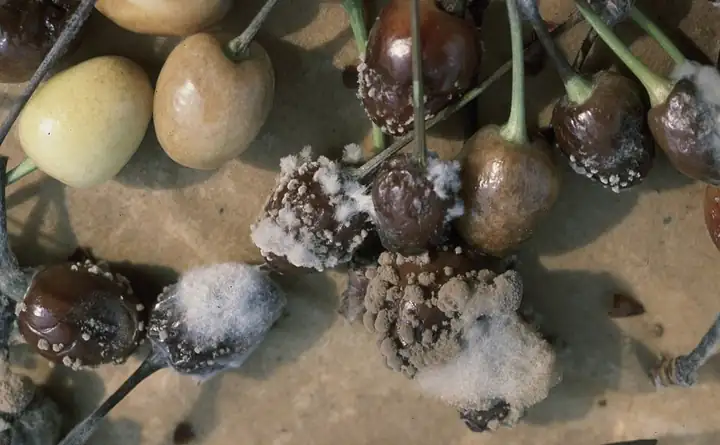
Brown rot
Fungi (Monilinia fructicola and Monilinia laxa)
| Type | Fungus |
|---|---|
| Cause | Fungi (Monilinia fructicola and Monilinia laxa) |
| When | Bloom in spring, then again as fruit ripen. |
About
A major fungal rot of peaches, plums, cherries and apricots, attacking blossoms in spring and ripening fruit near harvest. Rotted fruit dry into mummies that start next year's infections.
Also called brown rot
How to recognize it
Symptoms
Infected blossoms turn brown, die and stay stuck to the twig, often with a drop of sticky gum; twig cankers can kill the shoot beyond them. Ripening fruit get a small, firm brown spot that spreads fast and grows tufts of tan-to-gray spores. Rotted fruit shrivel into hard mummies that may hang on the tree into the next season.
Often confused with
Blossoms killed by frost fall off, while brown rot blossoms stay attached with gum.
Worse when
Wet, humid bloom periods (blossoms can be infected after 3 hours wet at 70°F), and rain or wounds on ripening fruit.
How it spreads
The fungi spend the winter in mummified fruit and twig cankers; spores blow or splash to blossoms in spring and from fruit to fruit near harvest.
When
Bloom in spring, then again as fruit ripen.
What to do, gentlest first
Prevention works best; most sprays only protect healthy leaves and can't cure infected ones. Always read and follow the product label.
Remove mummies and fallen fruit Prevent
Before bud break, pick every shriveled fruit off the tree and the ground, and pick up dropped fruit through summer.
Prune, water and feed with care Prevent
Cut out cankers and blighted twigs in late winter or in dry weather, thin the canopy so it dries fast, water at the ground instead of wetting blossoms and fruit, and avoid excess nitrogen.
Fruit injured by insects, hail or rubbing are much more likely to rot, so managing fruit pests helps too.
Remove blighted shoots and rotten fruit By hand
Cut out wilted, blighted shoots in dry weather and pick up rotten and fallen fruit through the season, since rotting fruit make masses of spores that spread to healthy fruit.
Sulfur Organic spray
Sulfur is one listed option: spray from first open blossom through petal fall in wet springs, and again starting 2 to 3 weeks before harvest.
Sprays protect healthy tissue; they do not save fruit that are already rotting. UC IPM's pesticide database says not to let sulfur drift onto flowering plants, so for bloom sprays work in the evening when bees are not foraging. Follow the label and pre-harvest interval.
Captan, myclobutanil, propiconazole or thiophanate-methyl Conventional spray
Use at bloom (UC IPM suggests 20 to 40% bloom, with a possible second spray at 80 to 100% bloom) and again as fruit ripen. Chlorothalonil is labeled for blossom blight only.
Do not use chlorothalonil for fruit rot; UC IPM rates it highly hazardous to fish and other aquatic life, so keep it out of water. UC IPM notes some products on its list are sold only to licensed applicators. Make sure your crop is on the label, and follow the label and pre-harvest interval.
Plants it affects
Apricot, Cherry (sweet and tart), Mayhaw, Nanking cherry, Peach, Plum, Quince
Sources
Photo: Photo: Mary Ann Hansen, Virginia Polytechnic Institute and State University, Bugwood.org, CC BY 3.0 US, via Wikimedia Commons (CC BY 3.0 US). Photo resized for the web.

Planting dates and advice are general guidance; check with your local Cooperative Extension office for your area.