
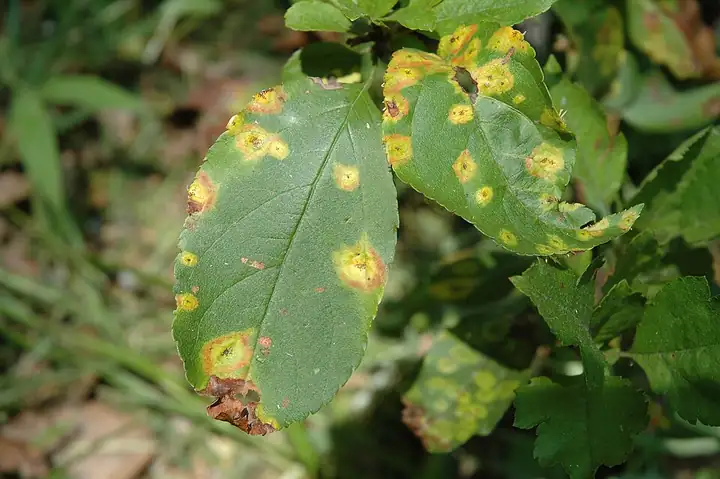
Cedar-apple rust
Rust fungus (Gymnosporangium), which needs both an apple and a juniper host
| Type | Fungus |
|---|---|
| Cause | Rust fungus (Gymnosporangium), which needs both an apple and a juniper host |
| When | Spring for apple infection; leaf spots show from late spring into summer. |
About
A rust fungus that must alternate between junipers (such as eastern red cedar) and apples or crabapples to complete its life. It makes bright orange leaf spots on apples and odd orange, jelly-like horns on junipers in spring.
Also called cedar apple rust, cedar-apple rust, cedar-hawthorn rust, cedar hawthorn rust
How to recognize it
Symptoms
Apple leaves get yellow spots that turn bright orange-red, often with a red border, with tiny black dots in the center and short fringed tubes on the leaf underside. Fruit can get green to brown spots. On junipers, brown woody galls up to 2 inches across push out orange, gummy tentacles half an inch to three-quarters of an inch long in wet spring weather.
Worse when
Wet spring weather when the juniper galls are swelling and releasing spores.
How it spreads
Spores from juniper galls blow to apples in spring and can travel more than a mile; spores from apple leaves then blow back to junipers in mid to late summer, where galls take about two years to form.
When
Spring for apple infection; leaf spots show from late spring into summer.
What to do, gentlest first
Prevention works best; most sprays only protect healthy leaves and can't cure infected ones. Always read and follow the product label.
Plant rust-resistant apples Prevent
Freedom, Liberty, Nova Easygro, Novamac, Redfree and Fireside are rated resistant. Avoid Beacon and Wealthy where rust has been a problem.
Keep apples and junipers apart Prevent
Avoid planting eastern red cedar and other junipers within a few hundred yards of apples and crabapples.
This cuts disease but will not end it, because spores can blow in from junipers more than a mile away, including your neighbors' trees.
Prune galls off junipers By hand
Before spring, cut off the brown, woody galls before the orange horns form, to reduce spores near your apples.
Copper or sulfur (ornamental trees only) Organic spray
On ornamental (non-fruiting) trees, UMN says copper and sulfur products can be used as protectants, starting when flower buds emerge and repeating until spring turns steadily warm and dry.
UMN says no fungicides available to home gardeners can be used on trees whose fruit will be eaten, and it does not recommend fungicides for this disease in general because trees usually tolerate it. Sprays only work before spots appear. Blooming trees draw bees, so avoid spraying if you can, and follow the label.
Myclobutanil (ornamental trees only) Conventional spray
For ornamental trees, UMN rates myclobutanil the most effective protectant, on the same bud-emergence-to-dry-weather schedule.
Not for apple trees whose fruit you will eat: UMN says no home-garden fungicides are available for that use. Follow the label.
Plants it affects
Sources
Photo: Photo: Littleinfo, Public domain, via Wikimedia Commons. Photo resized for the web.

Planting dates and advice are general guidance; check with your local Cooperative Extension office for your area.