
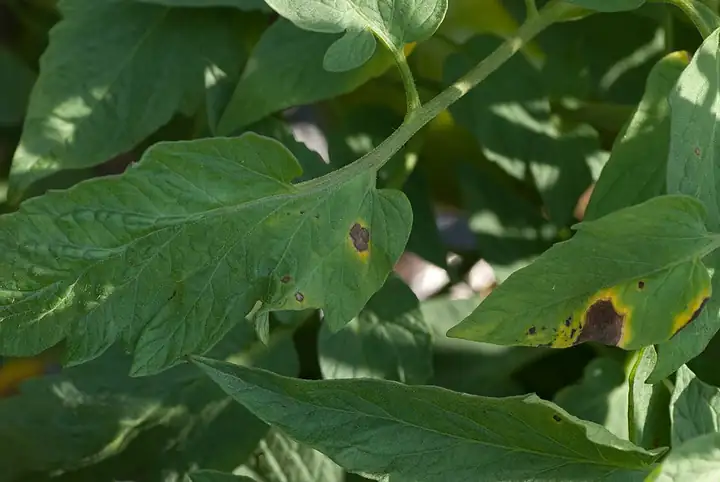
Early blight
Fungus (Alternaria tomatophila and Alternaria solani)
| Type | Fungus |
|---|---|
| Cause | Fungus (Alternaria tomatophila and Alternaria solani) |
About
Early blight is one of the most common leaf diseases of tomatoes and potatoes, and it also attacks peppers and nightshade weeds. Badly infected plants lose many of their leaves from the bottom up, which weakens them and cuts the harvest.
Also called early blight, Alternaria blight
How to recognize it
Symptoms
Small dark spots appear first on the oldest leaves near the ground and grow to about half an inch, often with target-like rings and a yellow zone around them. Badly spotted leaves yellow, brown and drop, and the disease climbs the plant. Stems can get dark ringed lesions (a sunken collar rot on seedlings), and fruit may get leathery black spots with raised rings, usually near the stem.
Often confused with
Septoria leaf spot also starts low on tomatoes, but its spots are smaller (pencil-tip size) with pale centers and tiny black specks and no target rings. Bacterial spot makes small spots without rings.
Worse when
Warm, wet weather: it develops from about 59 to 80°F, is worst around 82 to 86°F, and spreads fast with rain, heavy dew or humidity above 90%.
How it spreads
The fungi overwinter in infected plant debris and soil and can also come in on tomato seed or transplants; spores then move by wind, splashing water, hands and tools.
When
Early summer through fall; in Minnesota it usually appears in mid to late June and builds as the season goes on.
What to do, gentlest first
Prevention works best; most sprays only protect healthy leaves and can't cure infected ones. Always read and follow the product label.
Resistant or tolerant varieties Prevent
Look for tomatoes labeled EB (early blight). Resistant plants still get some spots but tolerate the disease better.
Resistance is not immunity, so keep up the other steps too.
Rotate and space Prevent
Wait at least two years before planting tomatoes, potatoes or peppers in the same spot. Stake or trellis plants, space them well and pull weeds so leaves dry quickly.
Mulch and water at the base Prevent
Mulch the soil with straw, dried leaves, fabric or plastic to stop spores splashing up. Water with drip lines, a soaker hose or a careful hand at the base of the plant, not over the leaves.
Remove spotted and lower leaves By hand
Pick off leaves with spots and bury them or throw them away. Pruning the lowest leaves keeps soil splash off the plant. Clean pruners between plants.
Do not work among plants while they are wet.
Copper fungicide Organic spray
Clemson rates copper as good against early blight when sprayed before spots spread. Start when weather favors disease and repeat as the label directs.
Copper only protects leaves it coats before infection; it will not heal spots already there. It can burn young leaves, especially in weather above 85°F, and some plants are sensitive (Purdue lists celery, strawberry, apple, pear and plum among them). PNW 591 rates copper hydroxide toxic to bees, so spray when bees are not foraging. Follow the label, including the days to wait before harvest.
Chlorothalonil or mancozeb Conventional spray
Clemson rates mancozeb very good and chlorothalonil good for early blight. They protect healthy leaves; they do not cure spotted ones. Alternate chemical groups, since UMN reports some resistance to one fungicide family.
Chlorothalonil is a protectant: it keeps new infections from starting but does not cure existing spots. UC IPM rates it highly hazardous to fish and other aquatic life, and product labels carry a DANGER signal word. Keep it out of water and off flowering plants, wear gloves and eye protection, and follow the label and pre-harvest interval. Mancozeb: Follow the label, including which crops it may be used on and how many days to wait before harvest.
Plants it affects
Eggplant, Ground cherry, Lovage, Pepper (sweet and chili), Potato, Tomatillo, Tomato
Sources
Photo: Photo: Dwight Sipler, CC BY 2.0, via Wikimedia Commons (CC BY 2.0). Photo resized for the web.

Planting dates and advice are general guidance; check with your local Cooperative Extension office for your area.