
Fire blight
Bacterium (Erwinia amylovora)
| Type | Bacteria |
|---|---|
| Cause | Bacterium (Erwinia amylovora) |
| When | Spring bloom through early summer, while new shoots are growing. |
About
A bacterial disease of apples, pears and their relatives that makes blossoms and shoots look scorched by fire. Pear and quince are the most easily damaged, and a bad year can kill large limbs or a whole young tree.
Also called fire blight, fireblight
How to recognize it
Symptoms
Blossoms look water-soaked, then wilt and turn brown or black and stay stuck on the tree. Young shoots wilt and bend over into a shepherd's-crook hook, turning black on pears and brown on apples. Sunken, dark cankers form on branches and trunks, and in humid weather cream to light-yellow drops of ooze bead up on infected wood.
Worse when
Rainy or humid weather at bloom with days of about 75 to 85°F and nights above 55°F; spread starts once it is warmer than about 65°F with moisture.
How it spreads
The bacteria spend the winter in bark cankers, then move to flowers and wounds on insects (bees included), splashing rain, irrigation water, hands and pruning tools.
When
Spring bloom through early summer, while new shoots are growing.
What to do, gentlest first
Prevention works best; most sprays only protect healthy leaves and can't cure infected ones. Always read and follow the product label.
Plant less-susceptible varieties Prevent
Among apples, Haralson, Liberty, Red Baron and SnowSweet rate among the most resistant in Minnesota trials. For pears, Harrow Delight, Harrow Sweet, Magness, Moonglow, Seckel, Kieffer and Warren are among those listed as more resistant; many popular apples such as Fuji, Gala, Golden Delicious, Granny Smith and Jonathan are highly susceptible.
No pear is truly immune; resistant kinds just get less damage.
Go easy on nitrogen and heavy pruning Prevent
Lots of soft new growth is where the bacteria get in, so skip heavy nitrogen feeding and hard pruning that push a flush of shoots.
Cut out infections well below the damage By hand
Cut infected shoots at least 12 inches below the visible damage, and cut branch cankers at least 8 inches below the discolored bark, into healthy wood. Work on cool, dry days; larger limbs can wait until late winter. If the infection reaches the trunk of a small tree (under 2 to 3 inches thick), remove the whole tree.
Dip or wipe tools in rubbing alcohol or a 10% household bleach solution between cuts, and dry and oil them afterward because bleach corrodes metal. Where you cut matters more than the tool dip.
Copper during bloom (limited help) Organic spray
In problem years, a weak copper spray (such as a very dilute Bordeaux mixture) during bloom may reduce new blossom infections. UC IPM times it from when average temperatures pass 60°F, repeated every 4 to 5 days through bloom.
Copper cannot cure existing infections and can russet or scar fruit. Because this spray goes on during bloom, note that PNW 591 rates copper hydroxide toxic to bees; spray in the evening when bees are not foraging. UMN says sprays usually are not needed in home plantings; pruning and variety choice matter more. Follow the label.
Plants it affects
Sources
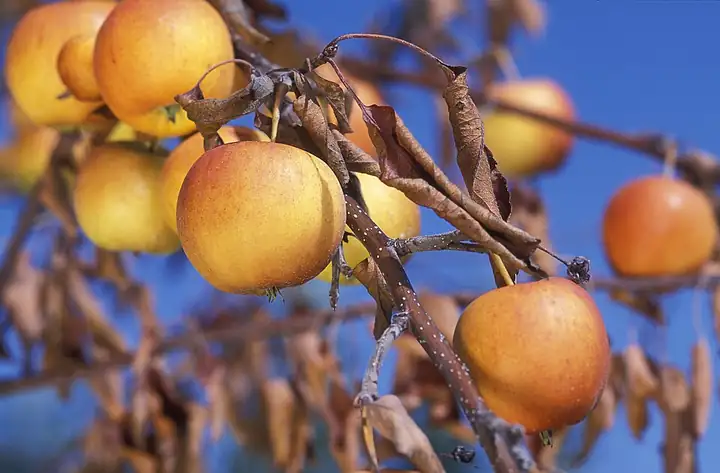
Photo: Photo: Peggy Greb, USDA ARS, Public domain (USDA ARS), via Wikimedia Commons. Photo resized for the web.

Planting dates and advice are general guidance; check with your local Cooperative Extension office for your area.