
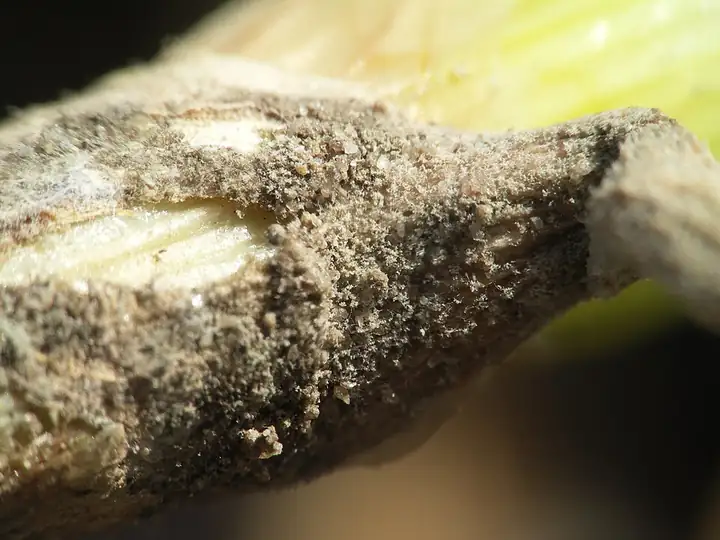
Neck rot
Fungi (Botrytis allii and Botrytis aclada)
| Type | Fungus |
|---|---|
| Cause | Fungi (Botrytis allii and Botrytis aclada) |
About
A storage rot of onions that usually starts at harvest but stays hidden until bulbs have been stored for a month or two. In garlic it can also show up in the field.
Also called neck rot, Botrytis neck rot, onion neck rot
How to recognize it
Symptoms
The neck of a stored onion turns soft and water-soaked, and yellowish-brown rot spreads down through the scales toward the base. The bulb feels spongy and may shrink. Gray mold grows between the scales, and hard black specks (sclerotia) form around the neck. In garlic, the neck near the soil line looks water-soaked and gets gray mold.
Worse when
Cool, moist weather (about 50 to 75°F) near harvest, late rain or watering, too much late nitrogen, harvesting green or poorly cured bulbs, bruising, and damp, warm storage.
How it spreads
Spores blow from dead onion tissue and cull piles into soft green necks and cut tops at harvest; the fungi can come in on seed and survive in soil as black sclerotia for two years or more.
When
Shows up in storage, usually 4 to 8 weeks after harvest; garlic can show it any time after spring growth starts.
What to do, gentlest first
Prevention works best; most sprays only protect healthy leaves and can't cure infected ones. Always read and follow the product label.
Feed early, rotate, and clean up Prevent
Don't add nitrogen once bulbs start to form, rotate onion-family crops for three to four years, and bury or remove culls and crop leftovers.
No resistant onion varieties are available.
Harvest mature, cure well Prevent
Harvest after at least half the tops have fallen and browned, cure on the ground for 6 to 10 days in dry weather (or somewhere airy at 70 to 80°F), and only cut tops once necks are dry and tight.
Handle bulbs gently; bruises let the fungus in.
Store cold, dry and airy Prevent
Keep cured onions and garlic at about 32 to 40°F with good air flow and moderate humidity (about 65 to 75%).
Sort stored bulbs By hand
Check stored bulbs often and use or discard any with soft necks. Healthy bulbs in storage don't pick up new infections.
Late-season fungicides in wet years Conventional spray
Farms in rainy harvests use chlorothalonil, cyprodinil plus fludioxonil, or pyraclostrobin plus boscalid late in the season to cut infection.
Rarely needed in a home garden; good curing does most of the work. Follow the label, including days to harvest.
Plants it affects
Sources
Photo: Photo: Jochen Kreiselmaier, DLR Rheinpfalz / Wikimedia Commons, CC BY-SA 4.0 (CC BY-SA 4.0). Photo resized for the web.

Planting dates and advice are general guidance; check with your local Cooperative Extension office for your area.