
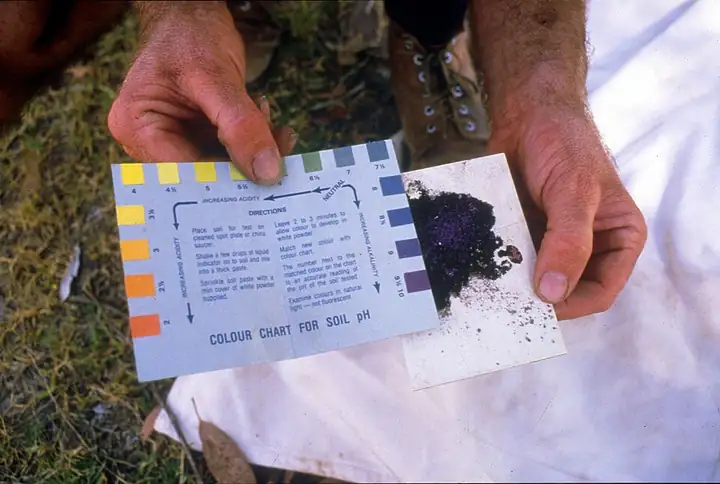
Soil pH problems
Not an infection: soil that is too acidic or too alkaline locks up some nutrients and can make others reach toxic levels
| Type | Not an infection |
|---|---|
| Cause | Not an infection: soil that is too acidic or too alkaline locks up some nutrients and can make others reach toxic levels |
| When | Any time. Testing in fall leaves time to correct pH before spring planting. |
About
Soil pH runs from 0 to 14, with 7 as neutral. Most vegetables, lawns and flowers grow best around pH 5.8 to 6.5, while azaleas, rhododendrons and blueberries like about 5.0 to 5.5; outside the right range, plants go hungry even when nutrients are in the soil.
Also called soil pH problems, wrong soil pH, acidic soil, alkaline soil, soil too acidic, soil too alkaline, high soil pH, low soil pH
How to recognize it
Symptoms
In soil that is too alkaline, the classic sign is iron chlorosis: yellow new leaves with green veins, especially on acid-loving plants, and phosphorus and most micronutrients become harder to get. In very acidic soil, aluminum and manganese can reach toxic levels while calcium, phosphorus and magnesium run short, and plants grow poorly. Bigleaf hydrangeas bloom blue only when the soil pH is below about 5.0.
Often confused with
pH problems show up as nutrient shortages (iron chlorosis and nitrogen, phosphorus, potassium or magnesium deficiency), so the fix is often changing the pH, not adding more fertilizer. Only a soil test tells you the pH.
Worse when
Rainy climates and sandy soils tend to turn acidic, and ammonium and urea fertilizers slowly acidify soil. Dry-climate soils with free lime (calcium carbonate) stay alkaline.
How it spreads
It does not spread from plant to plant.
When
Any time. Testing in fall leaves time to correct pH before spring planting.
Where
Southeastern soils are usually acidic (South Carolina soils run about pH 4.5 to 6.0), while many Western soils, such as Colorado's, are alkaline (about pH 7.0 to 8.3).
What to do, gentlest first
This is not an infection, so sprays for diseases won't help. Fix the cause below.
Test before you change anything Prevent
Get a soil test before adding lime or sulfur, ideally in fall, and retest every few years.
Choose plants that fit your soil Prevent
Grow plants suited to your pH. Acid lovers like blueberries, azaleas and rhododendrons are hard to grow in soil above pH 7.3 or with free lime. To check for free lime, wet a heaping tablespoon of dry, crumbled soil with vinegar: fizzing means free lime.
Raise pH with lime Prevent
Work ground agricultural limestone into moist soil at the rate your soil test gives, in fall or winter, about 2 to 3 months before planting. Dolomitic lime also adds magnesium.
Hydrated lime acts fast and is easy to overdo. Wood ashes also raise pH; spread them thinly and keep them off seedlings. Coal ash has no liming value.
Lower pH with elemental sulfur Prevent
Soil bacteria slowly turn sulfur into acid over several months. Clemson's rate for loamy soil going from pH 7.0 to 5.5 is about 0.3 pound per 10 square feet (less for sand, more for clay); follow your soil test.
In soil with free lime, lowering pH is usually not practical. Aluminum sulfate works fast but can injure roots and build up aluminum. Retest before adding more.
Add organic matter Prevent
Compost, organic amendments and mulch help buffer soil and support plants in tough pH soils.
Plants it affects
Sources
Photo: Photo: CSIRO Forestry and Forest Products / Wikimedia Commons, CC BY 3.0 (CC BY 3.0). Photo resized for the web.

Planting dates and advice are general guidance; check with your local Cooperative Extension office for your area.