
Allium leafminer
Phytomyza gymnostoma
| Type | Insect |
|---|---|
| Pressure by region | High pressure: Northeast |
About
A tiny gray or black fly, about an eighth of an inch long, with a yellow-orange spot on its head and yellow 'knees.' It was first found in the Western Hemisphere near Lancaster, Pennsylvania, in 2015. It attacks only the onion family.
Spotting it
Damage
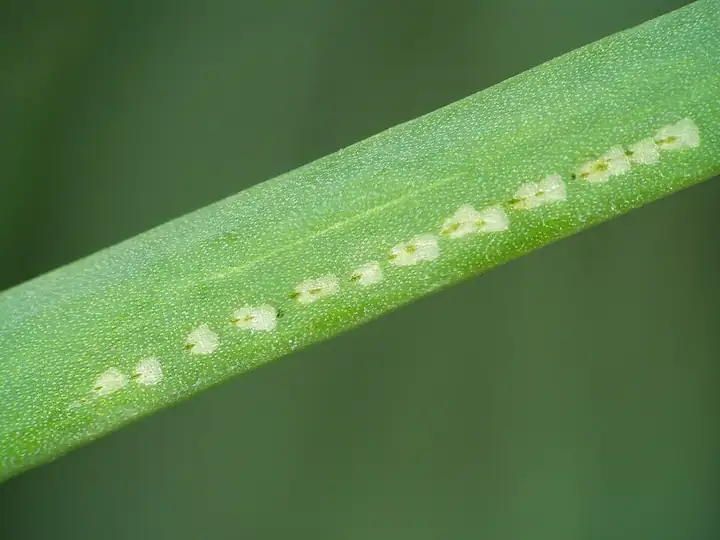
Females poke rows of small white dots in a straight line, usually near the leaf tips. The pale maggots then tunnel straight down the leaf toward the base and into the bulb or leaf sheath, leaving twisted leaves and openings for rot. Leeks are often hit hardest, and Cornell notes it can sometimes wipe out a whole planting.
How to find it early
Starting in early spring (about when forsythia and daffodils begin to bloom), look for lines of white dots near leaf tips on garlic, chives and overwintered onions; check fall leeks from early September. Yellow sticky cards catch the adult flies.
When
Early spring (late March into May) and again in fall (late August into late fall).
Life cycle
There are two generations a year in the Northeast. The spring flight starts between late March and mid-April and lasts about 6 weeks; the fall flight starts between late August and mid-September, and females lay eggs for up to 8 weeks (Cornell Cooperative Extension). It spends winter, and the summer lull, as reddish-brown pupae inside old plants or in the soil (Cornell).
What to do, gentlest first
Start at the top. Sprays are a last step; always read and follow the product label.
Time your plantings around the flights Prevent
Plant spring onions and leeks after mid-May, and wait until late October to plant garlic, after the fall flight is over (UMass). Rotate the onion family with other crops, and till under or remove old plants right after harvest.
Insect netting Barrier
Cover onion-family crops before the flies appear, from March through mid-May and again from mid-August through September (UMass). Bury the edges in the soil so flies cannot crawl under.
UMass recommends insect netting rather than spun-bonded row cover. Covers only help if the flies are not already in the soil under them.
Spinosad Organic spray
Cornell Cooperative Extension's home-garden sheet suggests a spinosad product labeled for leafminers, sprayed twice: in the second and fourth weeks after you first see the flies or their white dots. In UMass trials, two well-timed spinosad sprays controlled the fly.
Spinosad is toxic to bees for about 3 hours to a day after spraying (PNW 591); spray in the evening and keep it off flowering plants. Read and follow the label, and observe the pre-harvest interval for each crop.
Plants it goes after
Pressure by region
This invasive fly is established in Pennsylvania, New York, New Jersey, Connecticut, Massachusetts, Delaware, Maryland, Washington DC and Virginia (Cornell), and it is still spreading. No source we found reports it outside the East, and Oregon treats it as a threat to keep out, so the low ratings outside the Northeast and Southeast are estimates. Southeast is rated moderate because Virginia is the only state there on the list. If you find it somewhere new, report it to your state department of agriculture.
| Northeast | High pressure |
|---|---|
| Southeast | Moderate |
| South Central | Low |
| Midwest | Low |
| Great Plains | Low |
| Mountain West | Low |
| Southwest | Low |
| Pacific Northwest | Low |
| California | Low |
| Alaska | Low |
| Hawaii | Low |
Ratings come from extension sources where available; some are estimates, as noted above.
Sources
- cals.cornell.edu
- umass.edu
- extension.umd.edu
- plant-pest-advisory.rutgers.edu
- oregon.gov
- s3.wp.wsu.edu
- bpb-us-e1.wpmucdn.com
Photo: Photo: Jochen Kreiselmaier, DLR Rheinpfalz, CC BY-SA 4.0, via Wikimedia Commons (CC BY-SA 4.0). Photo resized for the web.

Planting dates and advice are general guidance; check with your local Cooperative Extension office for your area.