
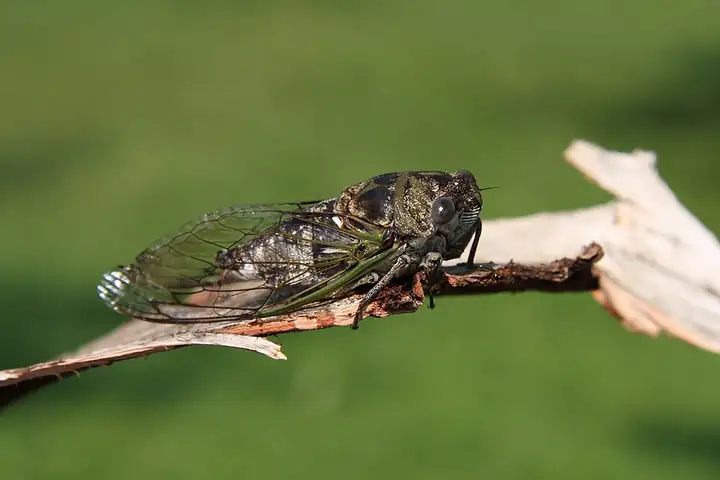
Annual cicadas (dog-day cicadas)
Neotibicen species, such as the dog-day cicada (Neotibicen canicularis), in the East; Megatibicen, Okanagana, Platypedia and other genera in the West
| Type | Insect |
|---|---|
| When | Mid to late summer, about July through September. |
| Pressure by region | Low: all regions |
About
Big, dark cicadas, about 1 1/2 to 2 1/2 inches long with green markings, whose loud buzzing fills mid- to late-summer days. Unlike periodical cicadas (their own page), some come out every summer, and they rarely harm plants (Illinois, NC State).
Spotting it
Damage
Females cut rows of slits into small twigs to lay eggs, and those twig tips may die, brown and break off (flagging). Numbers are usually small, so the damage often goes unnoticed, and nymphs feeding on roots do no noticeable harm (NC State, Ohio State, CSU).
How to find it early
You'll hear them first. In late summer, look for browned, wilted twig tips with rows of small slits on young trees (NC State, Ohio State).
When
Mid to late summer, about July through September.
Life cycle
Eggs hatch in six or seven weeks, and the nymphs drop to the ground and feed on roots for 2 to 10 years, depending on the species. Generations overlap, so some adults come out every summer, leaving exit holes in the soil and papery cast skins on bark (NC State, Illinois, Ohio State).
What to do, gentlest first
Start at the top. Sprays are a last step; always read and follow the product label.
Live with them Prevent
Annual cicadas do little harm to tree health, and NC State says pesticides aren't warranted. Cicada killers, the big ground-nesting wasps that hunt them, are not aggressive and rarely sting (Ohio State).
Net young trees only if needed Barrier
Control rarely works, but netting can keep egg-laying females off young woody plants (UC IPM).
Plants it goes after
Aster, Flowering crabapple, Goldenrod, Oaks (white, red and pin oak), Peach, Persimmon (American and Asian), Red maple, Sugar maple, Thornless honeylocust
Pressure by region
Annual cicadas live across the lower 48: North Carolina has at least 13 Neotibicen species, Colorado 29 cicada species and California at least 65 (NC State, CSU, UC IPM). Damage is minor everywhere, so every region is rated low; the Alaska and Hawaii ratings are estimates.
| Northeast | Low |
|---|---|
| Southeast | Low |
| South Central | Low |
| Midwest | Low |
| Great Plains | Low |
| Mountain West | Low |
| Southwest | Low |
| Pacific Northwest | Low |
| California | Low |
| Alaska | Low |
| Hawaii | Low |
Ratings come from extension sources where available; some are estimates, as noted above.
Sources
Photo: Photo: Cephas / Wikimedia Commons, CC BY-SA 3.0 (CC BY-SA 3.0). Photo resized for the web.

Planting dates and advice are general guidance; check with your local Cooperative Extension office for your area.