
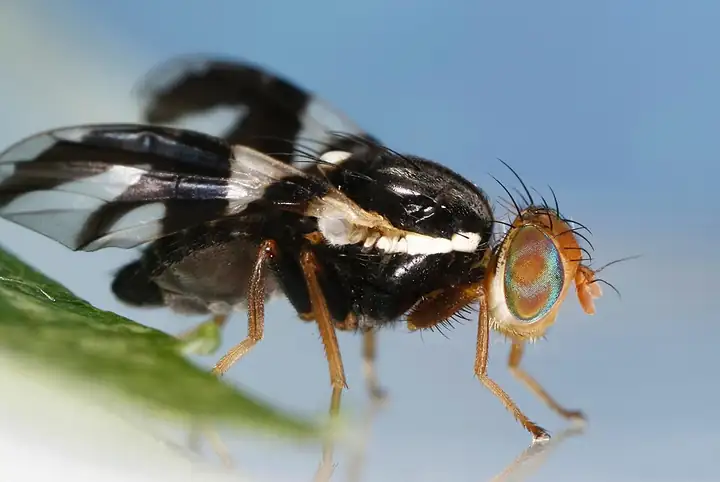
Apple maggot
Rhagoletis pomonella
| Type | Insect |
|---|---|
| When | Early July through September, peaking in late July and early August. |
| Pressure by region | Moderate: Northeast, Midwest, Pacific Northwest |
About
A native fruit fly, a little smaller than a housefly, with dark bands on its wings and a white spot on its back. It first lived on hawthorn and moved onto apples.
Spotting it
Damage
Egg-laying leaves tiny pinprick 'stings' and the fruit grows pitted and lumpy. Maggots tunnel through the flesh, which discolors and rots; badly infested apples are inedible but can go for cider or animal feed.
How to find it early
Hang red sticky spheres (at least 3 inches across) by the end of June and check them weekly. Penn State and UMN treat an average of five flies per baited trap as the signal to act.
When
Early July through September, peaking in late July and early August.
Life cycle
Maggots leave dropped fruit, burrow up to 2 inches into the soil and spend winter there as pupae; a few wait two years or more to emerge. There is one generation a year, with adults emerging from late June and laying eggs into September.
What to do, gentlest first
Start at the top. Sprays are a last step; always read and follow the product label.
Pick up every dropped apple Prevent
Collect drops all season and after harvest and put them in sealed bags in the trash, not the compost pile. USU notes a tarp under infested trees keeps maggots from reaching the soil. Remove neglected fruit trees nearby if you can.
In Washington's quarantine area, do not move homegrown fruit out of the area (WSDA).
Bag fruit or net the tree Barrier
After thinning in early to mid June, cover each apple with a plastic sandwich bag with the bottom corners snipped for drainage (UMN). Or wrap the whole tree in exclusion netting after bloom; UMN research kept out an average of 96% of apple maggots.
Put netting on only after bloom so bees can pollinate.
Kaolin clay film Barrier
A visible white coat of kaolin clay on the tree and fruit discourages egg-laying and protected about 90% of fruit in UMN's account.
It must be reapplied after rain. Kaolin carries no bee warning (PNW 591).
Red sphere traps as a control Trap
On small trees, enough traps can catch many flies: about one sticky red sphere per 100 to 150 fruit, with at least one facing any woods and one on the south side (UMN, Penn State). Clean and recoat them regularly.
Spinosad Organic spray
Spinosad products for home fruit can protect apples when traps show flies; UMN says sprays may be needed three or four times a season, until flies stop showing up in traps.
Toxic to bees for a few hours to a day (PNW 591); spray in the evening, not during bloom. Make sure apple is on the label, and follow the pre-harvest interval.
Esfenvalerate, permethrin or carbaryl Conventional spray
UMN, Penn State and USU list these for home trees, applied when trap counts reach the threshold. Take traps down before spraying.
Highly toxic to bees (PNW 591): never apply during bloom or when bees are working. Carbaryl has been a restricted-use pesticide in California since August 1, 2020 (UC IPM), so California home gardeners cannot buy it without an applicator license. Use only products labeled for your fruit and follow the pre-harvest interval.
Plants it goes after
Apple (backyard tree), Apricot, Cherry (sweet and tart), Mayhaw, Pear, Plum, Tejocote (Mexican hawthorn)
Pressure by region
Sourced for Pennsylvania, Minnesota, Utah (only sporadic, in backyard plums and apples) and Washington. All of Western Washington and parts of Eastern Washington are under a state apple maggot quarantine, and it is unlawful to carry homegrown fruit out of the quarantine area (WSDA). Other regions are rated low for lack of a source; those ratings are estimates.
| Northeast | Moderate |
|---|---|
| Southeast | Low |
| South Central | Low |
| Midwest | Moderate |
| Great Plains | Low |
| Mountain West | Low |
| Southwest | Low |
| Pacific Northwest | Moderate |
| California | Low |
| Alaska | Low |
| Hawaii | Low |
Ratings come from extension sources where available; some are estimates, as noted above.
Sources
Photo: Photo: Joseph Berger, Bugwood.org, CC BY 3.0 US, via Wikimedia Commons (CC BY 3.0 US). Photo resized for the web.

Planting dates and advice are general guidance; check with your local Cooperative Extension office for your area.