
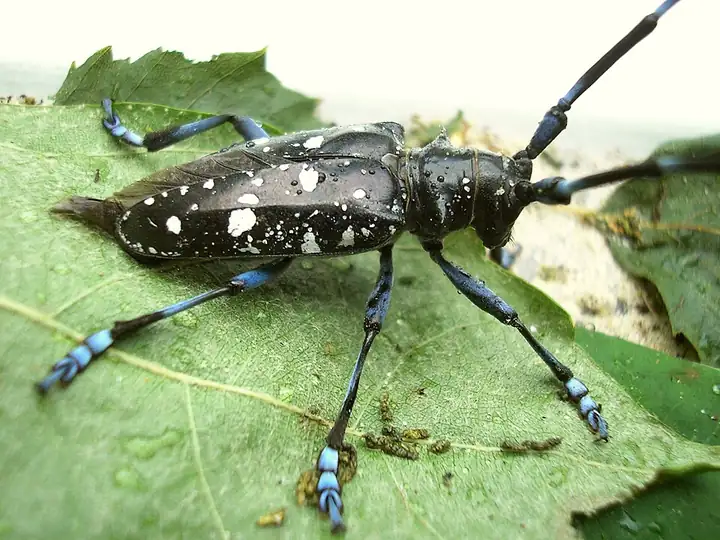
Asian longhorned beetle
Anoplophora glabripennis
| Type | Insect |
|---|---|
| When | Adults from July into fall; larvae inside trees all year. |
| Pressure by region | Low: Northeast, Southeast, Midwest |
About
A shiny black, almond-size beetle with white spots and black-and-white banded antennae longer than its body (USDA APHIS). It came from Asia, probably in wood packing material, was first found in Brooklyn, New York, in 1996, and its larvae tunnel deep into maples and other hardwoods (USDA APHIS, UMass).
Spotting it
Damage
Larvae feed under the bark and then bore into the wood, weakening the tree so limbs break off trees that otherwise look healthy. Leaves may yellow early or have chewed veins, and infested trees cannot be treated or saved (USDA APHIS, UMass). Maple is its favorite host; birch, elm, horsechestnut, willow, poplar and several others are also attacked (UMass).
How to find it early
Look for perfectly round exit holes about 3/8 inch across (dime size or smaller), oval or round egg pits in the bark that may weep sap, and coarse sawdust in branch forks or at the base of the tree (USDA APHIS, UMass). The beetles themselves are out in summer.
When
Adults from July into fall; larvae inside trees all year.
Life cycle
One generation takes one or two years, depending on temperature. Females chew small pits in the bark and lay one egg in each; larvae tunnel under the bark, move deeper into the wood in fall to spend winter, pupate in late spring, and adults come out from about July 1 in Massachusetts and stay active into fall (UMass).
What to do, gentlest first
Start at the top. Sprays are a last step; always read and follow the product label.
Don't move firewood Prevent
Do not move firewood or other tree material out of quarantined areas, and follow state and federal rules on moving wood (USDA APHIS).
Report it; don't try to treat it By hand
Photograph the beetle or damage, catch the beetle in a sturdy container and freeze it if you can, and report it to the ALB hotline (1-866-702-9938) or the USDA APHIS online form. Eradication crews remove infested trees and chip or burn the wood (USDA APHIS).
Monitoring and reporting is the only management UMass recommends for home landscapes; there is no home spray for it.
Plants it goes after
Pressure by region
A regulated pest being eradicated. As of 2026, USDA APHIS quarantines cover Worcester County, Massachusetts; parts of Nassau and Suffolk counties, New York; Clermont County, Ohio; and Charleston and Dorchester counties, South Carolina. Report a suspected beetle anywhere.
| Northeast | Low |
|---|---|
| Southeast | Low |
| South Central | Not found here |
| Midwest | Low |
| Great Plains | Not found here |
| Mountain West | Not found here |
| Southwest | Not found here |
| Pacific Northwest | Not found here |
| California | Not found here |
| Alaska | Not found here |
| Hawaii | Not found here |
Ratings come from extension sources where available; some are estimates, as noted above.
Sources
Photo: Photo: Pudding4brains / Wikimedia Commons, Public domain. Photo resized for the web.

Planting dates and advice are general guidance; check with your local Cooperative Extension office for your area.