
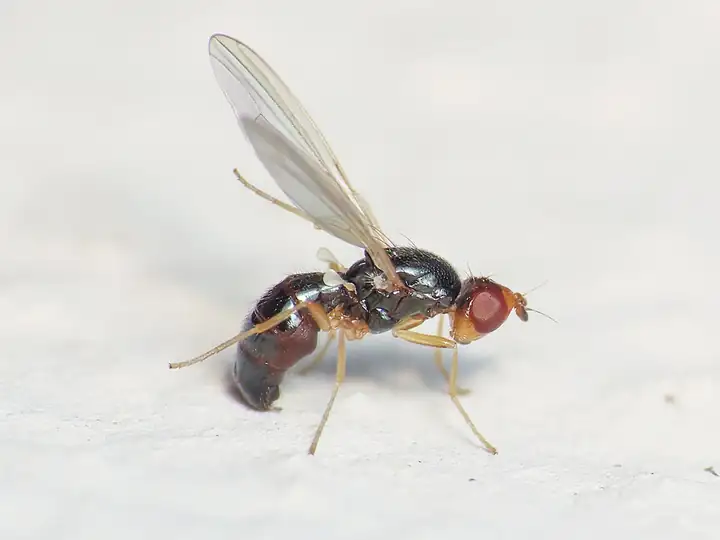
Carrot rust fly
Psila rosae
| Type | Insect |
|---|---|
| When | Spring through fall. |
| Pressure by region | High pressure: Pacific Northwest |
About
A small fly whose larvae tunnel into carrots and their relatives. It is named for the rust-colored droppings in its tunnels.
Spotting it
Damage
Roots are scarred with rusty brown tunnels, and damage builds through the season.
How to find it early
Set yellow sticky traps at the edge of the carrot bed, and pull a test carrot to check for rusty tunnels.
When
Spring through fall.
Life cycle
In the Pacific Northwest there are three generations a year: flies emerge from early April to mid-June, a second generation in mid-July to September, and the last overwinters in the soil. Larvae feed on root hairs for about two weeks, then tunnel into the roots for about two more before pupating.
What to do, gentlest first
Start at the top. Sprays are a last step; always read and follow the product label.
Time the sowing Prevent
In the Pacific Northwest, sow after mid-May (late May to early June is best) to miss the first generation, and harvest early or in blocks.
Rotate and clean up Prevent
Do not replant carrot-family crops where they were infested, grow resistant carrots such as 'Flyaway', remove infested roots, and till in fall or spring to expose pupae.
Yellow sticky traps By hand
Use traps at the bed edge to tell when flies are active.
Row cover sealed with soil Barrier
Cover beds right after sowing, bury all the edges in soil, and leave the cover on until harvest.
Few home options Conventional spray
Oregon State says available pesticides are unlikely to control large populations, and organic options such as spinosad, neem and pyrethrum remain largely untested in the Pacific Northwest, so rely on timing and covers.
Plants it goes after
Pressure by region
Washington State University says it thrives north of the 40th parallel, especially in the Northeast and on the West Coast. Other regions are rated low for lack of a source, so those ratings are estimates.
| Northeast | Moderate |
|---|---|
| Southeast | Low |
| South Central | Low |
| Midwest | Low |
| Great Plains | Low |
| Mountain West | Low |
| Southwest | Low |
| Pacific Northwest | High pressure |
| California | Low |
| Alaska | Low |
| Hawaii | Low |
Ratings come from extension sources where available; some are estimates, as noted above.
Sources
Photo: Photo: Emanuele Santarelli, CC BY-SA 4.0, via Wikimedia Commons (CC BY-SA 4.0). Photo resized for the web.

Planting dates and advice are general guidance; check with your local Cooperative Extension office for your area.