
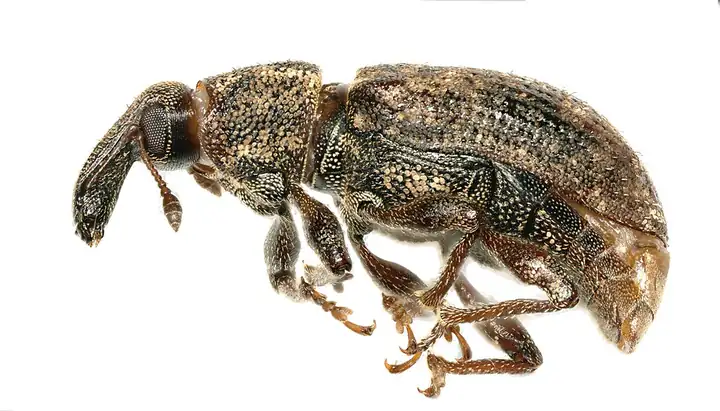
Carrot weevil
Listronotus oregonensis
| Type | Insect |
|---|---|
| When | Early spring through summer. |
| Pressure by region | Moderate: Northeast, Midwest |
About
A small, mottled brown snout beetle, about 1/4 inch (6 mm) long, native to North America. Its larvae tunnel into the roots and crowns of carrots, parsley and celery, and it is worst in the eastern US and the Great Lakes region (JIPM, Wisconsin).
Spotting it
Damage
Larvae tunnel through leaf stalks and crowns down into the root, so young plants wilt, yellow and die and older carrots are scarred and tunneled; losses can reach 70% in carrots and parsley. Adult feeding on leaves matters little (JIPM).
How to find it early
Adults are hard to find because they stay low and play dead. Look for small dark scars where eggs were sealed into leaf stalks, and for wilting seedlings. A trap baited with a whole carrot can catch adults early in the season (JIPM, Wisconsin).
When
Early spring through summer.
Life cycle
Adults spend winter in the topsoil of last year's planting or its weedy edges and come out in early spring; once plants have about four leaves, females lay eggs in small holes they chew in the leaf stalks. There are 1 or 2 generations a year in the north and 3 or 4 in the south (JIPM).
What to do, gentlest first
Start at the top. Sprays are a last step; always read and follow the product label.
Rotate far away and clean up Prevent
Plant carrots, parsley and celery as far as you can from last year's patch (JIPM suggests at least a quarter mile for farms), till in old crop residue, and clear weedy edges and wild carrot (Queen Anne's lace), where weevils spend winter (JIPM).
Floating row cover Barrier
Row covers cut damage by up to 75% in studies (JIPM).
Beneficial nematodes Natural enemies
Insect-killing nematodes, especially Heterorhabditis bacteriophora, are the most promising biological control (JIPM).
They cost more than sprays, and results vary.
Sprays for adults give limited control Conventional spray
Foliar insecticides aimed at adults, such as pyrethroids or malathion, have given only limited control (JIPM).
Pyrethroids and malathion are highly toxic to bees (PNW 591). Follow the label and its pre-harvest interval.
Plants it goes after
Pressure by region
JIPM names Ohio, New Jersey and Michigan as problem areas and says it was once a pest, but rarely is now, in Texas, Minnesota, Iowa, Wisconsin, southern Illinois, New York and Massachusetts. The sources found give no western records, so those ratings, like the others, are estimates.
| Northeast | Moderate |
|---|---|
| Southeast | Low |
| South Central | Low |
| Midwest | Moderate |
| Great Plains | Low |
| Mountain West | Low |
| Southwest | Low |
| Pacific Northwest | Low |
| California | Low |
| Alaska | Low |
| Hawaii | Low |
Ratings come from extension sources where available; some are estimates, as noted above.
Sources
Photo: Photo: Gagnonae / Wikimedia Commons, CC BY-SA 4.0 (CC BY-SA 4.0). Photo resized for the web.

Planting dates and advice are general guidance; check with your local Cooperative Extension office for your area.