
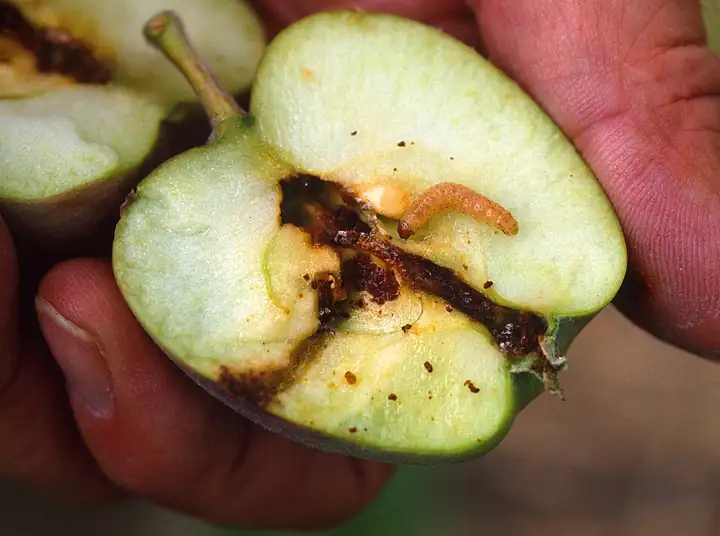
Codling moth
Cydia pomonella
| Type | Insect |
|---|---|
| Pressure by region | High pressure: California |
About
A small gray moth, about half to three-quarters of an inch long, with a coppery brown band at the wing tips. Its pinkish-white caterpillar is the classic 'worm in the apple.'
Spotting it
Damage
Caterpillars bore into the fruit and tunnel to the core, leaving reddish-brown droppings (frass) at the entry hole. Shallow 'stings' are spots where a young caterpillar started in and died. UC IPM says untreated trees can lose 20 to 90% of their fruit, depending on variety.
How to find it early
Starting six to eight weeks after bloom, look for tiny piles of frass on young fruit, and cut open dropped fruit. Pheromone traps hung before bloom show when moths are flying.
When
Spring through late summer; in Pennsylvania the first moth flight peaks about two weeks after full bloom.
Life cycle
Full-grown caterpillars spend winter in silken cocoons under loose bark or in soil and debris, then pupate and fly in spring. There are two to three generations a year in Pennsylvania and Utah and two to four in California.
What to do, gentlest first
Start at the top. Sprays are a last step; always read and follow the product label.
Clean up and thin fruit Prevent
Every week or two, pick off infested fruit and rake up drops, especially in May and June. Thin to one fruit per cluster so caterpillars have fewer hiding spots where fruits touch.
Put infested fruit in the trash, not the compost pile.
Bag the fruit Barrier
When fruits are half an inch to an inch across (4 to 6 weeks after bloom), slip a paper lunch bag with a 2-inch slit in the bottom over each one. UC IPM says bagging protects fruit without sprays even when infestations are heavy.
Pheromone traps for timing; cardboard bands Trap
Pheromone traps do not control the moth, but they show when to act. Corrugated cardboard bands around the trunk catch caterpillars looking for a place to spin cocoons; remove and destroy them on schedule (Penn State: put on in September, destroy in December).
UC IPM says banding catches only a small share of the moths and does not recommend it as a control. Mating-disruption dispensers do not work in home yards (UC IPM: under 5 acres; USU: under 10 acres) and can make damage worse.
Codling moth granulosis virus Natural enemies
This virus kills only codling moth caterpillars. Spray it weekly from egg hatch through the season; adding 1% horticultural oil can help (UC IPM).
It must be timed to egg hatch and needs good coverage. It does not affect other insects, people, pets or wildlife (UC IPM). Bt products have not worked against codling moth.
Spinosad, alone or with 1% oil Organic spray
Spray at egg hatch and repeat about every 10 days, about three sprays for the first generation (UC IPM). Adding 1% horticultural oil helps.
UC IPM says no more than six spinosad sprays a season. Spinosad is toxic to bees for a few hours to a day after spraying (PNW 591), so never spray during bloom or when bees are working. Follow the label and its pre-harvest interval.
Carbaryl or a pyrethroid, timed to egg hatch Conventional spray
These kill caterpillars only if they are on the fruit as the eggs hatch, so time sprays with trap catches and degree-days or your Extension office's alerts.
Carbaryl and pyrethroids are highly toxic to bees (PNW 591); never spray during bloom or when bees are present. More than one carbaryl spray a season can set off a spider mite outbreak (UC IPM). Carbaryl has been a restricted-use pesticide in California since August 1, 2020 (UC IPM), so California home gardeners cannot buy it without an applicator license. Follow the label and pre-harvest interval.
Garden friends that go after it
Trichogramma wasps
Protect these helpers: skip broad sprays when they're around.
Plants it goes after
Pressure by region
Sources found cover Pennsylvania (Penn State), Utah (USU) and California (UC IPM), where it is rated high because untreated trees can lose most of their fruit. Warmer areas get more generations: southern Utah often has a third one that northern Utah does not. Ratings for the other regions, including Alaska and Hawaii, are estimates.
| Northeast | Moderate |
|---|---|
| Southeast | Moderate |
| South Central | Moderate |
| Midwest | Moderate |
| Great Plains | Moderate |
| Mountain West | Moderate |
| Southwest | Moderate |
| Pacific Northwest | Moderate |
| California | High pressure |
| Alaska | Low |
| Hawaii | Low |
Ratings come from extension sources where available; some are estimates, as noted above.
Sources
Photo: Photo: Doug Wilson, USDA ARS, Public domain (USDA ARS), via Wikimedia Commons. Photo resized for the web.

Planting dates and advice are general guidance; check with your local Cooperative Extension office for your area.