
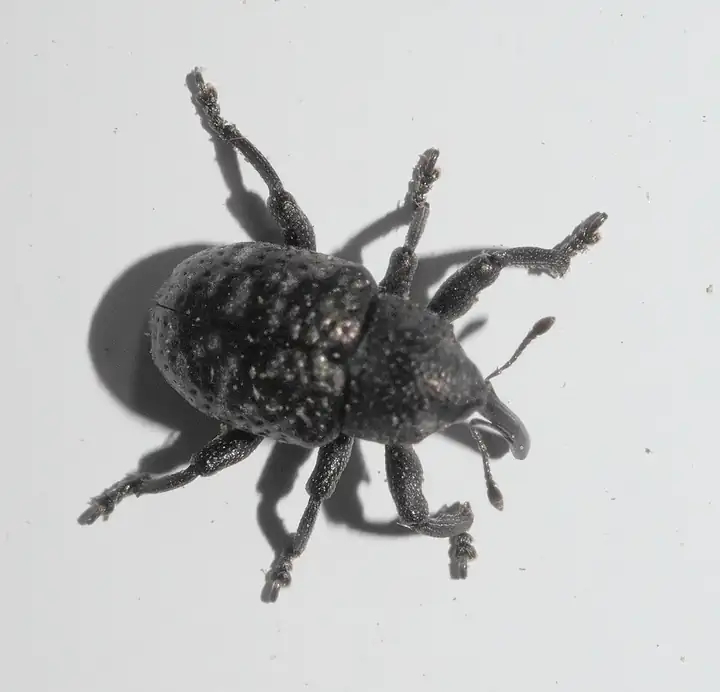
Cowpea curculio
Chalcodermus aeneus
| Type | Insect |
|---|---|
| Pressure by region | High pressure: Southeast, South Central |
About
A shiny, black, hump-backed snout beetle about a quarter inch long. Clemson calls it the most destructive insect pest of southern peas in South Carolina.
Spotting it
Damage
Adults chew small holes in the pods and lay eggs inside, leaving raised, wart-like spots on the hull. The grubs eat the peas, leaving dark, sunken spots and 'wormy' seeds, and unchecked infestations can cut yields by half or more (Alabama Extension).
How to find it early
From bloom on, hold a tray or sheet under plants and shake them; the beetles play dead and drop (UF). Check pods for small wart-like spots, starting at the garden edges.
When
Spring through summer; adults reach peas by mid-May in Georgia and can be active as early as April 10 in south Georgia.
Life cycle
Adults spend winter in crop debris and weeds near the garden and move into peas in spring (Clemson, UGA). A generation takes about 30 to 40 days, and grubs pupate 1 to 3 inches deep in the soil (UGA, UF). There are two generations a year in Alabama and South Carolina but only one in Virginia (UF, Clemson).
What to do, gentlest first
Start at the top. Sprays are a last step; always read and follow the product label.
Clean up, rotate and pick tougher varieties Prevent
Rotate crops, control weeds, and till and clean up in fall to destroy pupae in the soil (Alabama Extension). Don't plant southern peas next to early beans (UGA). 'White Acre' has held up better than 'Pinkeye Purple Hull' (Alabama Extension).
Spinosad, started at bloom Organic spray
Clemson says a preventive spray program is the only practical control. Start at first bloom (or when pods are half an inch long) and repeat every 5 to 7 days.
Spinosad is toxic to bees for about 3 hours to a day (PNW 591), so spray late in the day after bees stop flying (Mississippi State). Read and follow the label and observe the pre-harvest interval; Clemson lists 3 days.
Carbaryl, malathion or a pyrethroid Conventional spray
Mississippi State lists carbaryl, malathion, bifenthrin and zeta-cypermethrin products labeled for home gardens, as three sprays 5 days apart starting at first bloom. Pyrethroids may not work well, because many curculios now resist them (UGA, Alabama Extension).
All of these are highly toxic to bees (PNW 591); spray after sunset (Mississippi State). Carbaryl has been a restricted-use pesticide in California since August 1, 2020 (UC IPM). Read and follow the label and observe the pre-harvest interval; Clemson lists 3 days for bifenthrin and carbaryl.
Plants it goes after
Pressure by region
It is a pest throughout the Southeast (UGA) and attacks southern peas all across Oklahoma; Alabama Extension says it is worst where most southern peas are grown. Ratings outside the Southeast and South Central regions are estimates.
| Northeast | Low |
|---|---|
| Southeast | High pressure |
| South Central | High pressure |
| Midwest | Low |
| Great Plains | Low |
| Mountain West | Low |
| Southwest | Low |
| Pacific Northwest | Low |
| California | Low |
| Alaska | Low |
| Hawaii | Low |
Ratings come from extension sources where available; some are estimates, as noted above.
Sources
- hgic.clemson.edu
- fieldreport.caes.uga.edu
- aces.edu
- extension.msstate.edu
- extension.okstate.edu
- uaex.uada.edu
- ipm.ucanr.edu
- s3.wp.wsu.edu
- ask.ifas.ufl.edu
Photo: Photo: Robert Webster, CC BY-SA 4.0, via Wikimedia Commons (CC BY-SA 4.0). Photo resized for the web.

Planting dates and advice are general guidance; check with your local Cooperative Extension office for your area.