
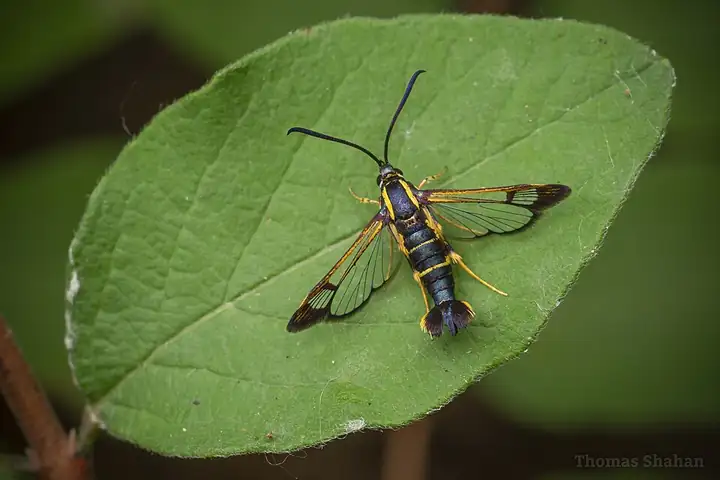
Dogwood borer
Synanthedon scitula
| Type | Insect |
|---|---|
| When | Moths fly late spring through September; larvae are under the bark all year. |
| Pressure by region | Moderate: Northeast, Southeast, South Central, Midwest |
About
The larva of a small clearwing moth that tunnels in the inner bark of flowering dogwood and other trees, including apple, flowering cherry, oak, birch and blueberry (UMass). The larvae can't chew into healthy bark, so they get in through wounds, cracks and branch crotches; kousa dogwood seems to resist it.
Spotting it
Damage
Larvae make winding tunnels under the bark and push out coarse, brown, sawdust-like frass. Bark loosens and cracks, the area can swell into knotty, callused bumps, and branches die back; heavily infested older trees can hang on for years (UMass).
How to find it early
Check trunks, especially mower and string-trimmer scars, bark cracks and branch crotches, for brown frass and loose bark. Empty pupal skins may stick out of the bark after moths come out (UMass).
When
Moths fly late spring through September; larvae are under the bark all year.
Life cycle
Usually one generation a year, though it may take two years in cold areas and more than one generation in warm ones. Adults start flying when dogwood flowers drop and keep flying into September; females lay eggs on wounded bark, and the larvae crawl around to find a way in (UMass).
What to do, gentlest first
Start at the top. Sprays are a last step; always read and follow the product label.
Avoid wounds Prevent
Keep mowers and trimmers away with a mulch ring, don't prune while moths are flying, and keep trees vigorous. Where the borer is common, consider kousa dogwood (UMass).
Vinyl tree wraps on young dogwoods have been reported to increase infestations (UMass).
Cover fresh wounds Barrier
Painting fresh bark wounds with white latex paint has been suggested to keep egg-laying moths away (UMass).
Beneficial nematodes Natural enemies
Insect-attacking nematodes sprayed into infested bark have given very good results; choose a species labeled for dogwood borer and water it in (UMass).
Nematodes are living and need careful storage and handling (UMass).
Trunk spray when moths fly Conventional spray
Contact sprays go on the trunk and lower branches to hit egg-laying moths; New York reports suggest spraying about 10 days after the first moth is caught in a pheromone trap. Active ingredients include chlorantraniliprole, bifenthrin and permethrin (UMass).
Spray after dogwood bloom and when bees are not active (UMass); bifenthrin is highly toxic to bees (PNW 591). Follow the label.
Plants it goes after
Apple (backyard tree), Blueberry, Flowering cherry, Flowering dogwood, Oaks (white, red and pin oak), Red twig dogwood
Pressure by region
Ratings are estimates based on where flowering dogwood is commonly grown.
| Northeast | Moderate |
|---|---|
| Southeast | Moderate |
| South Central | Moderate |
| Midwest | Moderate |
| Great Plains | Low |
| Mountain West | Low |
| Southwest | Low |
| Pacific Northwest | Low |
| California | Low |
| Alaska | Low |
| Hawaii | Low |
Ratings come from extension sources where available; some are estimates, as noted above.
Sources
Photo: Photo: Thomas Shahan / Wikimedia Commons, CC BY 2.0 (CC BY 2.0). Photo resized for the web.

Planting dates and advice are general guidance; check with your local Cooperative Extension office for your area.