
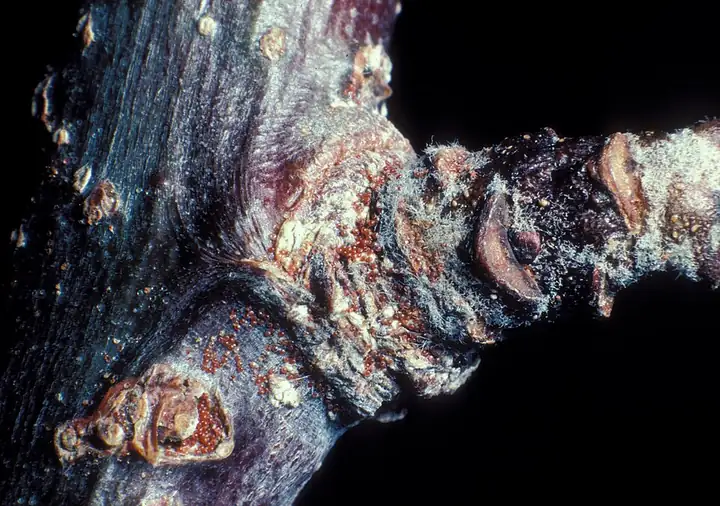
European red mite
Panonychus ulmi
| Type | Mite |
|---|---|
| When | Eggs hatch around bloom; mites build up from late spring through summer |
| Pressure by region | High pressure: Northeast |
About
A tiny red spider mite, less than 1/60 inch long, that came from Europe to the Pacific Northwest in the early 1900s and has spread across the U.S. and Canada. It feeds on the leaves of apple, pear and stone fruit and, unlike the twospotted spider mite, spins little webbing.
Spotting it
Damage
Feeding leaves fine pale speckles and then a bronze cast on the leaves. Heavy infestations burn leaves, cause early leaf drop, shrink fruit and weaken the tree. Early summer damage matters most, because that's when trees form next year's fruit buds.
How to find it early
From late fall to early spring, use a hand lens to look for red eggs around buds and spurs. After petal fall, check the undersides of leaves; UMass uses an average of 1 to 2 mites per leaf in May and June as the point to act in orchards.
When
Eggs hatch around bloom; mites build up from late spring through summer
Life cycle
Winter is spent as tiny, ridged red eggs on twigs and spurs that look like paprika sprinkled on the bark. They hatch between the tight-cluster stage and petal fall; a generation takes 10 to 25 days depending on heat, so 5 to 10 overlapping generations can pile up in a season.
What to do, gentlest first
Start at the top. Sprays are a last step; always read and follow the product label.
Spare the predators Prevent
Avoid pyrethroid, organophosphate and carbamate sprays, which kill the predatory mites that keep red mites in check.
Predatory mites and mite-eating lady beetles Natural enemies
Predatory mites such as Typhlodromus pyri, plus tiny Stethorus lady beetles, lacewings and minute pirate bugs, eat red mites. About 1 predator for every 10 pest mites can keep them in balance.
Utah State says predators are less dependable against European red mite than against webspinning spider mites, so keep checking.
Delayed-dormant oil Organic spray
Spray dormant horticultural oil between the half-inch green and tight-cluster stages to smother overwintering eggs. Utah State calls this the most important step.
Oil is briefly toxic to bees (under 3 hours), but this spray goes on before bloom. Read and follow the label.
Summer oil or insecticidal soap Organic spray
If mites build up in summer, spray summer-weight horticultural oil or insecticidal soap, covering leaf undersides. Check again a week later; a second spray 7 to 10 days after the first may be needed.
Oil is toxic to bees for under 3 hours, so spray when bees are not active. Read and follow the label and the pre-harvest interval.
Miticides (commercial orchards only) Conventional spray
Utah State lists miticides such as hexythiazox and clofentezine for commercial orchards, but marks none of them as available to home gardeners. On home trees, stick with oil and insecticidal soap.
Abamectin, another commercial miticide, is highly toxic to bees. Read and follow the label of any product you use.
Garden friends that go after it
Crab spiders (flower spiders), Predatory mites
Protect these helpers: skip broad sprays when they're around.
Plants it goes after
Almond, Apple (backyard tree), Cherry (sweet and tart), Peach, Pear, Plum
Pressure by region
Utah State says it has spread throughout the U.S. and Canada but outbreaks are sporadic in Utah, and Minnesota Extension calls it an occasional pest. Ratings other than the Northeast, Midwest and mountain regions are estimates, as are Alaska and Hawaii.
| Northeast | High pressure |
|---|---|
| Southeast | Moderate |
| South Central | Low |
| Midwest | Moderate |
| Great Plains | Low |
| Mountain West | Low |
| Southwest | Low |
| Pacific Northwest | Moderate |
| California | Moderate |
| Alaska | Low |
| Hawaii | Low |
Ratings come from extension sources where available; some are estimates, as noted above.
Sources
Photo: Photo: University of Georgia Plant Pathology Archive, University of Georgia, Bugwood.org, CC BY 3.0 US, via Wikimedia Commons (CC BY 3.0 US). Photo resized for the web.

Planting dates and advice are general guidance; check with your local Cooperative Extension office for your area.