
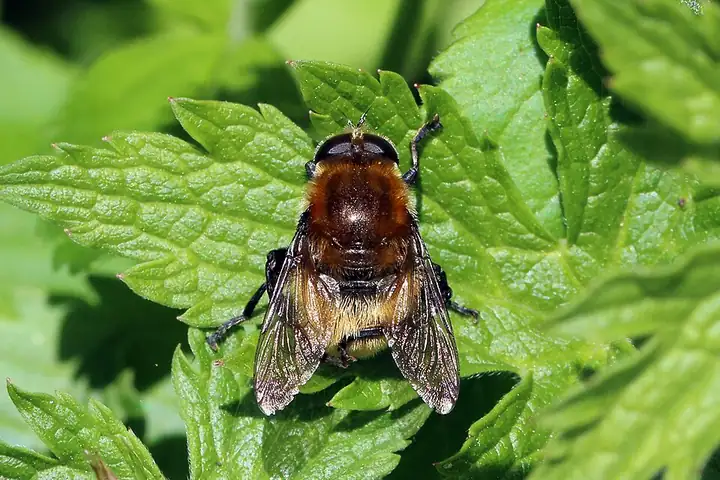
Narcissus bulb fly
Merodon equestris
| Type | Insect |
|---|---|
| When | Adults fly from late April through June; damage shows the following spring. |
| Pressure by region | Moderate: Pacific Northwest, California |
About
A hairy black, yellow and orange fly about 1/2 inch long that looks like a small bumble bee (Colorado State, PNW Handbook). Its dirty-white maggot, up to 3/4 inch long, hollows out daffodil bulbs from the inside.
Spotting it
Damage
Infested bulbs feel soft or spongy and rot into a brown mass. Plants come up yellow and stunted with few leaves, and the flower bud for next spring is destroyed (UMD, PNW Handbook, UC IPM). Usually only one maggot develops in each bulb (UMD).
How to find it early
Squeeze bulbs when you plant or divide them and throw out any that are soft. In spring, dig and check clumps that come up weak, yellow or stunted (UMD, UC IPM).
When
Adults fly from late April through June; damage shows the following spring.
Life cycle
There is one generation a year. Adults fly from late April through June and lay eggs on or near the bulbs; the maggot tunnels in at the base, spends winter full-grown in the bulb, and leaves it to pupate in the soil (Colorado State, PNW Handbook, UMD).
What to do, gentlest first
Start at the top. Sprays are a last step; always read and follow the product label.
Plant only firm bulbs Prevent
Buy and plant only firm, pest-free bulbs, and handle them gently to avoid injury (UC IPM, PNW Handbook).
Plant deep in breezy spots Prevent
The PNW Handbook suggests planting bulbs deep, about 10 inches, in open areas exposed to wind.
Destroy soft bulbs By hand
Dig and destroy soft or rotting bulbs so the maggots inside cannot become adults (UMD, PNW Handbook). To clean bulbs you keep, soak them in water held at 110 to 111°F for 40 minutes (NC State, Clemson).
Clemson warns that water hotter than about 111°F can damage the bulbs, so use a thermometer.
Row cover after bloom Barrier
Cover the planting with row cover after bloom to keep females from laying eggs (PNW Handbook).
Beneficial nematodes Natural enemies
Colorado State suggests a soil drench of insect-killing nematodes, especially Steinernema feltiae.
Colorado State notes this has not been tested against this fly.
Insecticide at the base of plants Conventional spray
NC State suggests spraying the base of the bulb plants as the leaves die down in spring, using an insecticide labeled for home landscapes. The PNW Handbook lists cyfluthrin, a pyrethroid, sprayed at the base of plants while adults fly (early May to June).
Pyrethroids such as cyfluthrin are highly toxic to bees for more than a day (PNW 591), so keep sprays off open flowers and spray when bees are not flying. Colorado State notes little recent research on controlling this fly. Read and follow the label, and make sure it lists home landscapes.
Plants it goes after
Amaryllis, Daffodil, Hyacinth, Iris, Lily (Lilium), Snowdrop, Tulip
Pressure by region
An introduced fly that moves into new areas in infested bulbs. Colorado State says it is spotty there but could settle almost anywhere except high, cool sites, and NC State reports it in North Carolina and Virginia. Sources also cover the Pacific Northwest, California and Maryland. All ratings are estimates.
| Northeast | Low |
|---|---|
| Southeast | Low |
| South Central | Low |
| Midwest | Low |
| Great Plains | Low |
| Mountain West | Low |
| Southwest | Low |
| Pacific Northwest | Moderate |
| California | Moderate |
| Alaska | Low |
| Hawaii | Low |
Ratings come from extension sources where available; some are estimates, as noted above.
Sources
- webdoc.agsci.colostate.edu
- pnwhandbooks.org
- ipm.ucanr.edu
- extension.umd.edu
- s3.wp.wsu.edu
- content.ces.ncsu.edu
- hgic.clemson.edu
Photo: Photo: Charles J. Sharp, CC BY-SA 4.0, via Wikimedia Commons (CC BY-SA 4.0). Photo resized for the web.

Planting dates and advice are general guidance; check with your local Cooperative Extension office for your area.