
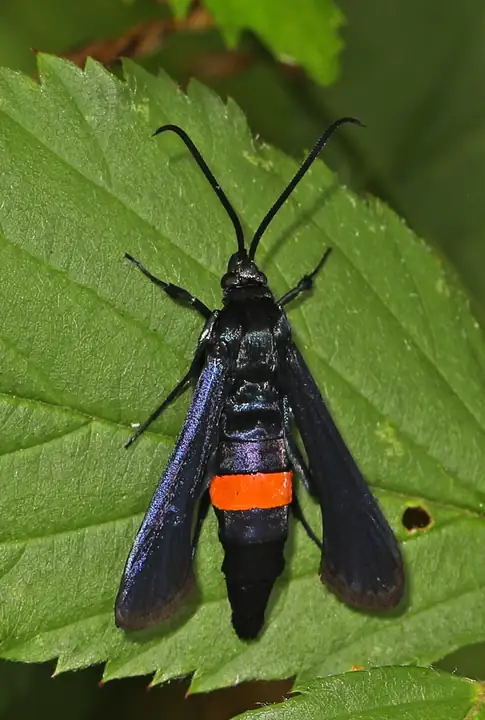
Peachtree borer
Synanthedon exitiosa (a related species, the lesser peachtree borer, S. pictipes, attacks higher on the trunk and limbs)
| Type | Insect |
|---|---|
| When | Caterpillars feed spring through fall; moths fly in summer. |
| Pressure by region | Moderate: Northeast, Southeast, South Central, Midwest, California |
About
A wasp-like clearwing moth whose white, brown-headed caterpillar, up to 1.5 inches long, tunnels in the bark at the base of the trunk. It is a serious pest of peach and nectarine and also attacks other stone fruits.
Spotting it
Damage
A mass of gum mixed with sawdust-like frass oozes from the trunk from a few inches below the soil to about a foot above it. Tunneling can girdle and kill young trees; heavily hit older trees look pale and wilted.
How to find it early
Check the base of the trunk in spring and fall for gummy ooze with reddish-brown frass, pulling mulch back to look.
When
Caterpillars feed spring through fall; moths fly in summer.
Life cycle
Caterpillars spend winter in the trunk, resume feeding in spring and pupate in late spring or summer. Moths lay eggs on the lower trunk or nearby soil in summer (July to August in Pennsylvania, peaking mid- to late August in South Carolina); there is one generation a year.
What to do, gentlest first
Start at the top. Sprays are a last step; always read and follow the product label.
Keep trees vigorous and the trunk base clear Prevent
Stressed trees (drought, winter injury, bark wounds) are most likely to be attacked. Keep mulch, weeds and debris several inches away from the trunk so you can inspect it and eggs dry out (UC IPM).
Dig out and stab the borers By hand
Pull back about 2 inches of soil, follow the gummy holes, and run a stiff wire into each tunnel to kill the caterpillar. Check again later in the season.
Work carefully to avoid more bark damage.
Beneficial nematodes into the tunnels Natural enemies
In mid to late summer, squirt Steinernema carpocapsae or S. feltiae nematodes into the tunnel openings; UC IPM suggests two applications 1 to 2 weeks apart.
Nematodes are living organisms; follow the storage and watering directions.
Trunk spray of permethrin or esfenvalerate Conventional spray
A bark spray from the lowest limbs down to the soil, timed to moth flight and egg hatch (August in South Carolina; UC IPM suggests early May and mid-July in California, timed by pheromone traps).
UC IPM says trunk sprays for this pest are for professional applicators in California. Pyrethroids are highly toxic to bees (PNW 591); keep spray off blooms and flowering ground cover. Follow the label.
Plants it goes after
Almond, Apricot, Cherry (sweet and tart), Peach, Plum, Serviceberry (juneberry, saskatoon)
Pressure by region
Sourced for Pennsylvania, South Carolina and California. South Central and Midwest ratings, and the low ratings elsewhere, are estimates.
| Northeast | Moderate |
|---|---|
| Southeast | Moderate |
| South Central | Moderate |
| Midwest | Moderate |
| Great Plains | Low |
| Mountain West | Low |
| Southwest | Low |
| Pacific Northwest | Low |
| California | Moderate |
| Alaska | Low |
| Hawaii | Low |
Ratings come from extension sources where available; some are estimates, as noted above.
Sources
Photo: Photo: Judy Gallagher, CC BY 2.0, via Wikimedia Commons (CC BY 2.0). Photo resized for the web.

Planting dates and advice are general guidance; check with your local Cooperative Extension office for your area.