
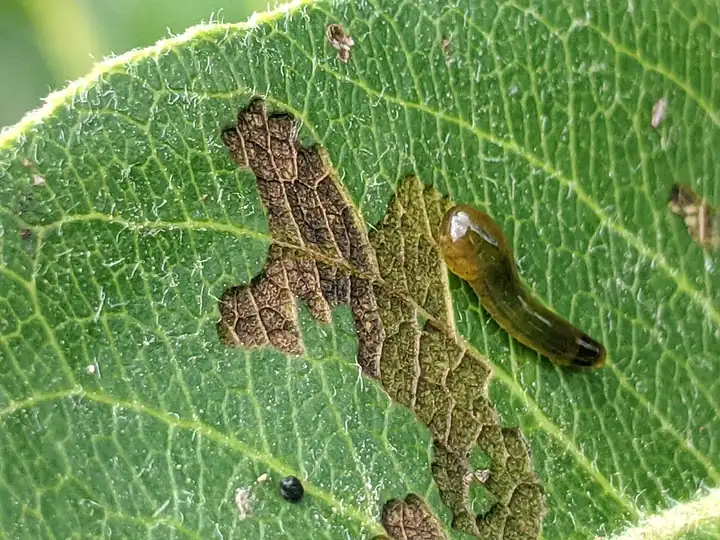
Pear sawfly (pearslug, cherry slug)
Caliroa cerasi
| Type | Insect |
|---|---|
| When | Late spring, then again in mid to late summer |
| Pressure by region | Moderate: Northeast, Midwest, Great Plains, Mountain West, Pacific Northwest, California |
About
A small, glossy black sawfly whose larvae look like tiny, slimy, olive-green slugs. They aren't slugs or caterpillars, and they skeletonize the leaves of cherry, pear and plum trees.
Spotting it
Damage
Larvae eat the upper surface of leaves between the veins, leaving lacy brown or gray patches. Badly hit leaves brown, shrivel and drop. Wisconsin calls the damage mostly cosmetic, but UC IPM says heavy feeding can mean smaller or fewer fruit that season and the next.
How to find it early
Check the tops of cherry and pear leaves for shiny, dark, slug-like larvae up to 3/8 inch long and lacy brown feeding spots, especially in late summer.
When
Late spring, then again in mid to late summer
Life cycle
There are two generations a year. The insects spend winter in cocoons 2 to 3 inches deep in the soil; adults come out in spring and lay eggs in leaves that hatch in 10 to 15 days, and larvae feed for 2 to 4 weeks before dropping to the soil. The second generation, in late summer, usually does more damage.
What to do, gentlest first
Start at the top. Sprays are a last step; always read and follow the product label.
Pick, hose or dust them off By hand
Pick larvae off by hand or knock them off with a strong spray of water. Montana State says wood ash or dry dirt tossed on the larvae dries them out.
Let natural enemies work Natural enemies
UC IPM says natural enemies often keep pear sawfly in check, so skip broad-spectrum sprays.
Bt (Bacillus thuringiensis) does not work, because sawfly larvae are not caterpillars.
Insecticidal soap, oil, neem, kaolin clay or spinosad Organic spray
Insecticidal soap, horticultural (narrow-range) oil, neem oil and spinosad all control the larvae. Kaolin clay sprayed on leaves helps keep them away.
Spinosad is toxic to bees for about 3 hours to a day, and oil and neem for up to about 2 to 3 hours, so don't spray plants in bloom or when bees are active. Read and follow the label and the pre-harvest interval on fruit trees.
Broad-spectrum insecticides (not recommended) Conventional spray
Pyrethroids and other broad-spectrum insecticides kill sawfly larvae, but UC IPM advises against them because they also kill beneficial insects and harm aquatic life.
Pyrethroids are highly toxic to bees. If you use one, read and follow the label and the pre-harvest interval.
Plants it goes after
Apple (backyard tree), Cherry (sweet and tart), Pear, Plum, Serviceberry (juneberry, saskatoon)
Pressure by region
Sources found cover California (mainly coastal and northern areas), the Pacific Northwest, Montana, Wisconsin and North Carolina. Ratings for the other regions, including Alaska and Hawaii, are estimates.
| Northeast | Moderate |
|---|---|
| Southeast | Low |
| South Central | Low |
| Midwest | Moderate |
| Great Plains | Moderate |
| Mountain West | Moderate |
| Southwest | Low |
| Pacific Northwest | Moderate |
| California | Moderate |
| Alaska | Low |
| Hawaii | Low |
Ratings come from extension sources where available; some are estimates, as noted above.
Sources
- ipm.ucanr.edu
- hort.extension.wisc.edu
- urbanipm.montana.edu
- content.ces.ncsu.edu
- pnwhandbooks.org
- s3.wp.wsu.edu
Photo: Photo: Rbreidbrown, CC BY-SA 4.0, via Wikimedia Commons (CC BY-SA 4.0). Photo resized for the web.

Planting dates and advice are general guidance; check with your local Cooperative Extension office for your area.