
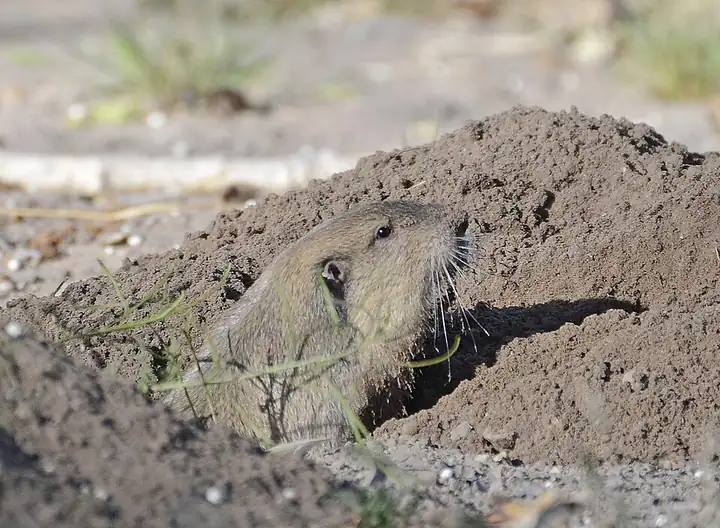
Pocket gophers
Pocket gophers (family Geomyidae), such as Botta's and northern pocket gophers (Thomomys) and plains and southeastern pocket gophers (Geomys)
| Type | Animal |
|---|---|
| Pressure by region | High pressure: California |
About
Burrowing rodents about 6 to 10 inches long that live almost entirely underground and eat roots. One gopher can push up several mounds a day and pull whole plants down into its tunnel.
Spotting it
Damage
Plants wilt or vanish as roots are eaten from below, and some are pulled straight down into the tunnel; they also chew drip lines. Gopher mounds are crescent or horseshoe shaped with a plugged hole off to one side, while mole mounds are round and volcano-shaped with the plug in the middle.
How to find it early
Look for fresh crescent-shaped mounds of loose soil, and for plants that suddenly wilt or disappear.
When
Year-round; mounding is heaviest in winter and spring where soil is not irrigated, and can happen any time in watered gardens.
Life cycle
Gophers live alone and do not hibernate. Where soil is not watered they have one litter a year in late winter or spring, but in irrigated ground they can have up to three litters of about five or six young.
What to do, gentlest first
Start at the top. Sprays are a last step; always read and follow the product label.
Wire-bottomed raised beds Prevent
When you build raised beds, lay wire mesh under the soil so gophers cannot tunnel up into them.
Wire baskets and buried fence Barrier
Set shrubs, trees and vines in wire baskets of light 3/4-inch non-galvanized wire when you plant; it rusts away before it can strangle roots. To guard an area, bury 1/2- to 3/4-inch mesh at least 2 feet deep, with 6 more inches bent at a right angle at the bottom and 1 foot above ground.
Tunnel traps Trap
Probe 4 to 12 inches out from the plugged side of a fresh mound to find the tunnel, then set pincer or box traps in pairs facing each other. Pocket gophers generally are not protected by law, but check your state's rules.
Keep children and pets away from set traps. This guide does not recommend poison baits, which put pets and wildlife at risk. Trapping and relocating wildlife is regulated by state law, and the rules differ from state to state. Check with your state wildlife agency before you set a trap.
Skip plant and gadget repellents Repellent
Gopher purge, castor bean and garlic have not been shown to repel gophers, and vibrating stakes, ultrasonic devices and pinwheels have not proven effective.
Predators Natural enemies
Owls, snakes, cats, dogs and coyotes eat gophers but rarely get them all, and owl boxes are not reliable for a small garden.
Plants it goes after
Pressure by region
Northern and Botta's pocket gophers cover most of the West, plains pocket gophers range from Canada south through Texas and Louisiana, and southeastern pocket gophers live in northern and central Florida, southern Georgia and southeastern Alabama (ICWDM). California is rated high because UC IPM reports densities of 60 or more per acre in irrigated fields and vineyards; other ratings are estimates, and regions outside these ranges are rated low, not absent.
| Northeast | Low |
|---|---|
| Southeast | Low |
| South Central | Moderate |
| Midwest | Low |
| Great Plains | Moderate |
| Mountain West | Moderate |
| Southwest | Moderate |
| Pacific Northwest | Moderate |
| California | High pressure |
| Alaska | Low |
| Hawaii | Low |
Ratings come from extension sources where available; some are estimates, as noted above.
Sources
Photo: Photo: VJAnderson, CC BY-SA 4.0, via Wikimedia Commons (CC BY-SA 4.0). Photo resized for the web.

Planting dates and advice are general guidance; check with your local Cooperative Extension office for your area.