
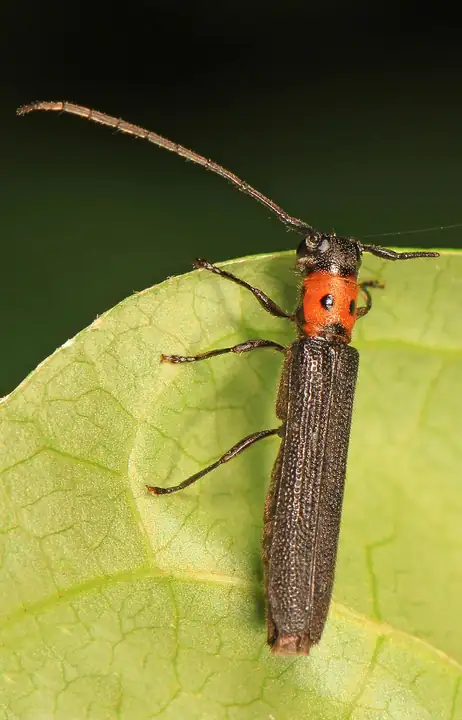
Raspberry cane borer
Oberea perspicillata
| Type | Insect |
|---|---|
| When | Early to midsummer (wilted tips); larvae feed inside canes year-round. |
| Pressure by region | Low: all regions |
About
A long, slender black beetle with a patch of yellow behind its head. Its larva tunnels down raspberry canes over two years.
Spotting it
Damage
New cane tips suddenly wilt in early summer. Look just below the wilt for two rings of punctures about half an inch apart; below them the cane is hollowed out.
How to find it early
From mid-June to mid-July, look for wilted, drooping cane tips and the telltale double ring of punctures.
When
Early to midsummer (wilted tips); larvae feed inside canes year-round.
Life cycle
In late June and early July, females girdle a new cane with two rings of punctures 4 to 6 inches below the tip and lay an egg there. The larva tunnels down the cane its first year and into the crown the second, so the life cycle takes two years.
What to do, gentlest first
Start at the top. Sprays are a last step; always read and follow the product label.
Cut out wilted tips below the rings By hand
During the season, cut infested canes at least 2 inches below the lower ring of punctures, before the larva moves down. In fall, cut a few inches below the holes or remove the whole cane.
Destroy the cuttings or take them out of the garden; do not leave them in the patch.
Usually not needed Conventional spray
UMN says the damage rarely justifies spraying; pruning is the main control.
Plants it goes after
Black raspberry (blackcap), Dewberry, Raspberry, Salmonberry
Pressure by region
UMN calls it an occasional pest in Minnesota. No other regional source was found, so every rating except the Midwest's is an estimate.
| Northeast | Low |
|---|---|
| Southeast | Low |
| South Central | Low |
| Midwest | Low |
| Great Plains | Low |
| Mountain West | Low |
| Southwest | Low |
| Pacific Northwest | Low |
| California | Low |
| Alaska | Low |
| Hawaii | Low |
Ratings come from extension sources where available; some are estimates, as noted above.
Sources
Photo: Photo: Judy Gallagher, CC BY 2.0, via Wikimedia Commons (CC BY 2.0). Photo resized for the web.

Planting dates and advice are general guidance; check with your local Cooperative Extension office for your area.