
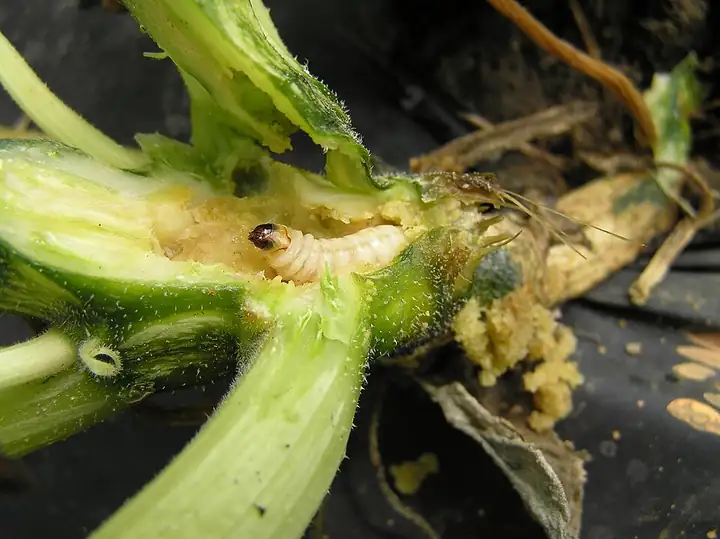
Squash vine borer
Melittia cucurbitae
| Type | Insect |
|---|---|
| When | Early to late summer. |
| Pressure by region | High pressure: Northeast, Southeast, Midwest |
About
The adult is a day-flying moth that looks like a wasp, with an orange abdomen and metallic green front wings. Its cream-colored larva tunnels inside squash stems.
Spotting it
Damage
A healthy vine suddenly wilts, and a hole at the stem base leaks sawdust-like frass. Summer squash and pumpkins suffer most; cucumbers, melons and watermelons are usually not attacked.
How to find it early
Watch for the orange moths and their loud buzz, catch them in yellow bowls of soapy water, and check stem bases for small holes and frass.
When
Early to late summer.
Life cycle
Larvae overwinter in the soil. In the North moths emerge once, in late June to early July, and larvae feed in stems for four to six weeks; farther south there are often two flights from May into September or mid-October.
What to do, gentlest first
Start at the top. Sprays are a last step; always read and follow the product label.
Grow butternut Prevent
Butternut squash (Cucurbita moschata) suffers less than acorn, Hubbard or zucchini.
Plant late and rotate Prevent
In the North, sowing susceptible squash in early July lets it grow after egg-laying ends. Move squash to a new spot each year.
Blue Hubbard trap crop Prevent
A border of Blue Hubbard squash cut infestations in the main crop by 88 percent in one study.
Stem surgery By hand
If a vine wilts, slit the stem lengthwise with a sharp knife, kill the borer, then mound moist soil over the wound so it roots again.
Floating row cover Barrier
Cover plants from late June, seal the edges, and remove the cover when flowers open.
Bt or beneficial nematodes Natural enemies
Bt sprayed on the stems worked about as well as the standard insecticide in trials, and was easier than injecting stems. Beneficial nematodes also help.
Results are mixed: UMN says Bt is not effective against squash vine borer, while trials reviewed by Texas A&M found Bt sprayed on stems worked about as well as the old standard insecticide. In field tests nematodes never killed more than about 40 percent of larvae.
Stem-base sprays Conventional spray
Carbaryl or a pyrethroid (permethrin, bifenthrin, esfenvalerate) applied to the base of stems every 7 to 10 days from late June.
Carbaryl and pyrethroids are highly toxic to bees (PNW 591); spray stem bases, not open flowers, late in the day. Carbaryl has been a restricted-use material in California since August 1, 2020 (UC IPM), so home gardeners there cannot buy it. Follow the label and pre-harvest interval.
Plants it goes after
Cantaloupe (muskmelon), Winter squash and pumpkin, Zucchini and summer squash
Pressure by region
Found in the U.S. and Canada east of the Rocky Mountains (Texas A&M); western regions, Alaska and Hawaii are rated low rather than absent because no source states it is absent there; those ratings are estimates. South Central and Great Plains are rated moderate, not high, for lack of a regional severity source.
| Northeast | High pressure |
|---|---|
| Southeast | High pressure |
| South Central | Moderate |
| Midwest | High pressure |
| Great Plains | Moderate |
| Mountain West | Low |
| Southwest | Low |
| Pacific Northwest | Low |
| California | Low |
| Alaska | Low |
| Hawaii | Low |
Ratings come from extension sources where available; some are estimates, as noted above.
Sources
Photo: Photo: Abby Seaman, NYS IPM Program at Cornell University, CC BY-SA 2.0, via Wikimedia Commons (CC BY-SA 2.0). Photo resized for the web.

Planting dates and advice are general guidance; check with your local Cooperative Extension office for your area.