
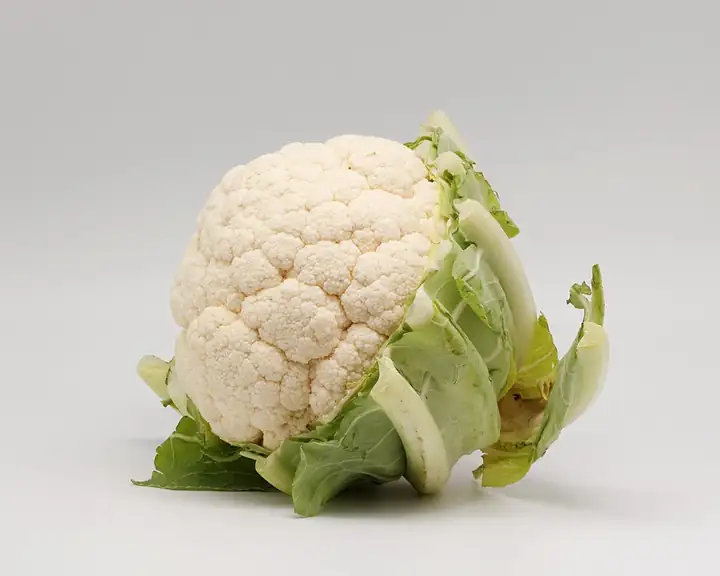
Cauliflower
Brassica oleracea var. botrytis · Cabbage family (Brassicaceae)
| Hardiness zones | 2 to 11 |
|---|---|
| Sun | full sun |
| Water | moderate |
| Life cycle | annual |
| Frost | Half-hardy: takes a light frost |
| Soil pH | 6.0–7.0 |
| Spacing | 18 to 24 inches |
| Days to harvest | 50 to 80 days |
| Soil temperature to plant | at least 40°F |
About Cauliflower
Cauliflower is a cabbage-family crop grown for its dense white (or orange, green or purple) head of flower buds. It is fussier than its relatives: it needs steady moisture and mild temperatures, but a well-timed crop is a real treat.
Grown as a cool-season annual in every zone; time it for the cool weather of spring or fall. It is more sensitive to cold than cabbage, and hot nights (above about 77F) can keep heads from forming.
When to plant
Timing is counted from your average last spring frost (and first fall frost). Sow & Tell works out the actual dates for your ZIP code.
- Start seeds indoors: 4 to 8 weeks before the last frost
- Set out plants: up to 2 weeks before the last frost
- Fall planting: 9 to 10 weeks before the first fall frost
Days count from setting out transplants: about 50 to 60 for spring varieties and up to 80 for fall ones. Start seed indoors 4 to 6 weeks before transplanting; the fall number is for setting out transplants started in early summer.
Soil
Rich, moist, well-drained loam; plants should never dry out, so water about an inch a week.
Use rich, well-drained soil with compost or well-rotted manure and follow a soil test; without one, about 3 lb of 5-10-10 per 100 sq ft before planting, with soil pH about 5.8 to 6.5.
Feeding
- 3 to 4 weeks after transplanting, once plants are established: nitrogen fertilizer such as calcium nitrate (15.5-0-0) or 33-0-0. Use about 2 lb of calcium nitrate or 1 lb of 33-0-0 per 100 ft of row, beside the plants, and water it in.
If you worked in plenty of manure or compost you may need less fertilizer; skip extra phosphorus unless a soil test calls for it.
Harvest
For white types, tie the outer leaves over the head once 2 to 3 inches of curd shows, then cut the head 7 to 12 days later when it is about 6 to 8 inches across, firm and tight. Pick before the curd turns loose and grainy ('ricey'); colored types are not tied.
Cut the head once when it is about 6 to 8 inches across, firm and tight; the plant is then done.
Varieties (24)
| Variety | Type | Days | Notes |
|---|---|---|---|
| Flame Star | Orange | 62 to 80 days | Yellow-orange heads. Mississippi State notes high yields. |
| Cheddar | Orange, hybrid | 58 days | Firm, medium-weight orange heads with more beta-carotene than white cauliflower. |
| Purple Moon | Purple | 62 days | A purple cauliflower on the Central Texas variety list. |
| Graffiti | Purple, hybrid | 80 days | Purple heads colored by anthocyanin pigment. The plant is large, vigorous and open, with smooth, domed heads. |
| Violet Queen | Purple, hybrid | 65 days | Purple curds on a tall, upright plant. |
| Puntoverde | Romanesco (green) | 78 days | Strong, rugged plants. Mississippi State says it does better than typical Romanesco types. |
| Veronica | Romanesco (green) | 78 days | Slightly nutty. A green Romanesco type with pointed, spiraling peaks. |
| Absolute | White | 90 days | Very white curds on an upright plant. |
| Aerospace | White | 65 days | Dense, uniform heads with a dome shape. |
| Amazing | White | 65 to 68 days | A white cauliflower that Utah State rates excellent for yield and eating quality. |
| Denali | White | 80 days | A white cauliflower Utah State recommends for fall harvest. |
| Early Snowball | White | 52 days | An early white type with large, smooth heads. |
| Snowball Y | White | 60 to 68 days | A standard white type with deep, very solid, smooth heads. It matures later than Snowball X. |
| Symphony | White | A vigorous, upright, early plant with dense, white, domed heads. | |
| White Contessa | White | 65 days | A heat-tolerant white type that Utah State rates excellent for yield and eating quality. |
| White Magic | White | An extra-large, upright plant with heavy white domed heads that are well covered by leaves. | |
| Candid Charm | White, hybrid | 75 days | A uniform, vigorous hybrid with a tight, domed head. It matures later than Snowball Y. |
| Early Glacier | White, hybrid | 50 to 55 days | An early hybrid. Wisconsin lists it at 50 to 55 days from transplanting. |
| Early White Hybrid | White, hybrid | A very early hybrid with large, round heads that hold well without turning loose or grainy. | |
| Fremont | White, hybrid | A hybrid on Kansas State's recommended list. | |
| Majestic | White, hybrid | 66 days | A vigorous hybrid with a heavy, domed head. Kentucky lists resistance to black rot and downy mildew. |
| Snow Crown | White, hybrid | 50 to 68 days | An early white cauliflower on a medium-size plant with a half-domed head. It does well in early summer or fall. |
| Snow King | White, hybrid | A white hybrid on Wisconsin Extension's variety lists. | |
| Self-Blanche | White, self-blanching | 60 to 68 days | Leaves next to the head wrap over it and shade it, so the curd stays white with less work. The wrapping works best in cool weather. |
Good neighbors
UMN Extension says arugula and mustard can work as trap crops that draw flea beetles away from cabbage-family plants, and mixes of three or more species work better than one; this is a pest-trapping tactic, not a guarantee.
Pests to watch for
Flea beetles, Imported cabbageworm, Cabbage looper, Diamondback moth, Cabbage maggot, Swede midge, Bagrada bug, Beet armyworm, Voles
Diseases and problems
Black rot of cabbage-family crops, Clubroot, Downy mildew, Edema (oedema), Transplant shock, Bolting (going to seed), Boron deficiency, Tipburn, Alternaria leaf spot (cabbage family), Verticillium wilt, White mold, White rust, Turnip mosaic
In the kitchen
Roasted, steamed, mashed, riced or eaten raw with dips.
Keeping it: Keep heads in a plastic bag in the refrigerator for up to a week; very cold, humid storage stretches that to about 3 weeks.
Pets: Not listed as toxic by the ASPCA
Sources
- extension.umn.edu
- extension.illinois.edu
- plants.ces.ncsu.edu
- extension.unh.edu
- extension.colostate.edu
- yardandgarden.extension.iastate.edu
- warren.cce.cornell.edu
- riley.k-state.edu
- extension.purdue.edu
- extension.umn.edu
- aspca.org
- aspca.org
- hgic.clemson.edu
Photo: Photo: Coyau / Wikimedia Commons, CC BY-SA 3.0 (CC BY-SA 3.0). Photo resized for the web.

Planting dates and advice are general guidance; check with your local Cooperative Extension office for your area.