
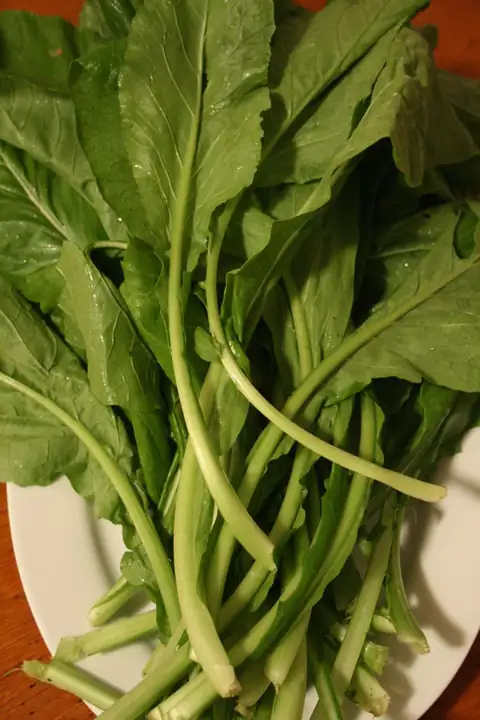
Mustard greens
Brassica juncea · Cabbage family (Brassicaceae)
| Hardiness zones | 2 to 11 |
|---|---|
| Sun | full sun to part shade |
| Water | moderate |
| Life cycle | annual |
| Frost | Half-hardy: takes a light frost |
| Soil pH | 6.0–6.5 |
| Spacing | 6 to 12 inches |
| Days to harvest | 25 to 50 days |
About Mustard greens
Mustard greens are fast-growing, peppery leaves. They are easy to grow in spring or fall and can be picked as baby salad leaves or full-size cooking greens.
Grown as a cool-season annual in every zone; time it for the cool weather of spring or fall. Plants take frost but may be damaged by a hard freeze, and summer heat makes them bolt.
When to plant
Timing is counted from your average last spring frost (and first fall frost). Sow & Tell works out the actual dates for your ZIP code.
- Sow seeds outdoors: 1 to 6 weeks after the last frost
- Fall planting: 10 to 16 weeks before the first fall frost
Days count from seeding and depend on the variety and whether you pick baby or full-size leaves. Sow again every 2 to 3 weeks to stretch the harvest; spring sowings may bolt as it warms.
Soil
Moist, well-drained soil rich in organic matter; keep it evenly watered.
Follow a soil test and keep pH 6.0 to 6.5; without a test, work in about 2 to 3 lb of complete garden fertilizer such as 10-20-10 per 100 sq ft (or 1 cup per 10 ft of row).
Feeding
- when plants are 4 to 5 inches tall: complete garden fertilizer such as 10-20-10. Spread about 1/2 cup per 10 ft of row beside the plants, mix it lightly into the soil and water it in; add more later on sandy soil in a wet season.
- after cutting a harvest, to push new leaves: nitrogen fertilizer such as 21-0-0. Give a light side-dressing beside the row and water it in.
Plants need enough nitrogen for dark green leaves, but greens turn tough and go to seed fast once days get long and hot, so plant for cool weather.
Harvest
Pick leaves at baby size for salads, or when full-sized and still tender for cooking.
Remove the outermost leaves and let the center keep growing, which stretches the harvest; a light nitrogen side-dressing after picking helps new leaves form. Leaves can be picked at baby size (about 25 days) or full size.
Varieties (13)
Extension sources document 13 mustard green varieties; several salad types (Ruby Streaks, Golden Streaks, Red Streaks) are listed by name only.
| Variety | Type | Days | Notes |
|---|---|---|---|
| Florida Broadleaf | Broad leaf | 40 to 50 days | Broad, flat leaves with sawtooth edges. |
| Green Wave | Curled leaf | 21 to 45 days | Very curly leaves. |
| Southern Giant Curled | Curled leaf, heirloom | 50 to 70 days | Large plants with very curly leaves. |
| Savannah | Hybrid, broad leaf | 35 days | Thick, very dark green leaves with fewer yellow leaves as it ages. Slower to bolt than open-pollinated types and good for home gardens. |
| Osaka Purple | Purple leaf, heirloom | 40 days | A purple-leaved heirloom mustard. |
| Garnet Giant | Red leaf | 45 days | Red leaves that turn green when cooked. |
| Red Giant | Red leaf, heirloom | 45 days | A red-leaved heirloom mustard. UF/IFAS lists it as Giant Red. |
| Golden Streaks | Salad type | A salad mustard on Kansas State's list. | |
| Red Streaks | Salad type | A salad mustard on Kansas State's list. | |
| Ruby Streaks | Salad type | On Wisconsin Extension's list. | |
| Large Smooth Leaf | Smooth leaf | 49 days | On the Texas list. |
| Tendergreen | Smooth leaf, heirloom | 35 to 40 days | A smooth-leaved heirloom. |
| Golden Frills | 21 to 45 days | On Kentucky's and Wisconsin's lists. |
Good neighbors
Cabbage, Broccoli, Kale, Cauliflower, Brussels sprouts, Collards, Kohlrabi
UMN Extension says mustard can serve as a trap crop that lures flea beetles away from other cabbage-family crops, working best in a mix of several trap species; expect the mustard itself to get chewed.
Pests to watch for
Flea beetles, Aphids, Bagrada bug
Diseases and problems
Cercospora leaf spot, Black rot of cabbage-family crops, Nitrogen deficiency, Alternaria leaf spot (cabbage family), Clubroot, White rust, Turnip mosaic
In the kitchen
Cooked like collards or turnip greens, stir-fried, or used raw as a spicy baby green.
Keeping it: Wrap unwashed leaves in damp paper towels inside a plastic bag in the crisper and use them within about 3 to 5 days; the flavor gets stronger the longer they sit.
Pets: The ASPCA lists its 'White/Black/Yellow Indian Mustard' entry (Brassica species) as toxic to horses: isothiocyanates can cause stomach irritation and colic. It is not listed as toxic to dogs or cats.
Sources
- hgic.clemson.edu
- plants.ces.ncsu.edu
- agrilifeextension.tamu.edu
- extension.umn.edu
- aspca.org
- aspca.org
- aspca.org
- aggie-horticulture.tamu.edu
Photo: Photo: thebittenword.com, CC BY 2.0, via Wikimedia Commons (CC BY 2.0). Photo resized for the web.

Planting dates and advice are general guidance; check with your local Cooperative Extension office for your area.