
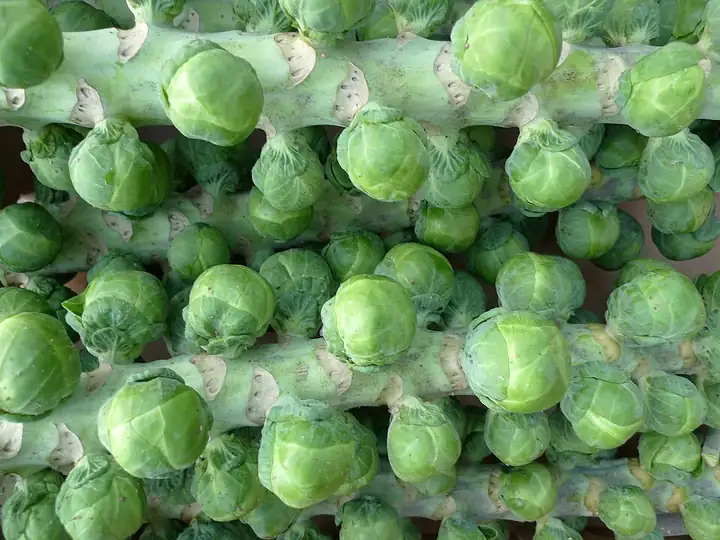
Brussels sprouts
Brassica oleracea var. gemmifera · Cabbage family (Brassicaceae)
| Hardiness zones | 2 to 11 |
|---|---|
| Sun | full sun |
| Water | moderate |
| Life cycle | biennial |
| Frost | Hardy: takes frost |
| Soil pH | 6.0–7.0 |
| Spacing | 14 to 24 inches |
| Days to harvest | 80 to 100 days |
About Brussels sprouts
Brussels sprouts form rows of little cabbage-like buds up a tall stalk. They need a long season and are at their best in fall, since cool weather and light frost make the sprouts sweeter.
Grown as a cool-season annual in every zone. It is usually timed to mature in fall, and plants can stay in the garden as long as temperatures stay above about 20F.
When to plant
Timing is counted from your average last spring frost (and first fall frost). Sow & Tell works out the actual dates for your ZIP code.
- Start seeds indoors: 6 to 10 weeks before the last frost
- Set out plants: 2 to 4 weeks before the last frost
- Fall planting: 10 to 14 weeks before the first fall frost
Days count from setting out transplants; direct-seeded plants can take up to 3 weeks longer. Start seed indoors 4 to 6 weeks before transplanting. In the North it is mostly grown as a fall crop from transplants set out in early summer.
Soil
Fertile, well-drained soil that still holds moisture; water thoroughly about once a week.
Work in compost or well-rotted manure, follow a soil test for phosphorus and potassium, and aim for soil pH about 6.2 to 6.8.
Feeding
- when plants are about 12 inches tall: nitrogen fertilizer. Side-dress beside the row and water it in.
- every 3 to 4 weeks after that, while sprouts are forming: nitrogen fertilizer. Repeat a light side-dressing to keep plants producing; water it in.
Do not use fresh manure or weed-and-feed products, and skip extra phosphorus unless a soil test calls for it.
Harvest
Pick sprouts from the bottom of the stalk up, starting when the lowest ones are about an inch across. Flavor improves after the first frosts.
Sprouts form and fill from the bottom of the stalk up, so pick the lowest ones first over several weeks; cutting off the top 1 to 2 inches once the lowest sprouts are an inch wide helps the top ones size up. When temperatures reach the mid-20s F, cut whole stalks and store them in a cool place to keep picking for a few more weeks.
Varieties (17)
| Variety | Type | Days | Notes |
|---|---|---|---|
| Captain Marvel | Hybrid | A very early hybrid. | |
| Diablo | Hybrid | A hybrid on Wisconsin Extension's recommended list. | |
| Jade Cross | Hybrid | 80 to 90 days | An early hybrid with dark green sprouts and wide adaptation. It won an All-America Selections award. |
| Jade Cross E | Hybrid | An early, tall hybrid with dark green sprouts and some tolerance to Botrytis (gray mold). | |
| Oliver | Hybrid | An early hybrid with medium to large, round-oval, dark green sprouts. | |
| Prince Marvel | Hybrid | A very early hybrid with small to medium, round-oval sprouts. | |
| Royal Marvel | Hybrid | An early hybrid on tall plants. | |
| Valiant | Hybrid | An early to midseason hybrid bred so the sprouts can be picked all at once. | |
| Bubbles | Open-pollinated | An open-pollinated type meant for home gardens. | |
| Catskill | Open-pollinated | A short, dwarf plant with hard sprouts packed closely together. It was selected from Long Island Improved for the eastern U.S. | |
| Rubine | Open-pollinated | Red-purple sprouts that mature midseason to late. | |
| Long Island Improved | Open-pollinated heirloom | 90 days | Compact plants that mature early to midseason. Mississippi State describes firm plants with sprouts about 1.5 inches across. |
| Brilliant | On Wisconsin Extension's recommended list. | ||
| Churchill | 90 days | On the Central Texas recommended list. | |
| Dimitri | 105 days | A late variety. Kentucky lists resistance to fusarium yellows. | |
| Gladius | 98 days | Uniform blue-green sprouts on plants that resist falling over. | |
| Tasty Nuggets | Very sweet. An early variety. |
Good neighbors
Sage, Thyme, Arugula, Mustard greens
UMN Extension cites a greenhouse study where sage and thyme reduced diamondback moths on Brussels sprouts, and notes arugula and mustard as flea beetle trap crops; field results are less certain.
Pests to watch for
Flea beetles, Imported cabbageworm, Cabbage looper, Diamondback moth, Cabbage maggot, Aphids, Swede midge, Bagrada bug, Voles
Diseases and problems
Black rot of cabbage-family crops, Clubroot, Alternaria leaf spot (cabbage family), Verticillium wilt, White rust, Turnip mosaic
In the kitchen
Roasted, sauteed or shaved raw into salads.
Keeping it: Refrigerate unwashed sprouts in an airtight bag for about a week. In very cold, humid storage they can keep about a month.
Pets: Not listed as toxic by the ASPCA
Sources
- extension.umn.edu
- plants.ces.ncsu.edu
- extension.unh.edu
- agrilifeextension.tamu.edu
- yardandgarden.extension.iastate.edu
- riley.k-state.edu
- extension.purdue.edu
- extension.umn.edu
- aspca.org
- aspca.org
- fieldreport.caes.uga.edu
Photo: Photo: Nick Saltmarsh, CC BY 2.0, via Wikimedia Commons (CC BY 2.0). Photo resized for the web.

Planting dates and advice are general guidance; check with your local Cooperative Extension office for your area.