
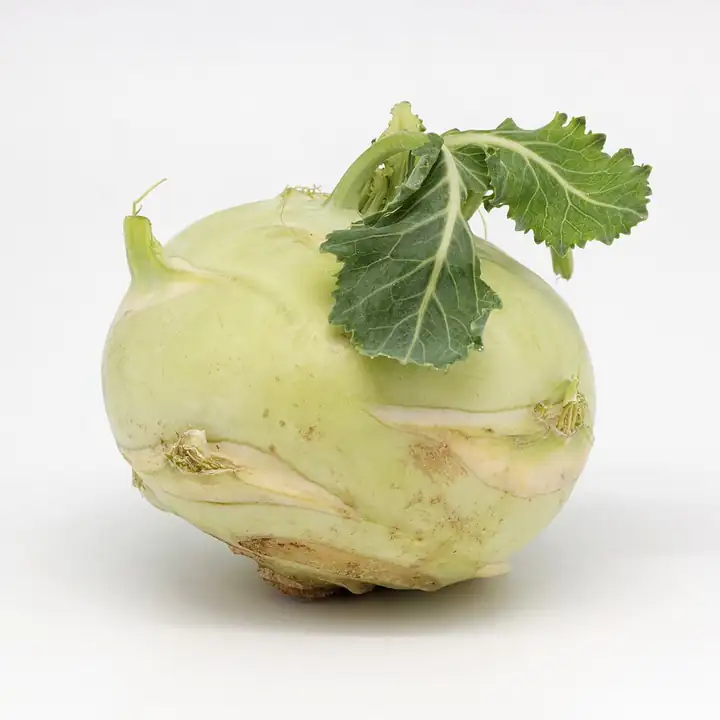
Kohlrabi
Brassica oleracea var. gongylodes · Cabbage family (Brassicaceae)
| Hardiness zones | 2 to 11 |
|---|---|
| Sun | full sun |
| Water | moderate |
| Life cycle | biennial |
| Frost | Hardy: takes frost |
| Soil pH | 6.0–7.5 |
| Spacing | 4 to 6 inches |
| Days to harvest | 35 to 70 days |
| Soil temperature to plant | at least 40°F |
About Kohlrabi
Kohlrabi is a cabbage relative grown for its swollen, round stem that sits just above the soil. It is quick, crunchy and mild, a bit like a sweet broccoli stem or a juicy turnip.
Grown as a cool-season annual in every zone; time it for the cool weather of spring or fall. More than a week of nights below 50F can make young plants bolt.
When to plant
Timing is counted from your average last spring frost (and first fall frost). Sow & Tell works out the actual dates for your ZIP code.
- Start seeds indoors: 8 to 10 weeks before the last frost
- Set out plants: 4 weeks before the last frost
- Sow seeds outdoors: 2 to 4 weeks before the last frost
- Fall planting: 12 to 16 weeks before the first fall frost
Days count from seeding or transplanting: about 35 to 45 for spring varieties and around 60 for large fall types, which need about 12 inches between plants. Start transplants 4 to 6 weeks before setting them out.
Soil
Loamy, well-drained soil high in organic matter; heavier or sandy soils work if drained and watered well.
Work in compost or well-rotted manure (up to about 1 inch), follow a soil test for phosphorus and potassium, and aim for soil pH 6.0 to 7.5.
Feeding
- 3 weeks after transplanting, or after thinning seeded plants (about 4 inches tall): nitrogen fertilizer such as 21-0-0. Use about 1/2 cup per 10 ft of row, 6 inches from the plants, and water it in.
If you worked in plenty of manure or compost you may not need more fertilizer; skip extra phosphorus unless a soil test calls for it.
Harvest
Cut the stem below the bulb when it is 2 to 3 inches wide; bigger bulbs turn tough, woody and bitter (giant fall types are the exception).
Cut each plant once when the bulb is 2 to 3 inches wide; bigger bulbs turn tough and woody. Sow in spring and again in July for a fall crop, which can grow a bit larger.
Varieties (12)
Extension sources document 12 kohlrabi varieties; Winner, Kossak, Waldemar and Gigante are listed by name with little description.
| Variety | Type | Days | Notes |
|---|---|---|---|
| Waldemar | Green | A green kohlrabi on Oklahoma State's list. | |
| Early White Vienna | Heirloom | 55 to 60 days | An heirloom that Utah State rates excellent for yield, eating quality and flavor. |
| Kossak | Hybrid | A hybrid on Kansas State's recommended list. | |
| Grand Duke | Hybrid, green | 45 to 50 days | A hybrid that Kentucky lists as resistant to black rot. Utah State rates it excellent. |
| Kolibri | Hybrid, purple | 45 to 50 days | Deep purple skin with crisp white flesh that is nearly free of fiber. |
| Quickstar | Purple skin | 40 days | A fast kohlrabi that Utah State rates excellent for yield, eating quality and flavor. |
| Early Purple Vienna | Purple, heirloom | 50 to 60 days | Utah State rates it excellent for yield, eating quality and flavor. |
| Beas | White | 42 days | An early, uniform white variety. |
| Gigante | On Wisconsin Extension's cole crop list. | ||
| Konan | 45 days | Smooth, globe-shaped bulbs up to about 6 inches across. | |
| Terek | 40 days | High-quality bulbs up to about 6 inches across. | |
| Winner | 45 days | On Kentucky's recommended list. |
Good neighbors
UMN Extension says arugula and mustard can work as trap crops that draw flea beetles away from cabbage-family plants; this is a pest-trapping tactic, not a guarantee.
Pests to watch for
Flea beetles, Imported cabbageworm, Cabbage looper, Diamondback moth, Cabbage maggot, Swede midge
Diseases and problems
Black rot of cabbage-family crops, Clubroot, Alternaria leaf spot (cabbage family)
In the kitchen
Peeled and eaten raw in slaws and snacks, or roasted, steamed or stir-fried.
Keeping it: Trim off the leaves and refrigerate bulbs; they keep about two weeks. Use the leaves within a few days.
Pets: Not listed as toxic by the ASPCA
Sources
- extension.umn.edu
- extension.unh.edu
- extension.colostate.edu
- agrilifeextension.tamu.edu
- yardandgarden.extension.iastate.edu
- riley.k-state.edu
- extension.umn.edu
- aspca.org
- aspca.org
- extension.usu.edu
Photo: Photo: Coyau / Wikimedia Commons, CC BY-SA 3.0 (CC BY-SA 3.0). Photo resized for the web.

Planting dates and advice are general guidance; check with your local Cooperative Extension office for your area.