
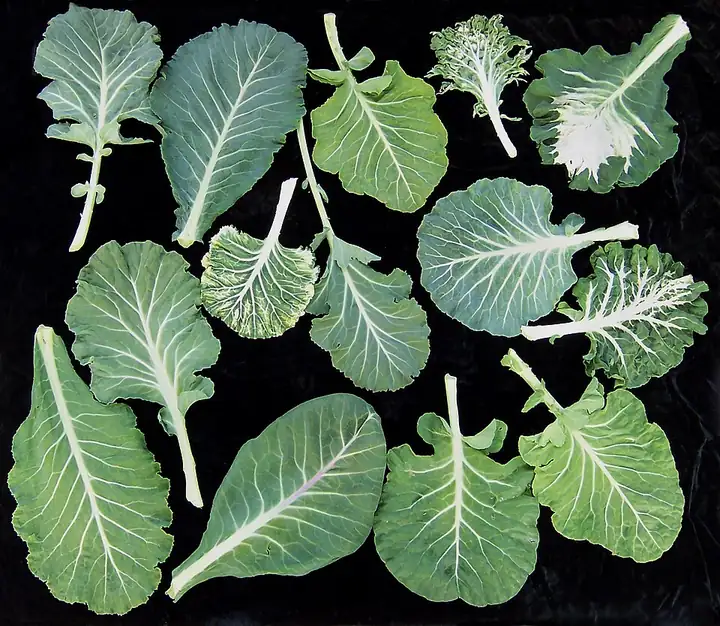
Collards
Brassica oleracea (Acephala group) · Cabbage family (Brassicaceae)
| Hardiness zones | 2 to 11 |
|---|---|
| Sun | full sun |
| Water | moderate |
| Life cycle | biennial |
| Frost | Hardy: takes frost |
| Soil pH | 6.0–6.5 |
| Spacing | 6 to 18 inches |
| Days to harvest | 50 to 80 days |
About Collards
Collards are a leafy, non-heading member of the cabbage family and a Southern garden staple. The big, smooth leaves can be picked for months, and mature plants shrug off frost and light freezes.
Grown as a cool-season annual in every zone; time it for the cool weather of spring or fall. Mature plants handle frosts and light to medium freezes, so in the South they are a classic fall and winter green.
When to plant
Timing is counted from your average last spring frost (and first fall frost). Sow & Tell works out the actual dates for your ZIP code.
- Sow seeds outdoors: 2 to 6 weeks before the last frost
- Fall planting: 8 to 12 weeks before the first fall frost
Days count from seeding (Clemson gives 60 to 80 days after direct seeding). Transplants can be used too: start them 6 to 8 weeks before you want to set them out.
Soil
Grows in many soil types; water deeply enough to wet the top 6 inches, early in the day so leaves dry before night.
Follow a soil test, mix any pre-plant fertilizer into the top 6 inches, and keep soil pH about 6.0 to 6.5.
Feeding
- 3 to 4 weeks after planting: nitrogen fertilizer such as calcium nitrate (15.5-0-0). Use about 1/2 lb per 30 ft of row (or per 100 sq ft), placed 4 to 6 inches from the plants, and water it in.
- 3 to 4 weeks after the first side-dressing: nitrogen fertilizer such as calcium nitrate (15.5-0-0). Repeat the same amount 4 to 6 inches from the plants and water it in.
Harvest
Cut whole plants when half-grown or full-grown, or pick single leaves from the bottom up to keep plants producing for a long time.
Break off a few leaves at a time from the bottom up to keep plants producing for a long time, or cut the whole plant once. Mature plants handle frosts and light to medium freezes, and leaves keep coming well past the first fall frost.
Varieties (14)
Extension and university sources document 14 collard varieties; several (Tiger, Top Pick) are listed by name only.
| Variety | Type | Days | Notes |
|---|---|---|---|
| Georgia Southern | Heirloom | 75 to 80 days | An old Southern heirloom that dates to the 1880s. |
| Morris Heading | Heirloom | An old variety with mostly large plants that vary quite a bit from one to the next. | |
| Vates | Heirloom, non-heading | 75 to 80 days | A non-heading type with thick, dark green leaves and lots of leaf compared to stem. Kentucky lists it as resistant to early bolting. |
| Blue Max | Hybrid | 68 days | Uniform, vigorous hybrid plants with good blue-green color. |
| Heavi-Crop | Hybrid | A uniform, vigorous, heavy-yielding hybrid. | |
| Tiger | Hybrid | A hybrid on Clemson's recommended list. | |
| Top Bunch | Hybrid | 70 days | A tall, fairly upright, fast-maturing hybrid with deep green, broad, slightly wavy leaves. |
| Champion | Hybrid (Vates type) | 60 to 75 days | Much like Vates, but much slower to send up seed stalks, so it holds longer in the garden. Clemson calls it productive and hardy. |
| Flash | Hybrid (Vates type) | 55 days | A very uniform Vates type with round, green to blue-green leaves. It is very slow to bolt and good for repeated picking. |
| Green Glaze | Open-pollinated heirloom | An unusual collard with glossy leaves that lack the normal waxy coating. | |
| Carolina | A compact plant much like Vates in color, shape, and wind and cold resistance. | ||
| Georgia LS | 75 days | A more uniform, longer-standing version of Georgia. | |
| Hi-Crop | A vigorous, versatile collard that tolerates both heat and cold, with tender, dark green leaves. | ||
| Top Pick | On Wisconsin Extension's recommended list. |
Good neighbors
UMN Extension says arugula and mustard can work as trap crops that draw flea beetles away from cabbage-family plants; this is a pest-trapping tactic, not a guarantee.
Pests to watch for
Imported cabbageworm, Cabbage looper, Diamondback moth, Harlequin bug, Mole crickets, Swede midge, Bagrada bug
Diseases and problems
Black rot of cabbage-family crops, Downy mildew, Nitrogen deficiency, Alternaria leaf spot (cabbage family), Clubroot, White rust
In the kitchen
Slow-cooked Southern style, sauteed, added to soups, or sliced thin and eaten raw.
Keeping it: Keep unwashed leaves in a plastic bag in the refrigerator crisper and use within about 5 days.
Safety: If you take the blood thinner warfarin, keep the amount of collards you eat about the same from day to day; they are one of the richest food sources of vitamin K (NIH Office of Dietary Supplements).
Pets: Not listed as toxic by the ASPCA
Sources
- hgic.clemson.edu
- agrilifeextension.tamu.edu
- extension.purdue.edu
- extension.umn.edu
- ods.od.nih.gov
- aspca.org
- aspca.org
Photo: Photo: Ann Perry, USDA ARS, Public domain (USDA ARS), via Wikimedia Commons. Photo resized for the web.

Planting dates and advice are general guidance; check with your local Cooperative Extension office for your area.