
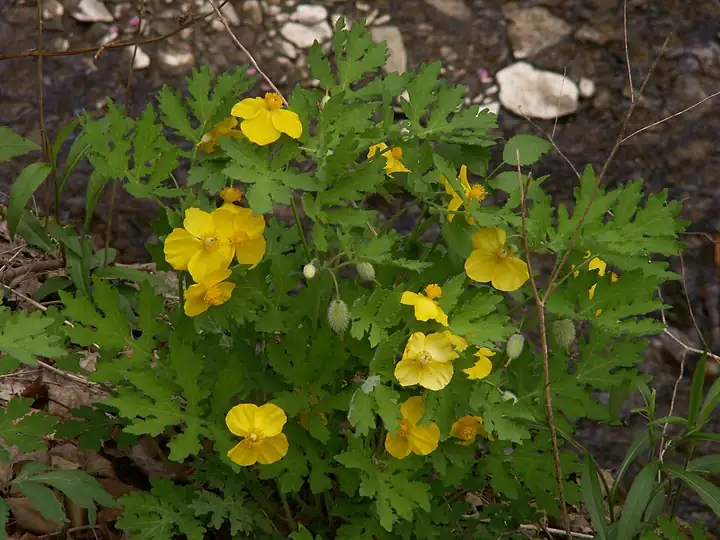
Celandine poppy (wood poppy)
Stylophorum diphyllum · Poppy family (Papaveraceae)
| Hardiness zones | 4 to 9 |
|---|---|
| Sun | part shade |
| Water | moderate |
| Life cycle | perennial |
| Frost | Hardy: takes frost |
About Celandine poppy (wood poppy)
Celandine poppy is a native woodland wildflower with bright yellow, four-petaled poppies 1-2 in across over lobed, blue-green leaves in spring; deadheaded and kept moist, it keeps blooming into summer (NC State, Wisconsin Extension). It is native from Wisconsin, Michigan and Pennsylvania south to Tennessee, Arkansas, northern Alabama and Georgia, and is threatened in parts of its range (wildflower.org, Wisconsin Extension). Don't confuse it with greater celandine (Chelidonium majus), a European weed listed as a noxious weed in Wisconsin, Michigan and New Hampshire (NC State): greater celandine has smaller flowers (3/4 in or less) in summer and smooth, upright seed pods, while celandine poppy's pods are hairy and hang down (Wisconsin Extension).
Hardy in zones 4-9 (NC State, Wisconsin Extension). Native and not invasive: it self-sows but isn't aggressive.
When to plant
Timing is counted from your average last spring frost (and first fall frost). Sow & Tell works out the actual dates for your ZIP code.
Set out nursery-grown plants in shade with spring sun. Sow fresh seed in fall in a cold frame, or chill it in moist potting mix in the refrigerator for several weeks first; plants can bloom the first year from seed (Wisconsin Extension). Divide clumps in spring, keeping a growing point on each piece. We found no sourced day count to first bloom.
Soil
Moist, humus-rich soil with good drainage, acid to neutral; it tolerates lime and wet spots, and goes dormant early if the soil dries out (NC State, wildflower.org, Wisconsin Extension).
Work in plenty of leaf compost or other organic matter for moist, humus-rich soil, and test the soil in a new spot (Missouri Extension, Wisconsin Extension).
Feeding
- Fall or late winter, while dormant: a mulch of shredded leaves or leaf compost. Missouri Extension recommends mulch rather than bare soil for woodland wildflowers; no fertilizer schedule is given.
Letting the soil dry out sends it dormant early (Wisconsin Extension, wildflower.org); too much fertilizer weakens wildflowers (Missouri Extension).
Harvest
Blooms in early spring to early summer (March to June). Cut off faded flower stems to get more flowers through summer, especially if you water regularly (Wisconsin Extension, NC State). Wear gloves: the yellow-orange sap stains hands.
Good neighbors
Bleeding heart, Columbine, Foamflower, Wild ginger, Hosta (plantain lily)
These are design pairings, not pest-control companions: Wisconsin Extension suggests bleeding heart, columbine, foamflower, spiderworts and wild ginger, and big-leaved hostas for contrast.
Pests to watch for
Slugs
In the kitchen
Safety: Wisconsin Extension says the foliage is toxic, and broken stems bleed a yellow-orange sap that stains skin; don't eat any part. Its weedy look-alike, greater celandine, is rated highly poisonous, with sap that badly irritates skin and eyes (NC State), so know which plant you have.
Pets: Not listed by the ASPCA. Wisconsin Extension says the foliage is toxic (that's why deer leave it alone), so keep pets from chewing it.
Sources
- plants.ces.ncsu.edu
- wildflower.org
- hort.extension.wisc.edu
- plants.ces.ncsu.edu
- extension.missouri.edu
- aspca.org
- aspca.org
Photo: Photo: Cbaile19, CC0, via Wikimedia Commons (CC0). Photo resized for the web.

Planting dates and advice are general guidance; check with your local Cooperative Extension office for your area.