
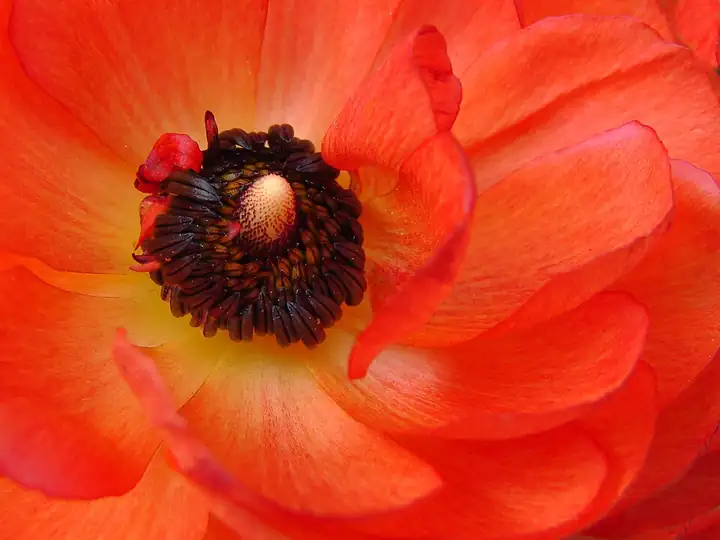
Ranunculus
Ranunculus asiaticus (Persian buttercup) and its hybrids · Buttercup family (Ranunculaceae)
| Hardiness zones | 8 to 10 |
|---|---|
| Sun | full sun |
| Water | moderate |
| Life cycle | tender perennial (grown as an annual) |
| Frost | Half-hardy: takes a light frost |
| Spacing | 3 to 8 inches |
| Days to harvest | 90 to 150 days |
About Ranunculus
Ranunculus grows from small, claw-shaped tuberous roots and makes rose-like flowers packed with layers of thin petals. It loves cool weather, blooms in spring, and is one of the longest-lasting flowers in a vase. In mild-winter areas it goes in the ground in fall; elsewhere gardeners plant it in late winter or early spring and treat it as an annual (Clemson, NC State, Utah State).
NC State lists zones 8-10, and the tubers usually survive winter in the ground in most of South Carolina (Clemson). In zones 3-7, grow it as an annual or dig the dormant tubers after the leaves die back (Clemson). Plants are hurt below about 26-28 F (NC State, Utah State).
When to plant
Timing is counted from your average last spring frost (and first fall frost). Sow & Tell works out the actual dates for your ZIP code.
Days to bloom count from planting the tubers: about 90 days (Clemson) to 3-5 months (Utah State). Soak tubers in room-temperature water for about 3-4 hours (no longer), then plant claws down, 2-3 inches deep and 3-8 inches apart. Plant in fall where winters are mild; in colder areas plant several weeks before the last frost once hard freezes are past, and cover with frost cloth on hoops on cold nights (Clemson, NC State, Utah State, UC ANR). In zones 3-7, dig the tubers after the leaves yellow, store them cool and dry (about 35-50 F), and replant in fall or late winter, or just buy fresh ones (Clemson, Utah State).
Soil
Rich, loose, well-drained soil with plenty of organic matter; it rots in heavy, wet clay and is sensitive to salty soil, so use low-salt compost (NC State, Utah State).
Test the soil first, then till in about 1 inch of low-salt compost; ranunculus is sensitive to salty soil (Utah State).
Feeding
- At planting: nitrogen fertilizer such as 46-0-0, or a slow-release fertilizer. Utah State's yearly total is about 0.34 lb of nitrogen per 100 sq ft (about 3/4 lb of 46-0-0); give half at planting, or use a slow-release source once. Follow a soil test for phosphorus and potassium.
- When the first flower buds show: nitrogen fertilizer such as 46-0-0. Side-dress the other half of the yearly nitrogen beside the plants and water it in (Utah State).
Too much nitrogen and potassium makes heavy flower stems flop over; skip phosphorus and potassium unless a soil test calls for them (Utah State). Soggy soil rots the tubers (NC State).
Harvest
Ranunculus blooms in spring into early summer for about 6-7 weeks, until temperatures reach the upper 70s to 80 F (Clemson, Utah State). For bouquets, cut when buds are colored and soft like a marshmallow but not yet open, in the cool of the day; in the garden, snip off spent flowers for more blooms (Utah State, NC State).
Varieties (7)
Extension sources we could open document 7 ranunculus series; most are sold as color mixes or single colors within a series.
| Variety | Type | Days | Notes |
|---|---|---|---|
| Tecolote | Classic garden series | Comes in pastels to bright colors; in Utah State's trial it gave the fewest stems (1.6 per plant) on shorter, weaker stems. | |
| Amandine | Cut-flower series | Trialed for three years at Utah State; yielded a bit less than LaBelle. | |
| Gigi | Cut-flower series | ||
| LaBelle | Cut-flower series | Highest-yielding series in Utah State's high-tunnel trial, about 3.6 stems per plant. | |
| Elegance 'Giallo' | Elegance series | Bright yellow flowers. | |
| Pon-Pon 'Hermione' | Italian Cloni Pon-Pon series | Ruffled flowers. | |
| Cloni Success 'Venere' | Italian Cloni series | Large, ruffled blooms on sturdy stems. |
Good neighbors
Tulip, Daffodil, Anemone (windflower), Hyacinth
Clemson suggests mixing ranunculus with tulips, daffodils, anemones and hyacinths for a pretty spring show; that's a design pairing, not a tested pest benefit.
Pests to watch for
Aphids, Thrips, Twospotted spider mite, Mice (house mice and deer mice), Voles
Diseases and problems
Gray mold, Powdery mildew, Root rot, Tomato spotted wilt
In the kitchen
Keeping it: Cut stems keep upright in water at about 40 F for up to 5 days before arranging (Utah State).
Safety: Not edible. All parts contain ranunculin, which breaks down to the irritant protoanemonin; eating it can burn the mouth and cause stomach pain, vomiting and diarrhea, and the sap can redden and blister skin, so wear gloves (NC State: low severity).
Pets: Toxic to dogs, cats and horses (ASPCA, listed as buttercup, Ranunculus spp.): the irritant protoanemonin can cause vomiting, diarrhea, drooling, mouth sores, loss of appetite and wobbly walking.
Sources
- plants.ces.ncsu.edu
- hgic.clemson.edu
- digitalcommons.usu.edu
- digitalcommons.usu.edu
- extension.usu.edu
- ucanr.edu
- aspca.org
- ask2.extension.org
Photo: Photo: Nevit Dilmen / Wikimedia Commons, CC BY-SA 3.0 (CC BY-SA 3.0). Photo resized for the web.

Planting dates and advice are general guidance; check with your local Cooperative Extension office for your area.