
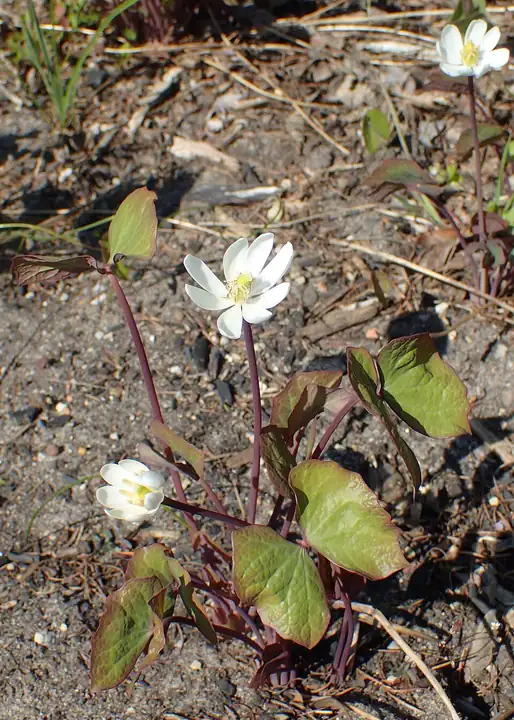
Twinleaf
Jeffersonia diphylla · Barberry family (Berberidaceae)
| Hardiness zones | 5 to 7 |
|---|---|
| Sun | part shade |
| Water | moderate |
| Life cycle | perennial |
| Frost | Hardy: takes frost |
About Twinleaf
Twinleaf is a native spring wildflower named for its leaves, which split into two wing-like halves, and for Thomas Jefferson, who grew it at Monticello (Wisconsin Extension, NC State). Its white, eight-petaled flowers, about an inch across, open in early spring and last only a day or so, followed by odd pear-shaped pods that pop open with a lid (NC State, Wisconsin Extension). It is native to rich woods from New York and Minnesota south to Maryland, Alabama and Georgia (wildflower.org). It's uncommon and imperiled in several states, so buy nursery-propagated plants or seed and never dig it from the wild (NC State).
Hardy in zones 5-7 (NC State, Wisconsin Extension). Native; ants carry off its seeds, so it spreads only slowly.
When to plant
Timing is counted from your average last spring frost (and first fall frost). Sow & Tell works out the actual dates for your ZIP code.
Plant dormant bare-root plants in early spring, or potted plants under deciduous trees (Wisconsin Extension). Sow seed as soon as it ripens, about 3-4 weeks after bloom, and don't let it dry out; seedlings take 4-5 years to bloom (wildflower.org). Divide big clumps in late summer or fall.
Soil
Rich, humus-filled, loamy soil that drains well but stays evenly moist, on the acid side; in the wild it often grows over limestone (NC State, Wisconsin Extension, wildflower.org).
Add leaf compost for rich, humus-filled, evenly moist soil that still drains well (Wisconsin Extension, Missouri Extension).
Feeding
- Fall, after tree leaves drop: a light mulch of shredded leaves or leaf compost. Missouri Extension says woodland wildflowers should be mulched, not grown in bare soil; no fertilizer schedule is given.
Young plants are easily crowded out, so keep weeds away (wildflower.org, Wisconsin Extension), and don't dig around established clumps.
Harvest
Blooms in early spring (March-April, into May in the North). Each flower lasts about a day and drops its petals in the first wind or rain, so there's nothing to deadhead. The leaves stay handsome into midsummer, then fade (NC State, Wisconsin Extension, wildflower.org).
Good neighbors
Garden ferns (ostrich, Christmas, lady, Japanese painted), Mayapple, Dutchman's breeches
These are design pairings, not pest-control companions: Wisconsin Extension suggests native ferns, mayapple, rue anemone and Dutchman's breeches.
Pests to watch for
Slugs, Brown garden snail
In the kitchen
Safety: No toxicity is listed in the extension sources we used, but it isn't a food plant; the old medicinal root was described as acrid and nauseating (King's American Dispensatory), so don't eat any part.
Pets: Not listed by the ASPCA.
Sources
- plants.ces.ncsu.edu
- wildflower.org
- hort.extension.wisc.edu
- henriettes-herb.com
- aspca.org
- extension.missouri.edu
Photo: Photo: Krzysztof Ziarnek, Kenraiz, CC BY-SA 4.0, via Wikimedia Commons (CC BY-SA 4.0). Photo resized for the web.

Planting dates and advice are general guidance; check with your local Cooperative Extension office for your area.