
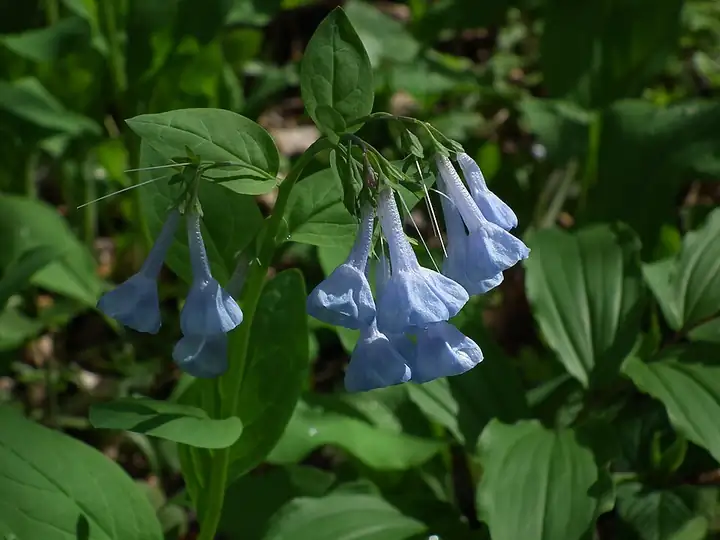
Virginia bluebells
Mertensia virginica · Borage family (Boraginaceae)
| Hardiness zones | 3 to 9 |
|---|---|
| Sun | part shade |
| Water | high |
| Life cycle | perennial |
| Frost | Hardy: takes frost |
| Soil pH | 6.8–7.2 |
| Spacing | 10 to 18 inches |
About Virginia bluebells
Virginia bluebells are a native spring wildflower with nodding clusters of pink buds that open into sky-blue bells, loved by bumblebees, butterflies and hummingbirds (NC State, Wisconsin Extension). They are native to moist woods and river floodplains of the central and eastern U.S., from New York and Minnesota south to Alabama, Arkansas and eastern Kansas (Wisconsin Extension, wildflower.org). Plants are summer dormant: the leaves yellow and vanish by early summer, so it's normal for the spot to look empty until next spring. Wisconsin Extension notes wild stands are declining as floodplain habitat is lost, so buy nursery-grown plants rather than digging them from the woods (Iowa State).
Hardy in zones 3-9 (Wisconsin Extension, NC State). Native and not invasive; it does self-sow into colonies in moist shade.
When to plant
Timing is counted from your average last spring frost (and first fall frost). Sow & Tell works out the actual dates for your ZIP code.
- Sow seeds outdoors: 6 weeks before the last frost
Set out potted plants in fall or after the last spring frost, 10-18 inches apart (Wisconsin Extension). Fresh seed can be sown right after it ripens in early summer; stored seed needs about 6 weeks of cold, moist chilling and is sown about 6 weeks before the last frost (wildflower.org). Seedlings take several years to bloom, and the long taproot dislikes being moved once settled. We found no sourced day count to first bloom.
Soil
Rich, moist, humus-rich soil; plants decline if the soil gets too dry, and they like it near neutral, about pH 6.8-7.2 (Wisconsin Extension, wildflower.org).
Work in compost or leaf mold for rich, moist, humus-rich soil; it likes soil near neutral (Wisconsin Extension, wildflower.org).
Feeding
- Fall or late winter, before shoots come up: compost or shredded leaves as a mulch. Spread a layer over the bed, especially on drier sites, to keep the soil moist and rich (Missouri Extension).
Don't let the soil dry out in spring, and don't dig into the spot after the plants go dormant in early summer; mark where they are (Wisconsin Extension).
Harvest
Blooms in early to mid-spring for about 3 weeks (NC State, Wisconsin Extension). There's no need to deadhead; let the leaves yellow and wither on their own, since they break down quickly with no cleanup (UT Gardens). Wisconsin Extension says it isn't a good cut flower. Mark where plants are so you don't dig into them in summer.
Good neighbors
Bleeding heart, Trillium, Columbine, Hosta (plantain lily), Garden ferns (ostrich, Christmas, lady, Japanese painted), Astilbe (false spirea), Solomon's seal
These are design pairings, not pest-control companions: Wisconsin Extension and UT Gardens suggest bleeding heart, columbine and trillium for a spring show, and hosta, ferns, astilbe or Solomon's seal to fill the gap when bluebells go dormant.
Pests to watch for
Slugs, Brown garden snail
In the kitchen
Safety: Neither NC State nor Wisconsin Extension lists it as poisonous, but it is not a food plant and we found no source on its safety to eat, so don't eat it.
Pets: Not listed by the ASPCA (no Virginia bluebells or Mertensia entry on its dog, cat or horse lists that we could check).
Sources
- plants.ces.ncsu.edu
- hort.extension.wisc.edu
- wildflower.org
- utianews.tennessee.edu
- yardandgarden.extension.iastate.edu
- yardandgarden.extension.iastate.edu
- extension.missouri.edu
- aspca.org
- aspca.org
- aspca.org
- aspca.org
- aspca.org
- extension.rutgers.edu
Photo: Photo: Cbaile19, CC0, via Wikimedia Commons (CC0). Photo resized for the web.

Planting dates and advice are general guidance; check with your local Cooperative Extension office for your area.