
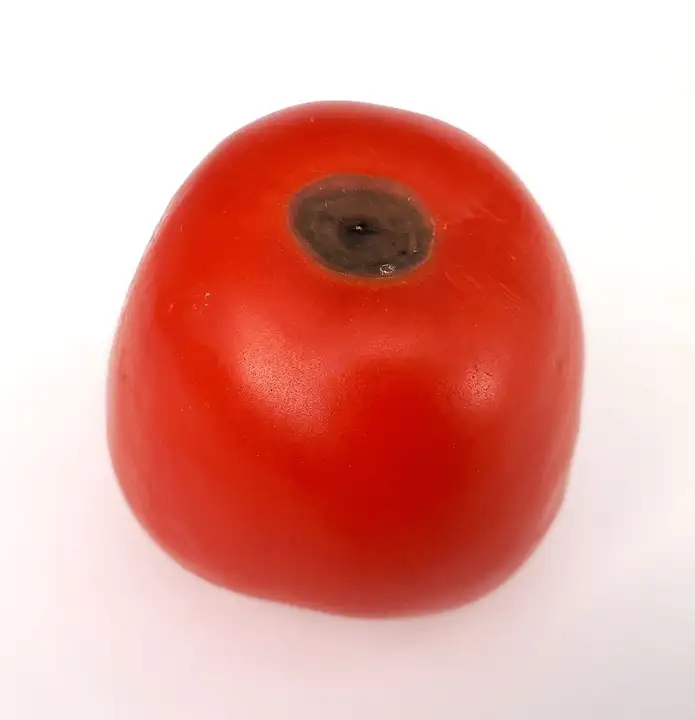
Blossom end rot
Not an infection: too little calcium reaches the developing fruit, usually because of uneven soil moisture
| Type | Not an infection |
|---|---|
| Cause | Not an infection: too little calcium reaches the developing fruit, usually because of uneven soil moisture |
| When | Early to midsummer, especially on the first fruit of the season. |
About
A dark, sunken patch on the bottom of tomatoes, peppers and some other fruit, caused by a local calcium shortage in the fruit, not a germ. The soil usually has enough calcium; uneven watering keeps it from reaching the fruit.
Also called blossom end rot, blossom-end rot
How to recognize it
Symptoms
A flat, tan to black patch forms at the blossom end (the bottom) of the fruit. It usually shows when fruit are one-third to one-half grown, and the first fruits of the season are often worst. Large slicing tomatoes get it more than cherry types.
Worse when
Swings between wet and dry soil, heavy nitrogen feeding, root damage, and hot spells that push fast growth.
How it spreads
It does not spread from plant to plant.
When
Early to midsummer, especially on the first fruit of the season.
What to do, gentlest first
This is not an infection, so sprays for diseases won't help. Fix the cause below.
Water evenly and mulch Prevent
Keep soil steadily moist with regular deep watering or drip irrigation, and mulch to hold moisture between waterings.
Soil test, then lime and fertilize by the results Prevent
Test before planting and add lime or fertilizer only as the test recommends; go light on nitrogen.
Calcium sprays and extra calcium are a common myth: calcium in leaves cannot move into the fruit, and fruit skin cannot absorb it (Clemson). Fix watering first.
Protect roots and choose less-prone varieties Prevent
Do not hoe or dig within about a foot of the plant, and try varieties less prone to the problem.
Pick off affected fruit By hand
Remove damaged fruit so the plant puts its energy into healthy ones.
Plants it affects
Cucumber, Eggplant, Pepper (sweet and chili), Tomato, Watermelon, Winter squash and pumpkin, Zucchini and summer squash
Sources
Photo: Photo: Fructibus, CC0, via Wikimedia Commons (CC0). Photo resized for the web.

Planting dates and advice are general guidance; check with your local Cooperative Extension office for your area.