
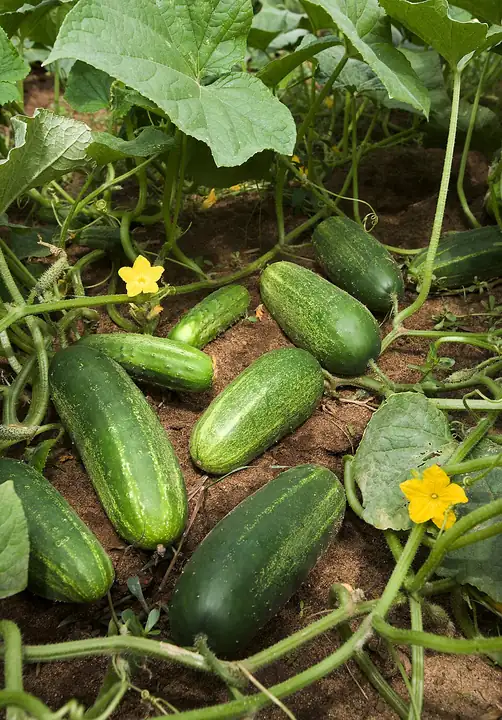
Cucumber
Cucumis sativus · Gourd family (Cucurbitaceae)
| Hardiness zones | 3 to 11 |
|---|---|
| Sun | full sun |
| Water | moderate |
| Life cycle | annual |
| Frost | Tender: killed by frost |
| Soil pH | 6.0–6.5 |
| Spacing | 8 to 12 inches |
| Days to harvest | 50 to 70 days |
| Soil temperature to plant | at least 70°F |
About Cucumber
Cucumbers are fast, heat-loving vines grown for slicing or pickling. Most need bees to carry pollen between separate male and female flowers, and once picking starts they need checking every day or two.
Grown as a warm-season annual in every zone; it is killed by frost, so plant it out after the danger of frost has passed.
When to plant
Timing is counted from your average last spring frost (and first fall frost). Sow & Tell works out the actual dates for your ZIP code.
- Start seeds indoors: 2 to 4 weeks before the last frost
- Set out plants: 1 to 2 weeks after the last frost
- Sow seeds outdoors: 1 to 2 weeks after the last frost
- Fall planting: 11 to 12 weeks before the first fall frost
Days count from seeding. Sow after the last frost once soil is at least 70F an inch down; start indoors no earlier than 4 weeks before the last frost. A 3- to 4-foot trellis gives straight fruit.
Soil
Moisture-retentive but well-drained soil; raised beds help drainage.
Follow a soil test and keep soil pH 6.0 to 6.5; without a test, about 3 lb of 5-10-10 per 100 sq ft, plus no more than 1 inch of compost.
Feeding
- when vines start to run (send out runners), before the plants flower: nitrogen fertilizer such as 21-0-0 or 34-0-0. Sprinkle 3 to 4 Tbsp of 21-0-0 around each plant (or about 1 lb of 34-0-0 per 100 ft of row) and water it in.
Do not use fresh manure or weed-and-feed products on cucumbers.
Harvest
Pick picklers at 2 to 6 inches and slicers at 6 to 10 inches, before the skin yellows and the seeds get large.
Keep fruit picked and the vines keep producing; cucumbers left to grow large and yellow slow the plant down. Cut them off with a knife or pruners rather than pulling.
Varieties (46)
| Variety | Type | Days | Notes |
|---|---|---|---|
| Suyo Long | Asian (Chinese) slicer | 61 days | Long Chinese-type cucumber; Cornell lists powdery mildew resistance. |
| Tasty Green | Asian (Japanese) burpless slicer, hybrid | 60 days | Burpless, with good eating quality. Long, slender fruit that keeps coming all summer; a trellis type. Resists powdery mildew, and Cornell lists several other diseases too. |
| Armenian | Burpless novelty (botanically a melon) | Long, curved, burpless fruit about 10 to 12 inches long; it grows straighter on a trellis. | |
| Burpless Hybrid | Burpless slicer, hybrid | 62 days | Mild flavor. Long fruit, about 10 inches, best grown on a trellis. |
| Sweet Slice | Burpless slicer, hybrid | 62 to 63 days | Sweet-tasting with few spines. Long, dark green fruit on a strong vine. Listed as resistant to cucumber mosaic and several other viruses plus downy and powdery mildew. |
| Bush Pickle | Bush pickler | 48 days | Compact bush plant with straight, cylinder-shaped fruit that ripens over a short period. Cornell lists resistance to cucumber mosaic virus, powdery mildew and scab. |
| Bush Crop | Bush slicer | 55 days | Home-garden bush type with slightly tapered, medium green fruit about 7.5 inches long. Resists scab. |
| Spacemaster | Bush slicer | 55 to 56 days | Dwarf, compact vine with dark green fruit about 7.5 inches long. Resists cucumber mosaic virus and scab, with moderate mildew resistance. |
| Salad Bush | Bush slicer, hybrid | 57 days | Compact, short-vined plant with dark green, 8-inch fruit. Resists cucumber mosaic virus, scab and target leaf spot; a 1988 All-America Selections winner. |
| Lemon | Heirloom novelty | Sweet. Round, lemon-sized fruit about 3 inches across that turns pale to golden yellow, with white flesh. Plants are prolific. | |
| Muncher | Middle Eastern (Beit Alpha) slicer | 59 days | Medium green fruit about 6.5 inches long. Resists cucumber mosaic virus. |
| Diva | Parthenocarpic (seedless) slicer, hybrid | 58 days | Sweet, crisp flesh with smooth, tender skin. Bright green, seedless fruit on mostly female plants. Resists scab, powdery and downy mildew and more; a 2002 All-America Selections winner. |
| Sweet Success | Parthenocarpic (seedless) slicer, hybrid | 54 to 55 days | Very long, smooth, medium green fruit about 12 to 14 inches, set without pollination. Resists scab and cucumber mosaic virus; an All-America Selections winner. |
| Picolino | Parthenocarpic snacking cucumber, hybrid | Small, thin-skinned, dark green snack cucumbers on mostly female plants that set fruit without pollination. Cornell lists resistance to powdery mildew, scab and several viruses. | |
| Arkansas Little Leaf | Pickler | 55 to 62 days | Small-leaved pickling type with medium green, white-spined fruit that can set without pollination. Resistant to anthracnose, angular leaf spot, downy mildew and CMV; Cornell also lists bacterial wilt and powdery mildew. |
| Eureka | Pickler | 56 to 57 days | Vigorous vines with very dark green, white-spined pickling fruit. Resists many leaf diseases and cucumber viruses, including anthracnose, angular leaf spot, downy and powdery mildew, scab and CMV. |
| Homemade Pickles | Pickler | 55 to 60 days | Vigorous open-pollinated plant with medium green, small white-spined fruit. Cornell lists resistance to angular leaf spot, anthracnose, cucumber mosaic virus, both mildews and scab. |
| Sumter | Pickler | Medium green, white-spined fruit with a small seed cavity. Broad resistance to downy and powdery mildew, anthracnose, angular leaf spot, scab, CMV and watermelon mosaic virus. | |
| Wautoma | Pickler | Open-pollinated pickler with white-spined fruit. Resists anthracnose, angular leaf spot, downy and powdery mildew, scab and CMV. | |
| Picklebush | Pickler (compact bush) | 52 days | Dwarf pickling plant with vines only 20 to 24 inches long and fruit about 4.5 inches long. Cornell lists resistance to CMV and powdery mildew. |
| Boston Pickling | Pickler (heirloom) | Old open-pollinated pickler with straight, dark green, black-spined fruit. Cornell lists resistance to cucumber mosaic virus and powdery mildew. | |
| National Pickling | Pickler (heirloom) | 54 to 55 days | Straight, medium green, black-spined fruit. Cornell lists resistance to cucumber mosaic virus and scab. |
| Parisian Pickling | Pickler (heirloom) | 50 days | Open-pollinated pickler with straight, dark green, black-spined fruit that reaches 9 to 10 inches if left to grow. |
| Fancipak | Pickler (hybrid) | Dark green hybrid pickler bred for hand picking, with few crooked or stubby fruit. Cornell lists resistance to angular leaf spot, anthracnose, CMV, downy and powdery mildew and scab. | |
| Regal | Pickler (hybrid) | Semi-dwarf hybrid pickler with mostly female flowers. Resistant to scab, with field resistance to anthracnose, angular leaf spot, downy and powdery mildew and CMV. | |
| Saladin | Pickler (hybrid) | Hybrid pickler with mostly female flowers and white-spined fruit. Resistant to powdery mildew and scab, with moderate resistance to CMV. | |
| Excelsior | Pickler (seedless hybrid) | Hybrid pickler that sets seedless fruit without bees (parthenocarpic). Cornell lists resistance to CMV, cucumber vein yellowing virus, powdery mildew, scab and target leaf spot. | |
| Calypso | Pickler, hybrid | 52 to 53 days | Mostly female-flowered pickler with dark green fruit that pickles well. Resists scab, cucumber mosaic virus, both mildews, anthracnose and angular leaf spot. |
| Carolina | Pickler, hybrid | 49 days | Mostly female-flowered, white-spined pickler with a small seed cavity. Resists a long list of diseases, including both mildews, anthracnose, scab and two mosaic viruses. |
| County Fair | Pickler, hybrid | 48 to 52 days | Mostly female-flowered pickler that can set fruit without pollination. Resists downy and powdery mildew, scab and cucumber mosaic virus; Cornell also lists bacterial wilt. |
| Fanfare | Semi-bush slicer, hybrid | 62 to 63 days | Semi-compact vine with straight fruit of good color and length. Resists cucumber mosaic virus, both mildews, anthracnose, angular leaf spot and scab; an All-America Selections winner. |
| Sweeter Yet | Slicer (Asian burpless hybrid) | Early Japanese-style burpless hybrid with fruit about 7 inches by 2 inches and mostly female flowers. Cornell lists resistance to CMV, downy and powdery mildew, and papaya ringspot and zucchini yellow mosaic viruses. | |
| Spacemaster 80 | Slicer (bush) | Bitter-free version of Spacemaster. Cornell lists resistance to CMV, downy and powdery mildew and scab. | |
| Patio Snacker | Slicer (compact bush) | Compact bush-type slicing cucumber. | |
| Burpee Hybrid II | Slicer (hybrid) | Hybrid slicer bred to be earlier and more productive than Burpee Hybrid, with slightly longer fruit. Resistant to cucumber mosaic virus and downy mildew. | |
| Slice Master | Slicer (hybrid) | 62 days | Early, high-yielding hybrid with very dark green fruit up to about 8 to 9 inches long. Resistant to scab, CMV, angular leaf spot and anthracnose. |
| Sugar Crunch | Slicer (seedless hybrid) | Sets seedless fruit without bees (parthenocarpic). Cornell lists resistance to CMV and downy and powdery mildew. | |
| Ashley | Slicer (vining) | 65 days | Early slicer with darker green fruit than older types. Bred for downy mildew resistance; Cornell also lists powdery mildew and angular leaf spot. |
| Marketmore 76 | Slicer (vining) | 67 to 70 days | Dark green, straight fruit about 8 to 9 inches long on vigorous vines. Bred at Cornell with resistance to downy and powdery mildew, scab and cucumber mosaic virus; Cornell also lists anthracnose and angular leaf spot. |
| Marketmore 80 | Slicer (vining) | Bitter-free version of Marketmore 76 with white-spined fruit about 8 inches long. Resistant to downy and powdery mildew, scab and CMV. | |
| Marketmore 97 | Slicer (vining) | 55 days | Bitter-free slicer with uniform green fruit. Cornell lists resistance to cucumber mosaic virus, downy and powdery mildew and scab, and the breeders' description adds several other leaf diseases and viruses. |
| Poinsett 76 | Slicer (vining) | 60 to 65 days | Uniform dark green, slightly tapered fruit about 7.5 to 8 inches long on a moderately vigorous vine. Resists anthracnose, angular leaf spot, downy and powdery mildew and scab. |
| Poinsett 97 | Slicer (vining) | White-spined slicer with fruit about 8 inches long. Bred to resist a long list of problems, including anthracnose, angular leaf spot, downy and powdery mildew, scab, target leaf spot and several viruses. | |
| Straight Eight | Slicer (vining) | 58 to 65 days | Dark green, cylinder-shaped fruit about 8 to 9 inches long with blunt ends, on vigorous vines. The cultivar descriptions list no disease resistance. |
| Dasher II | Slicer (vining), hybrid | 60 days | Mostly female-flowered hybrid with white-spined fruit about 8 inches long. Resists angular leaf spot, downy and powdery mildew, scab and cucumber mosaic virus. |
| General Lee | Slicer (vining), hybrid | 66 days | High-yielding hybrid with mostly female flowers and straight, dark green fruit on large vines. Resists powdery and downy mildew, scab and cucumber mosaic virus. |
Good neighbors
Nasturtium, Marigold, Winter squash and pumpkin
UMD and UMN Extension cite studies where nasturtiums and marigolds reduced squash bug and cucumber beetle damage, and Blue Hubbard squash can serve as a trap crop that lures cucumber beetles away.
Pests to watch for
Cucumber beetles, Pickleworm, Aphids, Twospotted spider mite, Whiteflies, Corn earworm (tomato fruitworm), Squash bug, Leafminers, Slugs, Root-knot nematodes, Pillbugs and sowbugs, Squash beetle, Corn rootworms, Mice (house mice and deer mice), Red imported fire ant, Broad mite, Seedcorn maggot
Diseases and problems
Bacterial wilt, Powdery mildew, Downy mildew, Anthracnose, Angular leaf spot, Cucumber mosaic virus, Poor pollination, Ozone injury, Blossom end rot, Frost and freeze injury, Gummy stem blight, Verticillium wilt, Damping-off, White mold, Sooty mold, Zucchini yellow mosaic, Watermelon mosaic, Curly top, Tomato and tobacco ringspot, Mosaic viruses
In the kitchen
Eaten fresh in salads and sandwiches or made into pickles.
Keeping it: Keep cucumbers in a plastic bag in the fridge and use them within about a week.
Pets: Listed as non-toxic to dogs, cats and horses (ASPCA).
Sources
- extension.umn.edu
- hgic.clemson.edu
- extension.unh.edu
- extension.colostate.edu
- yardandgarden.extension.iastate.edu
- warren.cce.cornell.edu
- extension.umn.edu
- extension.umd.edu
- aspca.org
- extension.umn.edu
- extension.usu.edu
Photo: Photo: Stephen Ausmus, USDA ARS, Public domain (USDA ARS), via Wikimedia Commons. Photo resized for the web.

Planting dates and advice are general guidance; check with your local Cooperative Extension office for your area.