
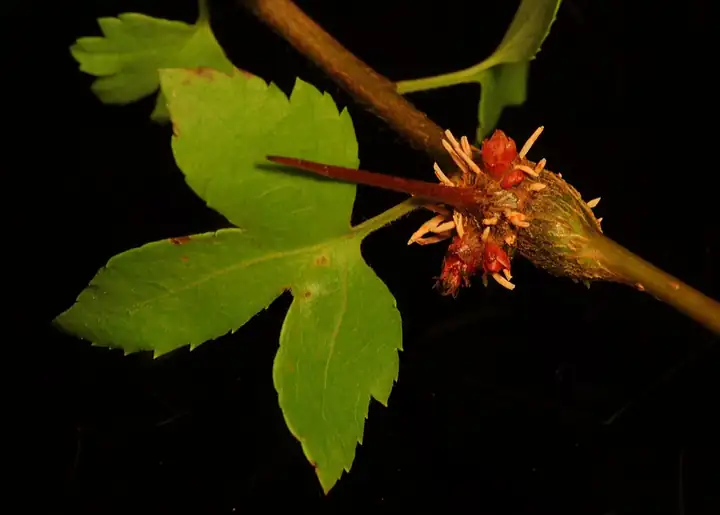
Cedar-quince rust
Rust fungus (Gymnosporangium clavipes), which alternates between junipers and rose-family plants
| Type | Fungus |
|---|---|
| Cause | Rust fungus (Gymnosporangium clavipes), which alternates between junipers and rose-family plants |
| When | Infection in spring; pinkish tubes on fruit and twigs in mid to late summer. |
About
A juniper rust that, unlike cedar-apple rust, attacks the fruit, twigs and thorns of hawthorn, serviceberry, quince and their kin. On junipers it makes long-lived swellings on branches instead of round galls.
Also called cedar-quince rust, cedar quince rust, quince rust
How to recognize it
Symptoms
On hawthorn, quince and serviceberry, fruit, shoot tips and thorns swell and get covered in short, pinkish-white tubes in mid to late summer. Twigs and branches get spindle-shaped cankers that grow each year and often girdle and kill the branch by the second season. On junipers, flaky swollen patches on branches turn bright orange and jelly-like in wet spring weather.
Often confused with
Cedar-apple and cedar-hawthorn rust mainly spot leaves and make round, ball-shaped galls on junipers; cedar-quince rust hits fruit and stems and makes long, flaky branch swellings that keep producing spores for 4 to 6 years or more.
Worse when
A few hours of cool, wet spring weather when juniper swellings are ready to release spores.
How it spreads
Spring spores from junipers blow and splash to rose-family hosts; spores from those hosts blow back to junipers from midsummer into fall, and spores can travel long distances.
When
Infection in spring; pinkish tubes on fruit and twigs in mid to late summer.
What to do, gentlest first
Prevention works best; most sprays only protect healthy leaves and can't cure infected ones. Always read and follow the product label.
Keep junipers and hosts apart Prevent
Don't plant hawthorn, quince or serviceberry near eastern red cedar and other junipers, and where disease is heavy choose resistant species or varieties.
Spores travel far, so removing the junipers on your own lot helps but won't end it.
Open the canopy Prevent
Prune for sun and air flow, especially in the lower, shaded branches where serviceberry infections tend to start.
Cut out cankers and infected fruit By hand
Prune off girdled or swollen branches on both hosts and pick off infected fruit.
Fungicides seldom recommended Conventional spray
UMass says fungicides are rarely recommended for this rust because none has worked very well, in part because spores fly for so long in spring and late summer.
If you do spray, follow the label and check that it allows use on fruit you'll eat.
Plants it affects
Apple (backyard tree), Aronia (black chokeberry), Mayhaw, Pear, Serviceberry (juneberry, saskatoon)
Sources
Photo: Photo: Ragesoss / Wikimedia Commons, CC BY-SA 3.0 (CC BY-SA 3.0). Photo resized for the web.

Planting dates and advice are general guidance; check with your local Cooperative Extension office for your area.