
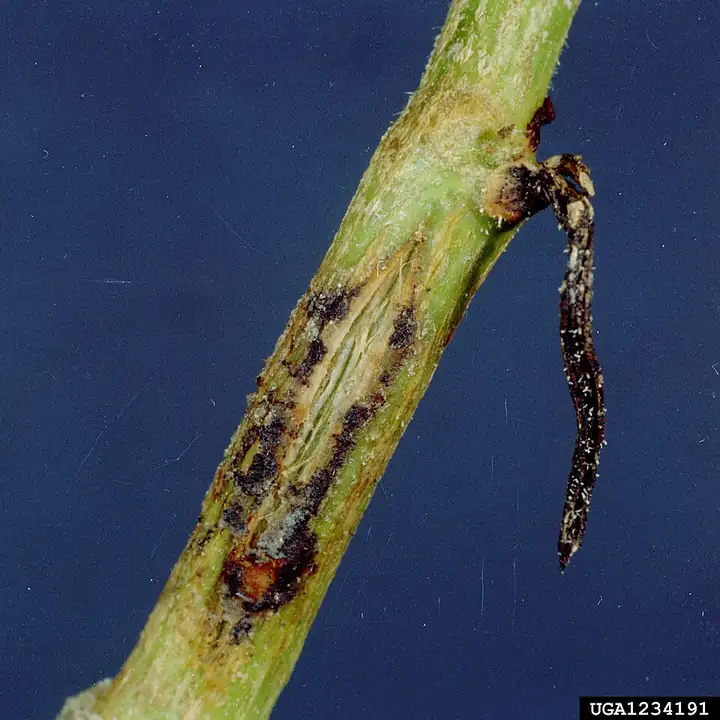
Gummy stem blight
Fungi (Stagonosporopsis cucurbitacearum and related species, formerly Didymella bryoniae)
| Type | Fungus |
|---|---|
| Cause | Fungi (Stagonosporopsis cucurbitacearum and related species, formerly Didymella bryoniae) |
| When | Any time in the season; in North Carolina it peaks in late June and July. |
About
A disease of melons, cucumbers, squash and pumpkins that blights leaves, cracks vines and rots fruit. On pumpkins and squash the fruit rot is called black rot.
Also called gummy stem blight, black rot of cucurbits, cucurbit black rot, Didymella
How to recognize it
Symptoms
Dark brown to reddish-brown spots start at leaf edges and spread inward until leaves curl and die. Vines get water-soaked, cracked cankers, often near a leaf joint, that ooze reddish-brown gum and later show tiny black dots. Fruit gets water-soaked spots that turn brown to black and rot the rind and flesh.
Often confused with
Anthracnose spots usually have a yellow halo. Blossom end rot is a dry, sunken spot only at the blossom end, opposite the stem.
Worse when
Mild to warm weather (about 61 to 75°F) with frequent rain, dew, overhead watering or poor drainage.
How it spreads
Comes in on seed, then splashes from spores in the gummy ooze and blows on the wind; it survives 2 to 4 years on undecomposed cucurbit debris and volunteer plants.
When
Any time in the season; in North Carolina it peaks in late June and July.
What to do, gentlest first
Prevention works best; most sprays only protect healthy leaves and can't cure infected ones. Always read and follow the product label.
Clean seed and transplants Prevent
Buy seed from a reputable source and inspect seedlings, tossing any with spots or stem lesions.
There are no truly resistant varieties.
Rotate and keep leaves dry Prevent
Keep all squash-family crops out of that spot for 2 to 4 years. Water at the base, and pull volunteer melons and squash.
Clean up vines after harvest By hand
Remove or deeply bury vines and rotten fruit after harvest so they break down fully.
Chlorothalonil and other labeled fungicides Conventional spray
When the weather favors disease, a protectant such as chlorothalonil can help; farms rotate it with other active ingredients such as penthiopyrad or cyprodinil plus fludioxonil.
Rotate fungicides with different modes of action because this fungus can become resistant. Follow the label, including days to harvest.
Plants it affects
Cantaloupe (muskmelon), Cucumber, Watermelon, Winter squash and pumpkin, Zucchini and summer squash
Sources
Photo: Photo: Clemson University - USDA / Wikimedia Commons, CC BY 3.0 US (CC BY 3.0 US). Photo resized for the web.

Planting dates and advice are general guidance; check with your local Cooperative Extension office for your area.