
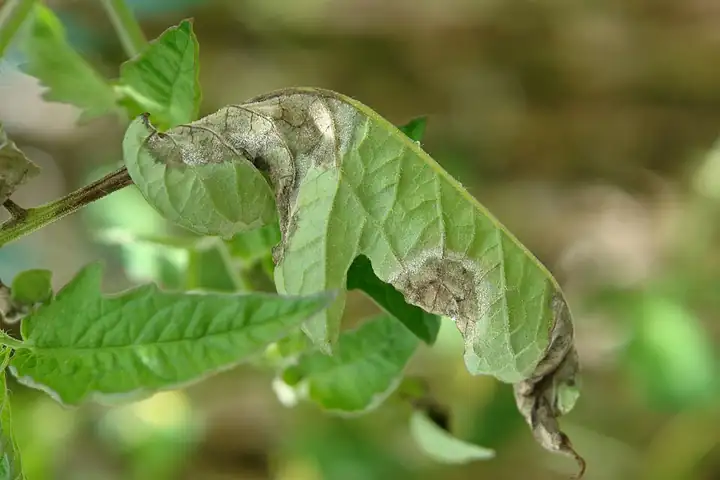
Late blight
Water mold (Phytophthora infestans)
| Type | Water mold |
|---|---|
| Cause | Water mold (Phytophthora infestans) |
About
Late blight is a fast-moving disease that can destroy tomato and potato plants within days in cool, wet weather. It is a community disease: spores blow for miles, so one infected garden puts every tomato and potato grower nearby at risk.
Also called late blight
How to recognize it
Symptoms
Leaves get large, dark brown to olive blotches (at least nickel-size) that are not held in by the veins, often with a pale green-gray edge and a thin white fuzz underneath in damp weather. Stems get firm dark brown lesions, and whole plants can look frost-killed. Tomato fruit gets firm, dark brown spots; potato tubers show brown to reddish-purple rot.
Often confused with
Early blight spots are smaller and have target rings and a yellow halo, and they build slowly from the bottom of the plant. Late blight blotches are large, spread fast, and show white fuzz in humid weather.
Worse when
Cool, wet weather with wet leaves and temperatures around 60 to 70°F; long hot, dry spells stop it.
How it spreads
Airborne spores travel several miles on the wind; in the North the pathogen cannot live through winter without living tissue, so it survives mainly in infected potato tubers, cull piles, volunteer potatoes and infected transplants.
When
Any time in the growing season when cool, wet weather sets in; it does not show up every year.
What to do, gentlest first
Prevention works best; most sprays only protect healthy leaves and can't cure infected ones. Always read and follow the product label.
Resistant tomato varieties Prevent
Look for tomatoes labeled LB. UMass names 'Mountain Magic', 'Legend' and 'Plum Regal' as having excellent resistance, and Cornell keeps lists of others.
Resistance slows the disease but does not make plants immune.
Clean starts and no volunteers Prevent
Buy healthy-looking transplants, plant certified seed potatoes, and pull any potatoes that sprout from last year's leftovers. Bury or destroy leftover infected tubers instead of piling them.
Rotate, space and water at the base Prevent
Keep tomatoes and potatoes out of the same spot for three to four years, space plants for airflow, and water in the morning with drip or a soaker hose so leaves dry fast.
Report it and watch the maps Prevent
Tell your county Extension office and neighbors if you find late blight. USAblight (usablight.org, run by NC State) lets you report cases, see outbreak maps and sign up for alerts.
Pull and bag infected plants right away By hand
At the first confirmed sign, pull infected plants, seal them in bags or bury them, and do not compost them. Cornell also advises removing nearby healthy-looking plants.
Late blight spreads to neighbors, so act quickly rather than waiting to see.
Copper fungicide Organic spray
Clemson lists copper as a good protectant for late blight. It must be on the leaves before spores land, so start when blight is reported nearby and weather is cool and wet.
Copper only protects leaves it coats before infection; it will not heal spots already there. It can burn young leaves, especially in weather above 85°F, and some plants are sensitive (Purdue lists celery, strawberry, apple, pear and plum among them). PNW 591 rates copper hydroxide toxic to bees, so spray when bees are not foraging. Follow the label, including the days to wait before harvest. UMN notes late blight is uncommon in Minnesota gardens and does not recommend sprays there.
Chlorothalonil or mancozeb Conventional spray
Clemson rates chlorothalonil very good and mancozeb good as protectants. Spray only healthy plants when late blight is nearby; UMN notes that products must be ones that work on water molds.
Chlorothalonil is a protectant: it keeps new infections from starting but does not cure existing spots. UC IPM rates it highly hazardous to fish and other aquatic life, and product labels carry a DANGER signal word. Keep it out of water and off flowering plants, wear gloves and eye protection, and follow the label and pre-harvest interval. None of these sprays cures an infected plant.
Plants it affects
Sources
- extension.umn.edu
- vegetables.cornell.edu
- umass.edu
- usablight.org
- hgic.clemson.edu
- ucanr.edu
- ipm.ucanr.edu
- extension.purdue.edu
- s3.wp.wsu.edu
Photo: Photo: Scot Nelson, CC0, via Wikimedia Commons (CC0). Photo resized for the web.

Planting dates and advice are general guidance; check with your local Cooperative Extension office for your area.