
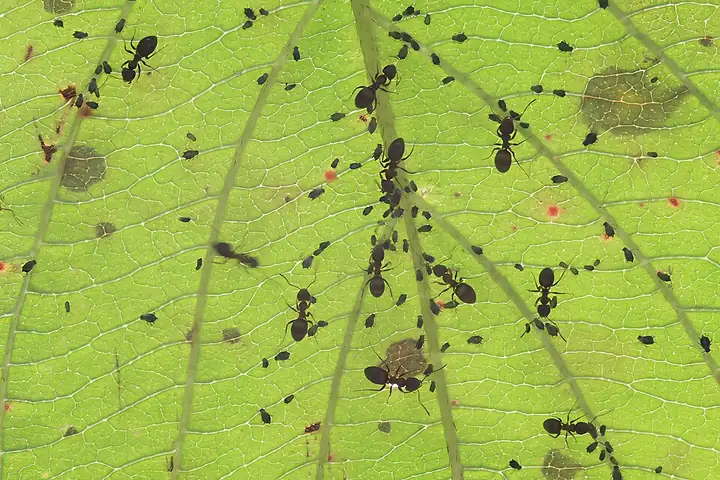
Garden ants
Many species, including soil-nesting field ants, pavement ants, odorous house ants and the invasive Argentine ant (Linepithema humile); the red imported fire ant has its own page
| Type | Insect |
|---|---|
| When | Spring through fall; mound building peaks in wet spring weather. |
| Pressure by region | Moderate: Northeast, Southeast, South Central, Midwest, Great Plains, Mountain West, Southwest, Pacific Northwest, California, Hawaii |
About
Most ants in the garden are harmless or helpful: they eat other insects, and the ants on peony buds are just sipping nectar. They matter when they farm aphids, scales and mealybugs for their sweet honeydew and guard them from predators, or when their digging dries out the roots of transplants (UC IPM, Illinois, Iowa State).
Spotting it
Damage
Ants don't eat plants, but where they tend aphids, soft scales, mealybugs and whiteflies, those pests often build up, because the ants drive off lady beetles and other natural enemies (UC IPM, UMD). Digging next to transplants can leave roots in air pockets so plants dry out and stall, and mounds roughen lawns (Iowa State).
How to find it early
Busy lines of ants running up a stem or trunk usually lead to aphids or scale above, so check new shoots and leaf undersides (UMD, UC IPM). Look for small soil mounds in beds and lawns, most often in wet spring weather (Iowa State).
When
Spring through fall; mound building peaks in wet spring weather.
Life cycle
Ants live in colonies with one or more queens and many workers, and most garden ants nest in soil. Argentine ants link many shallow nests into huge supercolonies with many queens (UC IPM).
What to do, gentlest first
Start at the top. Sprays are a last step; always read and follow the product label.
Leave most ants alone Prevent
Ants on peonies don't hurt the flowers and aren't needed for them to open, and Illinois Extension advises against controlling them in the garden. Before bringing cut peonies inside, dip soft buds in water, or shake open blooms upside down and swish them in water.
Knock them off and flatten mounds By hand
Shake or hose ants off plants; with their guards gone, aphids are easier to control (UMD). Rake or hose lawn mounds flat, especially in wet spring weather (Iowa State).
Sticky bands on trunks Barrier
Prune branches that touch buildings or other plants so ants must climb the trunk, then put a sticky barrier band around the trunk. Stir or renew it every week or two (UC IPM).
On young or thin-barked trees, put the sticky material on a wrap of paper, duct tape or fabric, not directly on the bark (UC IPM).
Bait stations for problem colonies Trap
Slow-acting baits that workers carry back to the nest work better than sprays. For Argentine ants, UC IPM suggests refillable stations with dilute borate in sugar water, set along ant trails; expect 5 to 10 days before numbers drop.
Keep bait stations away from children and pets, and don't spray insecticides near baits. UC IPM warns against pyrethroid perimeter sprays, which wash into waterways. Follow the label.
Spot-treat a mound by a transplant Conventional spray
If a transplant near a mound is still healthy enough to recover, Iowa State says to drench just the soil around it with a garden insecticide; there's no need to treat the whole garden.
Use only a product labeled for vegetable gardens near food crops, and follow its label and pre-harvest interval. Pyrethroids are highly toxic to bees (PNW 591), so keep them off flowers.
Plants it goes after
Pressure by region
Ants live in every region, and no source rated them by region, so ratings are estimates. The Argentine ant is the most common ant in and around California gardens and homes (UC IPM). Stinging fire ants are covered on the red imported fire ant page.
| Northeast | Moderate |
|---|---|
| Southeast | Moderate |
| South Central | Moderate |
| Midwest | Moderate |
| Great Plains | Moderate |
| Mountain West | Moderate |
| Southwest | Moderate |
| Pacific Northwest | Moderate |
| California | Moderate |
| Alaska | Low |
| Hawaii | Moderate |
Ratings come from extension sources where available; some are estimates, as noted above.
Sources
- ipm.ucanr.edu
- yardandgarden.extension.iastate.edu
- extension.illinois.edu
- extension.umd.edu
- s3.wp.wsu.edu
Photo: Photo: ImagePerson / Wikimedia Commons, CC BY 4.0 (CC BY 4.0). Photo resized for the web.

Planting dates and advice are general guidance; check with your local Cooperative Extension office for your area.