
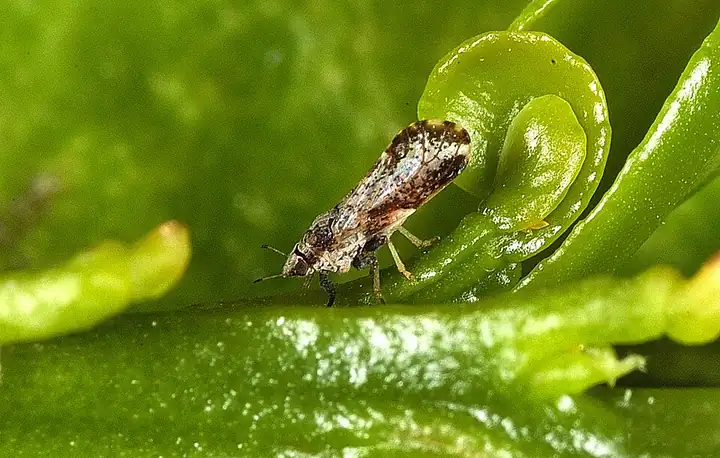
Asian citrus psyllid
Diaphorina citri
| Type | Insect |
|---|---|
| Pressure by region | High pressure: Southeast, South Central, California |
About
A tiny, aphid-sized brown insect, about 1/8 inch long, that feeds with its head down and its rear tipped up at about a 45-degree angle. It spreads the bacterium that causes huanglongbing (HLB, or citrus greening), which CDFA calls the most devastating citrus disease in the world: there is no cure, and infected trees make small, lopsided, bitter fruit and die, in as little as 5 years (UC IPM).
Spotting it
Damage
Feeding twists and notches new leaves and leaves honeydew and sooty mold, but the real harm is HLB. An HLB tree shows blotchy, uneven yellowing that doesn't match on both halves of a leaf, often on one limb at first, then twig dieback, early fruit drop, and small, partly green, misshapen fruit with bitter juice.
How to find it early
Walk slowly around each tree and look at the new growth for adults tilted up at an angle, yellow-orange eggs, and young nymphs, which make unique curly white wax tubes with a bulb on the end. Orange jasmine (Murraya) and curry leaf plants are hosts too.
When
Year-round where it lives; it builds up whenever trees push new growth. Mature trees flush mostly in spring and fall, while young trees and lemons flush on and off all through warm weather (UC IPM).
Life cycle
Females lay several hundred eggs (CDFA: 300 to 800), only on tender new shoots, and adults live 1 to 2 months. A generation takes 15 to 47 days, and CDFA counts 9 to 10 generations a year in California.
What to do, gentlest first
Start at the top. Sprays are a last step; always read and follow the product label.
Buy certified trees locally and never move citrus Prevent
Buy only certified citrus trees from a nursery in your own state (APHIS; UC IPM says local, reputable nurseries). Don't carry, ship or mail citrus plants, cuttings, leaves or homegrown fruit out of a quarantine area, and don't order trees from one.
Federal and state quarantines restrict moving citrus plants and plant parts out of these areas (APHIS).
Check new growth and report suspected finds Prevent
Inspect flush every time you water or tend the tree. If you think you see the psyllid or HLB, especially outside a known quarantine area, report it right away to your state department of agriculture or your USDA APHIS State Plant Health Director; in California call the CDFA pest hotline, 1-800-491-1899. Arizona asks people to call the state Department of Agriculture or the local Master Gardener program.
There is no cure for HLB, so catching it early and reporting it protects your neighbors' trees as well as yours.
Parasite wasps and ant control Natural enemies
A tiny parasite wasp, Tamarixia radiata, has been released at thousands of sites in Southern California (UC IPM). Keep ants off the tree with sticky trunk bands or ant baits, because ants tend psyllids for their honeydew and drive off their enemies.
Horticultural oil, neem oil or insecticidal soap Organic spray
Spray new growth thoroughly, including leaf undersides, and repeat every 7 to 14 days while flush is present; these kill only the psyllids they touch (UC IPM).
Oil is toxic to bees for under 3 hours and neem for under 2 hours (PNW 591); avoid spraying open blossoms or when bees are active. Follow the label.
Imidacloprid soil drench or a pyrethroid spray Conventional spray
An imidacloprid drench moves up from the roots and controls nymphs for 1 to 2 months; a foliar pyrethroid such as beta-cyfluthrin knocks down adults quickly and protects for weeks (UC IPM). Wet the foliage thoroughly, including undersides.
UC IPM says never apply these while citrus is blooming because they are toxic to honey bees; PNW 591 rates imidacloprid and pyrethroids highly toxic to bees. Broad-spectrum sprays also kill natural enemies. Use only products labeled for citrus and follow the label and pre-harvest interval.
Garden friends that go after it
Snakeflies
Protect these helpers: skip broad sprays when they're around.
Plants it goes after
Calamondin, Finger lime, Grapefruit, Kumquat, Lemon, Lime (key and Persian), Makrut lime, Mandarin (satsuma, clementine, tangerine), Meyer lemon, Orange and blood orange
Pressure by region
Based on APHIS's quarantine list of September 1, 2026. The psyllid: all of Alabama, Arizona, Florida, Georgia, Hawaii, Louisiana, Mississippi and Texas, plus Puerto Rico and other U.S. territories; many California counties from San Diego to the Bay Area and Sacramento; Clark County, Nevada; and three South Carolina counties. HLB itself: all of Florida, Georgia and Mississippi, and parts of Alabama, California (six southern counties), Louisiana, South Carolina, Texas and Santa Cruz County, Arizona (the Arizona Department of Agriculture's own page still said HLB had not been found there). Hawaii has the psyllid but is not on the HLB list. 'Absent' means the region is not on APHIS's list; porch citrus in those states is safe only if trees come from a certified nursery in your own state. Quarantines change often, so check APHIS's citrus quarantine map or your state department of agriculture.
| Northeast | Not found here |
|---|---|
| Southeast | High pressure |
| South Central | High pressure |
| Midwest | Not found here |
| Great Plains | Not found here |
| Mountain West | Low |
| Southwest | Moderate |
| Pacific Northwest | Not found here |
| California | High pressure |
| Alaska | Not found here |
| Hawaii | Moderate |
Ratings come from extension sources where available; some are estimates, as noted above.
Sources
- ipm.ucanr.edu
- aphis.usda.gov
- aphis.usda.gov
- cdfa.ca.gov
- agriculture.az.gov
- invasivespeciesinfo.gov
- s3.wp.wsu.edu
Photo: Photo: David Hall, USDA ARS, Public domain, via Wikimedia Commons. Photo resized for the web.

Planting dates and advice are general guidance; check with your local Cooperative Extension office for your area.