
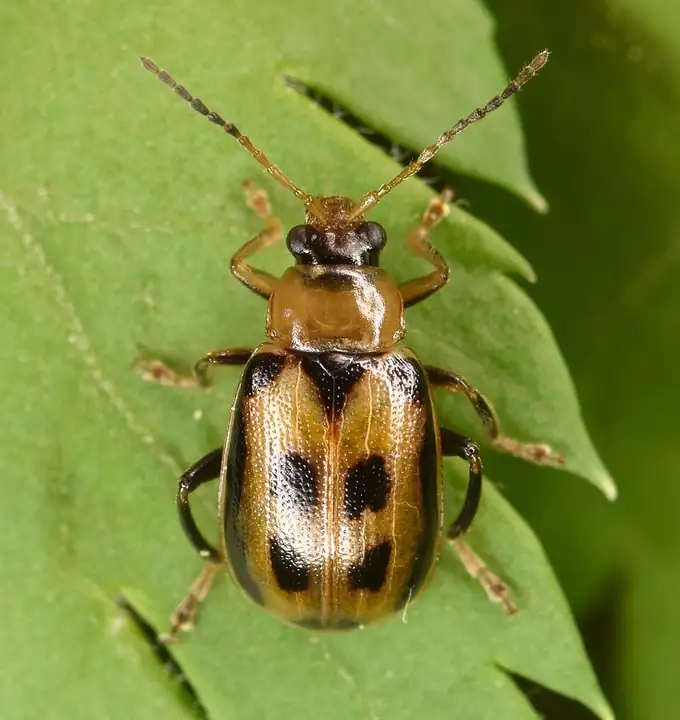
Bean leaf beetle
Cerotoma trifurcata
| Type | Insect |
|---|---|
| When | April through fall; worst on seedlings in spring. |
| Pressure by region | Moderate: Northeast, Southeast, South Central, Midwest, Great Plains |
About
A small beetle about a quarter inch long, yellow, orange or red, usually with black spots and always with a black triangle at the base of the wing covers. It is best known as a soybean pest but also feeds on snap beans and southern peas in home gardens.
Spotting it
Damage
Adults chew small, round holes between the leaf veins and scar the pods, which lets in rot. Damage is worst on young seedlings, and the beetles can spread bean pod mottle virus.
How to find it early
Check seedlings and leaf undersides for small round holes and for the beetles themselves.
When
April through fall; worst on seedlings in spring.
Life cycle
Adults spend the winter in leaf litter, mostly in wooded areas, and become active in spring; larvae feed on roots and root nodules. There are about three generations a year in the South, two in the central states and one in Minnesota.
What to do, gentlest first
Start at the top. Sprays are a last step; always read and follow the product label.
Floating row cover Barrier
Cover young bean plants with row cover, since seedlings suffer the most damage (Mississippi State).
Home-garden insecticides Conventional spray
Mississippi State lists bifenthrin, permethrin, zeta-cypermethrin and malathion for bean leaf beetle in home gardens.
All of these are highly toxic to bees and kill natural enemies. Keep sprays off open flowers, and follow the label and pre-harvest interval.
Plants it goes after
Dry beans (pinto, black, kidney, navy), Edamame, Green beans (snap beans), Southern peas
Pressure by region
It is a pest in most soybean-growing parts of the U.S., with three generations in the South and one in Minnesota. No source rated it by region, so the moderate ratings are estimates, and the West, Alaska and Hawaii are rated low as estimates.
| Northeast | Moderate |
|---|---|
| Southeast | Moderate |
| South Central | Moderate |
| Midwest | Moderate |
| Great Plains | Moderate |
| Mountain West | Low |
| Southwest | Low |
| Pacific Northwest | Low |
| California | Low |
| Alaska | Low |
| Hawaii | Low |
Ratings come from extension sources where available; some are estimates, as noted above.
Sources
Photo: Photo: Christina Butler, CC BY 2.0, via Wikimedia Commons (CC BY 2.0). Photo resized for the web.

Planting dates and advice are general guidance; check with your local Cooperative Extension office for your area.