
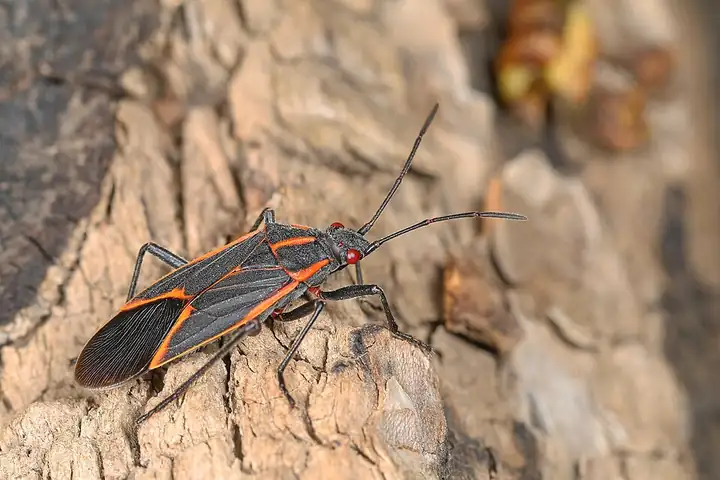
Boxelder bugs
Eastern boxelder bug (Boisea trivittata) and western boxelder bug (Boisea rubrolineata)
| Type | Insect |
|---|---|
| When | Spring through fall; they gather on houses in fall and on warm winter days. |
| Pressure by region | Moderate: Northeast, Midwest, Great Plains, Mountain West, Pacific Northwest, California |
About
Black bugs about 1/2 inch long with red stripes, whose bright red nymphs crowd onto boxelder trees. They mostly feed on the seeds of female boxelders and are best known for gathering on sunny walls and slipping into homes in fall (CSU, UC IPM).
Spotting it
Damage
They do little harm to landscape plants. Western boxelder bugs sometimes pierce ripening apples, pears, cherries, peaches, plums and grapes, leaving dimpled spots with corky white flesh beneath, a lot like stink bug damage (WSU, UC IPM). Indoors they don't bite or breed, but they stain curtains and smell when crushed (UC IPM, Wisconsin).
How to find it early
Look for clusters of red nymphs and black adults on boxelder trunks and seed pods in summer, and on south- and west-facing walls in fall (CSU, UC IPM). Check fruit near boxelder trees as it ripens.
When
Spring through fall; they gather on houses in fall and on warm winter days.
Life cycle
Adults spend winter in wall cracks, buildings and debris and come out in spring to lay red eggs on host trees; nymphs hatch in 10 to 14 days and grow up over summer. There are one or two generations a year, depending on the region (Wisconsin, WSU, UC IPM).
What to do, gentlest first
Start at the top. Sprays are a last step; always read and follow the product label.
Seal the house and rake up seeds Prevent
Before fall, seal cracks and gaps around windows, doors, siding, pipes and vents. Rake up boxelder, maple, ash and elm seeds, and clear a 6- to 10-foot strip of debris next to the foundation, especially on the south and west sides (UC IPM, Wisconsin).
Skip female boxelders Prevent
Removing seed-bearing female boxelder trees is the most lasting fix, though bugs can fly in from several blocks away. When you plant a shade tree, choose something other than boxelder (CSU, UC IPM, Wisconsin).
Vacuum and hose By hand
Vacuum bugs indoors, and wash them off walls and tree trunks with a strong stream of water (UC IPM).
Soapy water Organic spray
Insecticidal soap, or a mix of laundry detergent and water, kills the bugs it hits directly (CSU, UC IPM).
Soap works only on contact, and detergent mixes may injure plants (CSU). Don't use insecticide sprays inside the house; UC IPM says outdoor sprays are rarely better than vacuuming and hosing, and any spray should be kept out of storm drains.
Plants it goes after
Apple (backyard tree), Cherry (sweet and tart), Grape, Peach, Pear, Plum, Red maple, Strawberry, Sugar maple
Pressure by region
Two species share the name: Wisconsin and Colorado State describe the eastern boxelder bug, and UC IPM and WSU describe the western one, which WSU calls a sporadic, usually minor fruit pest across western North America. Numbers depend on nearby female boxelder trees. Ratings are estimates.
| Northeast | Moderate |
|---|---|
| Southeast | Low |
| South Central | Low |
| Midwest | Moderate |
| Great Plains | Moderate |
| Mountain West | Moderate |
| Southwest | Low |
| Pacific Northwest | Moderate |
| California | Moderate |
| Alaska | Low |
| Hawaii | Low |
Ratings come from extension sources where available; some are estimates, as noted above.
Sources
Photo: Photo: Judy Gallagher / Wikimedia Commons, CC BY 2.0 (CC BY 2.0). Photo resized for the web.

Planting dates and advice are general guidance; check with your local Cooperative Extension office for your area.