
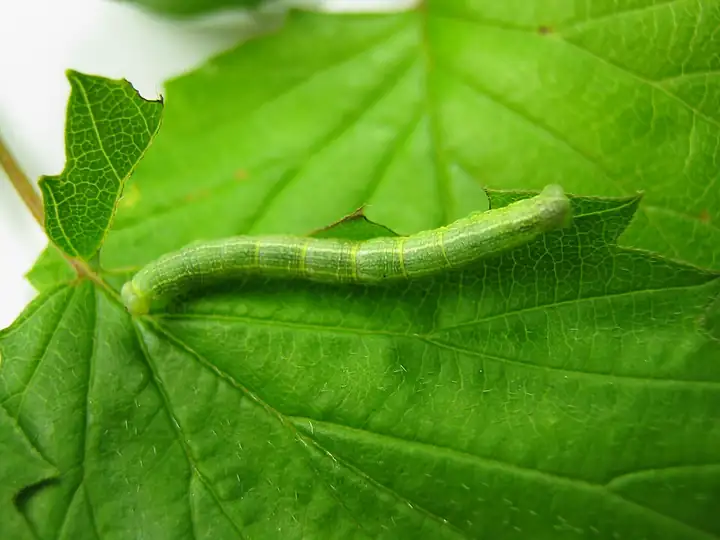
Cankerworms (fall and spring cankerworms)
Fall cankerworm (Alsophila pometaria) and spring cankerworm (Paleacrita vernata)
| Type | Insect |
|---|---|
| Pressure by region | Moderate: Northeast, Southeast, Midwest, Great Plains |
About
Native inchworms, also called loopers or spanworms, that hatch as buds open in spring and chew the new leaves of shade and fruit trees; outbreaks come and go, often with many quiet years in between (Virginia Tech). Both kinds often feed on the same tree, and the caterpillars dangling on silk threads and their droppings on cars and walks are a common nuisance (Morton Arboretum).
Spotting it
Damage
Feeding starts as small BB-size holes in young leaves that grow quickly, and larger caterpillars eat whole leaves down to the midrib and veins (Virginia Tech). Heavy outbreaks can strip a tree; most trees grow a second set of leaves, and healthy trees handle one or two years of defoliation, but three or more years, especially with drought, can cause decline (Virginia Tech, Morton Arboretum).
How to find it early
In late fall and late winter, look for wingless, spiderlike females climbing trunks. In spring, look for tiny holes in new leaves and green to blackish inchworms up to about 1 inch long; fall cankerworm has three pairs of hind prolegs and spring cankerworm has two (Virginia Tech, Morton Arboretum).
When
Caterpillars April through June; moths in fall (fall cankerworm) and late winter (spring cankerworm).
Life cycle
Each kind has one generation a year, and both have wingless females that must crawl up the trunk to lay eggs. Fall cankerworm moths come out in October and November and lay eggs on twigs that hatch in spring; spring cankerworm spends winter in the soil, and its moths come out in late winter as the ground thaws and lay eggs in bark crevices. Both hatch as buds open, and the caterpillars drop to the soil to pupate by mid to late June (Virginia Tech, Morton Arboretum).
What to do, gentlest first
Start at the top. Sprays are a last step; always read and follow the product label.
Tolerate light feeding and water the tree Prevent
A healthy mature tree can handle a season or two of heavy feeding. Water during drought so it can re-leaf (Virginia Tech).
Sticky trunk bands Barrier
To catch wingless females before they lay eggs, wrap the trunk at chest height with batting, cover it with a 6 to 12 inch band of tar paper, and spread sticky material on that. Morton Arboretum says bands work best in mid-October (fall cankerworm) and February (spring cankerworm); keep them clean and refreshed (Virginia Tech).
Never put sticky material right on the bark (Morton Arboretum). Bands fail if nearby trees are not banded or their branches touch yours (Virginia Tech).
Natural enemies Natural enemies
A tiny wasp that parasitizes the eggs, Calosoma ground beetles that eat the caterpillars, other flies and wasps, and birds all help, as does a late frost that kills the first leaves (Virginia Tech, Morton Arboretum).
They are not always enough by themselves (Morton Arboretum).
Bt while caterpillars are small Organic spray
Spray Bacillus thuringiensis (Bt) as soon as caterpillars show up on the leaves in spring; they stop feeding after eating it and usually die within three days (Virginia Tech).
Bt carries no bee warning (PNW 591). Homeowners shouldn't spray trees taller than about 10 feet; hire a licensed applicator for big trees (WSU). Follow the label.
Plants it goes after
Apple (backyard tree), Cherry (sweet and tart), Oaks (white, red and pin oak), Red maple, River birch, Sugar maple, Thornless honeylocust
Pressure by region
Fall cankerworm is native and found across the US and Canada; a 2011 outbreak in Virginia defoliated about 2.5 million acres of forest (Virginia Tech). Ratings are estimates, and outbreaks are local and sporadic.
| Northeast | Moderate |
|---|---|
| Southeast | Moderate |
| South Central | Low |
| Midwest | Moderate |
| Great Plains | Moderate |
| Mountain West | Low |
| Southwest | Low |
| Pacific Northwest | Low |
| California | Low |
| Alaska | Low |
| Hawaii | Not found here |
Ratings come from extension sources where available; some are estimates, as noted above.
Sources
Photo: Photo: Beatriz Moisset / Wikimedia Commons, CC BY-SA 4.0 (CC BY-SA 4.0). Photo resized for the web.

Planting dates and advice are general guidance; check with your local Cooperative Extension office for your area.