
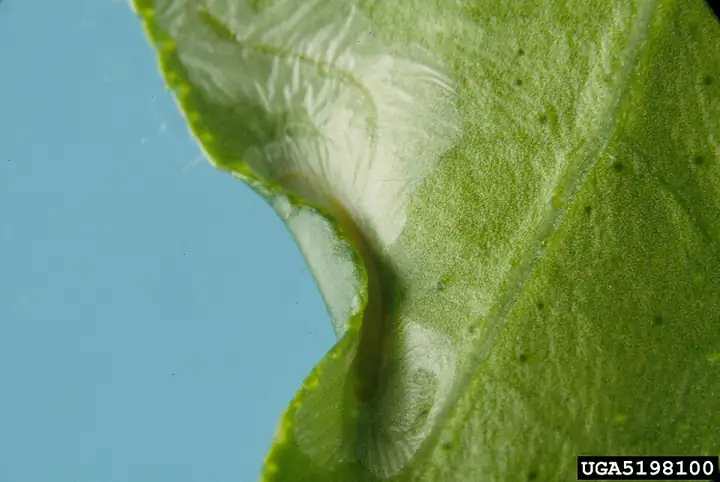
Citrus leafminer
Phyllocnistis citrella
| Type | Insect |
|---|---|
| Pressure by region | High pressure: Southeast, South Central, California |
About
A tiny silvery-white moth, under 1/4 inch long, whose caterpillars tunnel inside young citrus leaves. UC IPM says it is the only mining insect that commonly attacks citrus leaves; it was first found in the U.S. in Florida in 1993.
Spotting it
Damage
Caterpillars leave winding, silvery tunnels just under the leaf skin with a thin dark line of droppings down the middle, and the leaves curl and twist. Trees 4 years and older rarely suffer real harm, but young trees can grow more slowly; UF/IFAS adds that the tunnels open a way in for citrus canker bacteria where canker occurs.
How to find it early
Check soft new leaves (the flush) for shiny winding trails and curled edges, especially in summer and fall. A pheromone trap hung at shoulder height shows when male moths are flying, but it does not catch enough to control them (UC IPM).
When
Whenever citrus puts out new leaves, worst in summer and fall; March through October in Texas (Texas A&M AgriLife).
Life cycle
Eggs hatch in about a week, caterpillars feed inside the leaf for 1 to 3 weeks, then pupate in a rolled-over leaf edge; the whole cycle takes about 2 to 7 weeks depending on temperature. UF/IFAS counts 6 to 13 generations a year, about one every three weeks in Florida.
What to do, gentlest first
Start at the top. Sprays are a last step; always read and follow the product label.
Time pruning and feeding; leave damaged leaves on Prevent
Prune live branches no more than once a year so new growth comes in short, even bursts, and snap off water sprouts and suckers below the graft. Don't feed nitrogen in summer and fall, when leafminers are at their peak (UC IPM).
Do not pick off mined leaves; the undamaged parts still feed the tree (UC IPM, Texas A&M AgriLife).
Pheromone trap for timing only Prevent
Check a trap weekly during the summer and fall flushes to know when moths are laying eggs on new growth.
It catches only male moths and will not control the pest (UC IPM).
Let native parasite wasps work Natural enemies
Tiny, nonstinging wasps that are already around kill many leafminers, and you do not need to buy or release any (UC IPM). Avoid broad-spectrum sprays that kill them.
Spinosad, neem (azadirachtin) or horticultural oil on new flush Organic spray
These help mostly on young trees. Spray new leaves when they are about half grown, top and bottom, and repeat every 7 to 14 days while the flush lasts (UC IPM, LSU AgCenter, Texas A&M AgriLife). Oil works by keeping moths from laying eggs.
UC IPM limits spinosad to 6 sprays a season. UGA says not to spray oil above 85 F. Spinosad is toxic to bees for 3 hours to a day and oil for under 3 hours (PNW 591), so don't spray open blossoms or when bees are working.
Imidacloprid soil drench, once a year, for young trees Conventional spray
Applied to the soil as new flush starts, it moves up into the leaves in 1 to 2 weeks and protects them for 1 to 3 months (UC IPM). Use it no more than once a year.
It is highly toxic to bees (PNW 591): UC IPM says do not apply it during bloom or in the month before. NC State says watch for spider mites afterward. UC IPM advises against malathion, carbaryl and pyrethroids, which kill natural enemies and can set off whiteflies and scale; carbaryl needs an applicator license in California since August 2020. Follow the label.
Plants it goes after
Calamondin, Finger lime, Grapefruit, Kumquat, Lemon, Lime (key and Persian), Makrut lime, Mandarin (satsuma, clementine, tangerine), Meyer lemon, Orange and blood orange
Pressure by region
UF/IFAS lists it in Florida (since 1993), Alabama, Louisiana, Texas (since 1994), California (since 2000) and Hawaii (since 2001-2002, where an introduced parasite wasp is now established); UGA reports it in Georgia, and UC IPM says it covers most of southern California, the coast up to San Luis Obispo County and the San Joaquin Valley. It lives only on citrus and close relatives, so ratings for Arizona and for cold-winter regions, where citrus grows only in pots, are estimates.
| Northeast | Low |
|---|---|
| Southeast | High pressure |
| South Central | High pressure |
| Midwest | Low |
| Great Plains | Low |
| Mountain West | Low |
| Southwest | Low |
| Pacific Northwest | Low |
| California | High pressure |
| Alaska | Low |
| Hawaii | Moderate |
Ratings come from extension sources where available; some are estimates, as noted above.
Sources
- ipm.ucanr.edu
- ask.ifas.ufl.edu
- fieldreport.caes.uga.edu
- content.ces.ncsu.edu
- lsuagcenter.com
- txmg.org
- s3.wp.wsu.edu
Photo: Photo: Jeffrey W. Lotz, Florida Department of Agriculture and Consumer Services, Bugwood.org, CC BY 3.0 us, via Wikimedia Commons (CC BY 3.0 us). Photo resized for the web.

Planting dates and advice are general guidance; check with your local Cooperative Extension office for your area.