
Corn rootworms
Western corn rootworm (Diabrotica virgifera) and northern corn rootworm (Diabrotica barberi); the southern corn rootworm is the spotted cucumber beetle
| Type | Insect |
|---|---|
| When | Larvae June into July; adults from late June into fall. |
| Pressure by region | High pressure: Midwest, Great Plains |
About
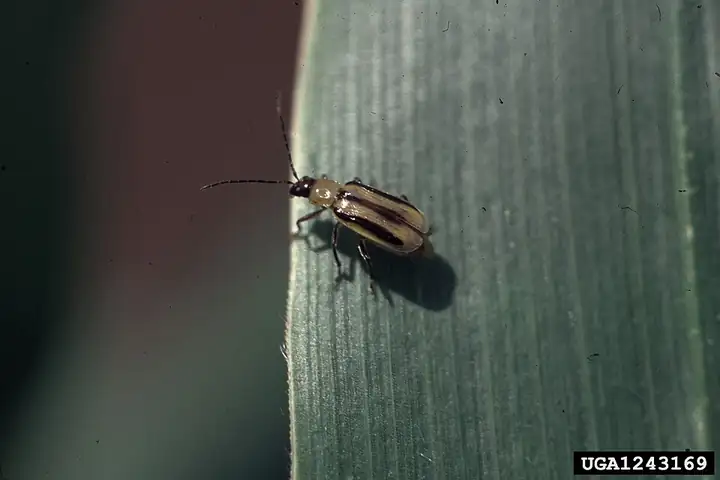
Small leaf beetles, about 1/4 inch long, whose slender white larvae chew corn roots. Western adults are yellow with black stripes and northern adults are plain pale green; the southern corn rootworm is the spotted cucumber beetle, covered on the cucumber beetle page (Iowa State, Illinois).
Spotting it
Damage
Larvae chew and tunnel into corn roots in early summer, so plants take up less water and can lean, fall over or grow in a curved "gooseneck" shape, and such plants often pollinate poorly (Purdue, Illinois). Adults clip green silks during pollen shed, which leaves ears poorly filled, and also feed on cucumber and squash blossoms (Purdue, Illinois).
How to find it early
From July on, check corn silks for beetles chewing them short, and watch for beetles on yellow sticky traps. If corn leans or goosenecks, dig a plant and look for brown, chewed-back root tips and thin white larvae with a dark head (Purdue, Illinois, Iowa State).
When
Larvae June into July; adults from late June into fall.
Life cycle
One generation a year: eggs laid in the soil from midsummer to fall spend winter there and hatch in late May or early June, larvae do their worst feeding from mid-June to mid-July, and adults emerge in late June and July (Purdue, Illinois). Some northern corn rootworm eggs wait through two winters before hatching (Purdue).
What to do, gentlest first
Start at the top. Sprays are a last step; always read and follow the product label.
Don't plant corn in the same spot two years running Prevent
Larvae starve on anything but corn roots, so moving corn to a new bed each year is the main defense (Purdue, Illinois).
Rotation doesn't always work: a variant of the western corn rootworm lays eggs in soybean fields, and some northern rootworm eggs skip a year (Purdue).
Protect silks only if beetles are many Conventional spray
In sweet corn, sprays aimed at corn earworm or European corn borer also kill rootworm beetles on the silks and keep them from laying eggs (Illinois).
Pyrethroids and many other corn insecticides are highly toxic to bees (PNW 591). Follow the label and its pre-harvest interval.
Plants it goes after
Cucumber, Sweet corn, Winter squash and pumpkin, Zucchini and summer squash
Pressure by region
Western and northern corn rootworms do the most harm in the Corn Belt; Purdue reports first-year corn damaged by delayed-hatching northern rootworm eggs in Minnesota, Iowa, South Dakota and Wisconsin. No regional source was found for the rest of the country, so all ratings are estimates.
| Northeast | Moderate |
|---|---|
| Southeast | Low |
| South Central | Low |
| Midwest | High pressure |
| Great Plains | High pressure |
| Mountain West | Low |
| Southwest | Low |
| Pacific Northwest | Low |
| California | Low |
| Alaska | Low |
| Hawaii | Low |
Ratings come from extension sources where available; some are estimates, as noted above.
Sources
Photo: Photo: Whitney Cranshaw, Colorado State University / Wikimedia Commons, CC BY 3.0 (CC BY 3.0). Photo resized for the web.

Planting dates and advice are general guidance; check with your local Cooperative Extension office for your area.