
Eastern tent caterpillar
Malacosoma americanum
| Type | Insect |
|---|---|
| When | Early spring into early summer. |
| Pressure by region | Moderate: Northeast, Southeast, South Central, Midwest |
About
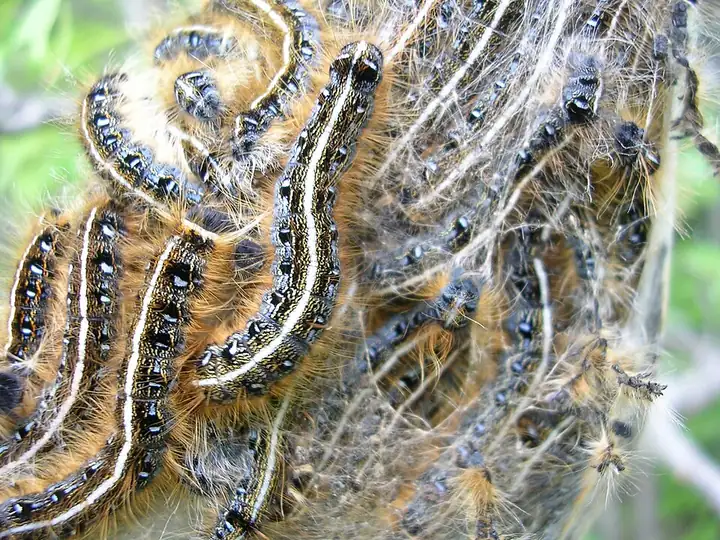
A hairy caterpillar, up to about 2 inches long, with a white stripe down its back and blue, black and orange markings. Colonies build silk tents in the forks of cherry, apple and crabapple trees in early spring.
Spotting it
Damage
Caterpillars strip leaves and can defoliate a tree, but healthy trees usually leaf out again. Young or stressed trees suffer more, and the tents are unsightly.
How to find it early
In winter, look for shiny black egg bands on twigs. In spring, look for silk tents in branch crotches; fall webworm tents come later in the year and sit at branch tips.
When
Early spring into early summer.
Life cycle
It spends winter as a shiny black egg mass of 150 to 400 eggs wrapped around a small twig. Eggs hatch as buds open in early spring, caterpillars feed for 4 to 6 weeks, and moths lay eggs in early summer; there is one generation a year.
What to do, gentlest first
Start at the top. Sprays are a last step; always read and follow the product label.
Prune egg masses and pull out tents By hand
Clip off egg bands in winter. In spring, pull out small tents, or wind them onto a stick, early or late in the day or in rain when caterpillars are inside; bag or bury them.
Do not burn tents out with a torch; this can easily damage the tree (University of Kentucky).
Bt or spinosad on young caterpillars Organic spray
Bacillus thuringiensis (Bt) works on small caterpillars under about an inch long (UMN, UK). Spinosad and insecticidal soap are other options; soap must hit the caterpillars.
Bt does not harm bees (PNW 591) and is safe even when trees bloom; spinosad is toxic to bees for a few hours to a day, so do not spray it on blooms. Sprays do little against large caterpillars (UK). Follow the label.
Last resort only Conventional spray
Penn State reserves broad-spectrum insecticides for older caterpillars, as a last resort.
Many broad-spectrum insecticides are highly toxic to bees (PNW 591), and eggs hatch as buds open, so trees may still be in bloom. Do not spray during bloom; follow the label and pre-harvest interval.
Plants it goes after
American plum (wild plum), Apple (backyard tree), Beach plum, Cherry (sweet and tart), Chokecherry, Flowering cherry, Peach, Pear, Plum, Quince
Pressure by region
Penn State gives its range as the northeastern U.S. south to Florida and west to the Dakotas and Texas, with scattered records in Colorado and Montana; outbreaks come every several years (UK). Regions outside that range are rated low for lack of a source; those ratings are estimates.
| Northeast | Moderate |
|---|---|
| Southeast | Moderate |
| South Central | Moderate |
| Midwest | Moderate |
| Great Plains | Low |
| Mountain West | Low |
| Southwest | Low |
| Pacific Northwest | Low |
| California | Low |
| Alaska | Low |
| Hawaii | Low |
Ratings come from extension sources where available; some are estimates, as noted above.
Sources
Photo: Photo: J.R. Carmichael, Public domain, via Wikimedia Commons. Photo resized for the web.

Planting dates and advice are general guidance; check with your local Cooperative Extension office for your area.